
Shiny Crocodile Leather vs Lizard Leather: Which Is Better?

Condividi
Shiny Crocodile Leather vs. Lizard Leather: Which Is Better?
Shiny crocodile leather usually has larger, more geometric belly scales, while lizard leather is recognized by a much finer and more intricate scale pattern. Neither is automatically better: the more suitable material depends on the scale size, finish, panel dimensions, price range, and handling needs of the item.
What “shiny crocodile leather” actually means
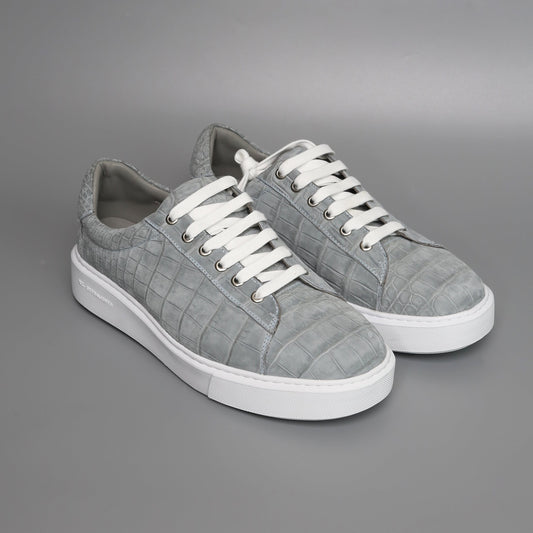
“Shiny crocodile leather” describes a finish rather than a separate crocodile species. The glossy surface is commonly produced through glazing or a similar finishing process that emphasizes the contrast between the scales and the natural structure of the hide. Crocodile leather can also be finished as matte, semi-matte, or nubuck, so the animal itself does not determine whether the result will shine.
This distinction matters when comparing crocodile with lizard. Lizard leather may also receive different finishes, but the fine scale pattern remains a major part of its visual identity. A glossy finish can increase surface reflection on either material; it does not turn lizard scales into crocodile scales or prove that a hide is genuine.
Shiny crocodile leather and lizard leather compared
| Decision factor | Shiny crocodile leather | Lizard leather |
|---|---|---|
| Scale appearance | Larger, more geometric scales, especially across the belly or pattern area | Finer, closely arranged scales with a more intricate surface pattern |
| Visual impact | Strong reflection and broad scale definition after glazing | Detailed texture, with smaller visual units across the surface |
| Panel planning | Large scale arrangement can be prominent on broad panels | Fine scales can suit narrower panels and smaller accessories |
| Common price factors | Species, hide grade, usable belly area, scale matching, construction, and handwork | Species, hide grade, usable area, scale consistency, construction, and handwork |
| Finish options | Glazed, matte, semi-matte, and nubuck finishes are used in crocodile leather | Finish varies by tannery and product; the fine scale structure remains visible |
Scale pattern: the main visual difference
The belly or pattern area is generally the most valuable section of a crocodilian hide because it provides the broadest, most usable scale arrangement for a finished product. On shiny crocodile leather, glazing can make these scales more pronounced by catching light along their edges and across their flatter centers.
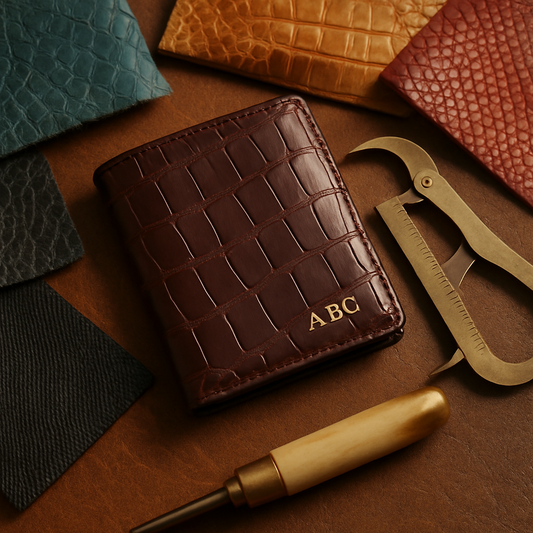
Lizard leather presents a different type of surface. Its smaller scales create a denser pattern, with more repeated detail in the same area. That can work well for narrow straps, compact accessories, and designs where a fine texture is preferable to large geometric panels.
On a large crocodile panel, the arrangement of neighboring scales is easy to see. Our material planning therefore gives priority to usable pattern area and scale flow: this helps keep the visible panel visually balanced rather than joining unrelated sections simply because they are available. That is a construction decision based on pattern control, not a claim that every crocodile hide has the same appearance.
Does a shinier surface mean better leather?
No single finish proves a hide is better. A high-gloss glazed surface may suit someone who wants strong reflection and clear scale definition, while matte crocodile leather may be more suitable for a quieter appearance with less surface glare. Nubuck has a different tactile and visual character again, created by working the surface to produce a softer, more velvety effect.
Hide grading and finish should also be kept separate. Crocodile grading commonly considers the number and location of defects across the belly or pattern area. A higher visual grade generally indicates a cleaner pattern area, while lower grades may show more scars or blemishes. Grading labels vary by supplier and tannery, so a label such as “Grade 1” should not be treated as a universal industry definition.
Visual grade is not the same as durability. The useful service life of a finished item also depends on leather thickness, backing, edge construction, stitching, hardware, daily handling, moisture exposure, and storage. A hide with a clean appearance is not automatically stronger than one with visible natural marks.
Which leather costs more?
There is no responsible single price answer without knowing the species, dimensions, and construction. A crocodile item may cost more because a larger usable belly area is needed, because the pattern must be matched across panels, or because more of the hide is discarded to achieve a particular layout. A smaller lizard item may use less total leather, but its price can still reflect the species, hide grade, finishing work, lining, hardware, and handwork.
For a fair comparison, ask what area of the hide is actually used. A product made primarily from the belly or pattern area may be priced differently from one using tail, flank, or other secondary sections. The snout, feet, and tail are often used for smaller goods because their shapes and scale arrangements are less suited to broad panels.
Construction can change the price as much as the raw leather. Relevant questions include whether the scales are aligned across adjoining sections, how the edges are finished, whether the lining supports the leather, how much handwork is involved, and whether the design requires multiple fitted pieces. Comparing only the word “crocodile” or “lizard” leaves out the factors that determine the finished product.
Which is more suitable for shoes and other larger items?
Shiny crocodile leather can be visually effective on larger panels because its belly scales create a clear geometric structure. The finish is especially noticeable on the vamp of a shoe, a broad bag panel, or another surface viewed directly under light. Lizard leather’s finer pattern can produce a more closely textured result and may be preferred where smaller scale detail is part of the design.
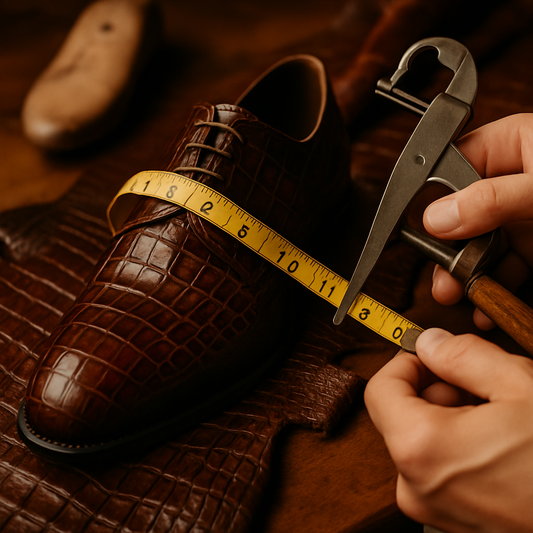
For shoes, material choice does not replace proper fitting. Length and width should be checked separately, with the intended EU, US, or UK size identified before ordering. A wide fit may need more room across the forefoot, while a high instep can require additional volume over the upper. The heel should be checked for movement independently from toe length.
In-person try-on and remote measurement are equally valid starting points when handled carefully. For a remote assessment, measure both feet while standing, record the longer foot, note the widest forefoot point, and measure around the instep. Send those measurements together with the usual EU, US, or UK size and information about whether socks or insoles will be worn. Foot shape can differ from one person to the other, so a size label alone does not describe the full fit.
Care for shiny crocodile leather and lizard leather
Begin with a dry, soft cloth to remove dust after use. This is the safest default for both surfaces and avoids adding moisture when it is not needed.
- Keep the item away from prolonged direct heat, radiators, and hot vehicles.
- Store it in a breathable dust bag rather than sealed plastic.
- Do not press sharp objects into the scales or fold a structured panel against its natural shape.
- Use water only as a last resort, applied sparingly with a lightly damp cloth rather than soaking the leather.
- Do not apply household polish or an untested conditioner, especially to glazed crocodile leather, because it can alter the sheen or leave residue between scales.
There is no fixed conditioning schedule that suits every crocodile or lizard product. Condition only when the leather shows a genuine need and use a product specifically confirmed as suitable for that finish. If the surface has become cloudy, sticky, heavily marked, or exposed to substantial moisture, professional assessment is safer than repeated home treatment.
How to style each material
For business settings
- Use shiny crocodile leather on a belt, shoe, or compact accessory with a restrained silhouette so the scale pattern remains the main detail.
- Pair lizard leather with plain wool, cotton, or smooth-grain garments when you want texture without large visible scales.
- Coordinate the hardware with the rest of the outfit rather than relying on the leather finish alone.
For formal occasions
- A dark glazed crocodile shoe can work with tailored evening clothing when the rest of the accessories are kept simple.
- Fine-scale lizard leather can suit a narrow dress belt, small case, or compact shoe detail where a dense texture will not dominate.
- Matte or semi-matte finishes may be easier to integrate with textured fabrics such as brushed wool or velvet.
For casual use
- Shiny crocodile leather can be balanced with denim, knitwear, or unpatterned cotton to reduce competing surface detail.
- Lizard leather works with casual outfits that already use fine textures, including suede-like fabrics and small woven patterns.
- Choose the scale size according to the visual size of the item: large crocodile scales draw more attention on a small accessory, while fine lizard scales can remain legible without becoming the entire focal point.
Buying and import checks
Ask the seller to identify the species, the finish, the main hide section used, and the grading terminology applied by that supplier or tannery. If the description says “shiny crocodile leather,” confirm that it refers to a glazed finish rather than using “shiny” as if it were a species name.
CITES controls are relevant to many commercially traded crocodilian and lizard leathers. Species are frequently listed under Appendix II, where trade generally requires valid export documentation. CITES paperwork concerns lawful international trade; it does not by itself prove that an item is genuine. Missing documents can lead to detention, seizure, or destruction in some markets, so import requirements should be checked before purchase or shipment.
Which should you choose?
Choose shiny crocodile leather if you want larger geometric scales, visible reflection from a glazed finish, and a surface that makes the belly pattern prominent. Choose lizard leather if you prefer finer, denser scale detail or a more intricate texture across a smaller panel.
The better material is the one that suits the item’s dimensions, the intended finish, the required fit, and the level of pattern matching in the construction. Looking at a sample in the actual finish is more useful than judging from the species name alone.
Frequently asked questions
Is shiny crocodile leather naturally glossy?
The shine normally comes from glazing or a comparable finishing method. Crocodile hides can also be produced in matte, semi-matte, or nubuck finishes, so gloss is a finish characteristic rather than a natural species trait.
Does lizard leather have smaller scales than crocodile leather?
Lizard leather is generally known for a much finer and more intricate scale pattern. Crocodile leather usually shows larger, more geometric scales, particularly across the belly or pattern area.
Does a higher crocodile grade guarantee a stronger item?
No grade label should be treated as a durability guarantee. Grading commonly describes defects across the visible pattern area, while strength and service performance also depend on construction, leather thickness, stitching, lining, and use.
Can a remote shoe fitting work for crocodile or lizard leather shoes?
It can provide useful information when both feet are measured while standing, including length, width, and instep circumference. The measurements should be reviewed alongside the intended EU, US, or UK size and any wide-fit requirement.
What should be checked before importing exotic leather?
Confirm the species identification, seller documentation, destination-country rules, and any required CITES export paperwork. Requirements differ by species and market, and incomplete documents can create serious customs problems.
To review crocodile and lizard leather footwear options, visit CrocodileViet shoes. For measurements, construction questions, or finish details, contact us on WhatsApp.