
How Alligator Leather Jacket Men Are Made: From Hide Selection to Hand Finishing

Condividi
How Men’s Alligator Leather Jackets Are Made: From Hide Selection to Hand Finishing
An alligator leather jacket for men is made by selecting a suitable belly section, planning the pattern around its scale layout, cutting the panels, assembling the garment, and completing the visible finishing work by hand.
What This Process Covers
This article focuses specifically on how a men’s alligator leather jacket is developed from alligator hide into a finished garment. It also explains how belly selection, natural markings, sizing, price, care, and styling affect the finished jacket. Crocodile leather is mentioned only where it helps clarify how the two materials can differ.
1. Selecting the Alligator Hide
The belly, also called the ventral section, is usually the main area considered for a jacket because it has smoother, more pliable scales than the flank. Flank scales have a different size and arrangement, so they create a visibly different surface when used on a garment.
At CrocodileViet, hides are assessed in-house before cutting because the workshop needs to understand the usable area, scale direction, natural marks, and panel requirements before planning a jacket. Selection is not based on a single universal numbered grading system. Grading labels can vary between suppliers and tanneries, so the actual hide should be examined rather than judged by a label alone.
The belly often has a regular or balanced scale pattern, but it is not perfectly uniform. Natural variation occurs, and the final appearance also depends on where each pattern piece is placed. A visible umbilical scar may appear on an alligator belly. This is a natural mark, not damage created during tanning or jacket finishing.
2. Checking the Hide Before Cutting
Before a pattern is placed, the hide is reviewed for usable size, flexibility, surface consistency, and areas that may need to be excluded from prominent panels. The jacket design determines how much leather is required: a short jacket, a long coat, a fitted cut, and a larger size all use the hide differently.
Visual grade should not be confused with durability. A cleaner-looking section may be preferred for a front panel, but durability also depends on tanning, leather thickness, construction, seam placement, lining, and how the jacket is worn. For this reason, a strong purchasing question is not simply “What grade is it?” Ask which part of the hide is used, how the leather is prepared, and what construction supports the garment.
3. Planning the Pattern Around the Scales
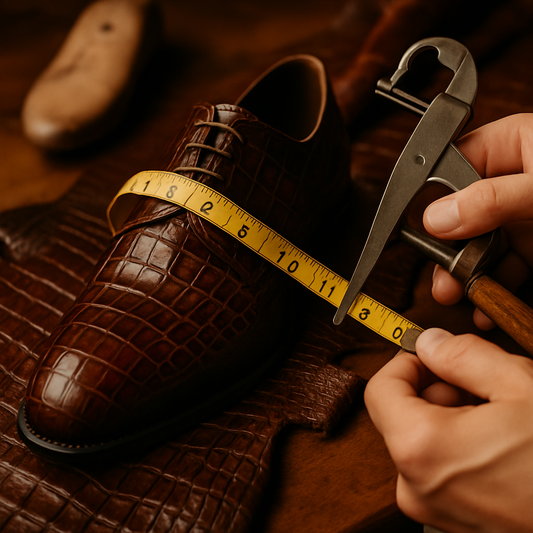
Alligator scale direction affects the jacket’s appearance. The front panels, sleeves, collar, cuffs, and back need to be planned so the pattern flows naturally across the garment. This planning also helps the workshop use the hide efficiently without treating every section as if it had the same scale layout.
A balanced front usually requires more than placing a paper pattern on the largest available area. The maker must account for the center line, pocket openings, zipper or button positions, sleeve movement, and the way the scales will be seen when the jacket is worn. The result should be judged as a garment, not only as a collection of attractive hide sections.
4. Cutting and Preparing the Panels
Once the layout is approved, the hide is cut into the pieces required for the chosen design. Cutting has to preserve the intended scale direction and leave suitable allowances for joining the panels. Small changes at this stage can affect the position of a scale row near a pocket, seam, or collar.
Leather panels are not handled like ordinary woven fabric. The material does not simply recover from every cut or stitch in the same way, so the pattern, thickness, and seam location matter. The lining and supporting materials are also planned alongside the outer leather so the finished jacket can move comfortably rather than feeling unnecessarily rigid.
5. Assembly and Structural Checks
The panels are joined according to the jacket design, followed by installation of the lining, closures, pockets, collar, cuffs, and other components. The exact sequence can vary by construction and design; there is no single universal jacket-making order that applies to every alligator garment.
At our in-house workshop, keeping production under one roof allows the team to compare the leather, pattern, and finished assembly directly. This matters because a panel that looks suitable before construction still needs to sit correctly beside adjoining panels, around hardware, and across areas that flex during wear.
Checks during assembly include the alignment of the front, the symmetry of major panels, sleeve movement, pocket placement, and the operation of zippers or buttons. These checks help identify a construction issue while correction is still practical.
6. What Hand Finishing Involves
Hand finishing is the final manual work that prepares the jacket for inspection and wear. Depending on the design, this can include refining edges, checking seams, cleaning the surface, reviewing hardware, and correcting small presentation issues created during assembly.
Hand finishing is not a guarantee that every jacket will have the same appearance. Alligator is a natural material, so scale size, small marks, and the umbilical area can vary from one hide to another. The purpose of the final work is to bring the individual garment into a clean, wearable condition while retaining the character of the hide.
Price Factors for a Men’s Alligator Jacket
The price of an alligator leather jacket depends on several concrete factors:
- Hide size: Larger jackets require more usable leather and may need more than one hide.
- Belly coverage: A design using more regular belly sections across the front and sleeves can require additional planning and material.
- Pattern complexity: Multiple panels, shaped collars, special pockets, and unusual closures increase cutting and assembly work.
- Leather preparation: Tanning, dye consistency, softness, thickness, and surface condition influence the material cost.
- Construction: Lining, hardware, seam work, and the amount of manual finishing affect the completed garment.
- Size and length: A long or wide jacket generally consumes more leather than a shorter, closer-fitting design.
A high visual grade alone does not establish durability or justify a specific price. Compare the hide section, construction, dimensions, materials, and workshop information together.
Fit and Sizing Before You Order
For a men’s alligator leather jacket, record your chest, shoulder width, sleeve length, waist, jacket length, and upper-arm measurement. Length and width should be reviewed separately: a jacket can fit across the chest while being too short in the body or sleeves.
Check the seller’s size chart rather than relying only on EU, US, or UK labels, because those systems do not guarantee identical measurements between brands. If you need a wide fit, have a high instep only in relation to footwear—not the jacket—or have a fuller upper body, state the relevant body measurements clearly. For remote orders, a well-fitting jacket measured flat can provide useful comparison data, especially for chest width, shoulder width, sleeve length, and back length.
Care After the Jacket Is Finished
For ordinary dust or light handling marks, start with a dry, soft cloth. Do not apply household cleaner, alcohol, or an untested conditioner to alligator leather. If the jacket becomes wet, blot it gently and let it dry naturally away from direct heat, radiators, and strong sun.
There is no useful fixed care schedule for every owner. Cleaning frequency depends on wear, humidity, storage, and contact with skin or other materials. Store the jacket on a broad hanger so the shoulders are supported, leave space around it, and follow the workshop’s product-specific care instructions if a treatment is recommended.
How to Style an Alligator Leather Jacket for Men
For business wear, a dark alligator jacket can work with tailored trousers, a fine-gauge knit, a plain shirt, and understated leather shoes. Keep the other textures controlled so the scale pattern remains the main surface feature.
For casual use, pair a shorter jacket with dark denim, a simple shirt, and clean boots. A lighter-toned jacket can be balanced with neutral trousers and minimal accessories. The jacket’s length and scale size should guide the rest of the outfit: larger visible scales and a longer silhouette often suit simpler supporting pieces.
Frequently Asked Questions
Is an alligator belly pattern perfectly uniform?
No. Alligator belly scales are comparatively regular or balanced, but natural variation occurs. The hide section, cut, and panel placement also affect how the pattern appears on the finished jacket.
How can I distinguish an alligator jacket from a crocodile leather jacket?
Scale shape alone is not a reliable test. Crocodile body scales may retain tiny sensory pores, while alligator belly scales generally lack them. A visible alligator umbilical scar can provide another clue, but one visual trait should not be treated as proof of authenticity.
Does a higher visual grade mean the jacket will last longer?
Not by itself. Visual grading and durability describe different concerns. Tanning, leather thickness, construction, seam work, lining, and care also influence how the jacket performs over time.
What measurements should I send for a remote order?
Send chest, shoulder, waist, sleeve, upper-arm, and jacket-length measurements. A flat measurement from a well-fitting jacket can also help confirm width, shoulder span, sleeve length, and back length.
Choose an In-House Alligator Jacket
See the current jacket designs and material options in the alligator and crocodile jacket collection. For measurements, leather details, or a remote fit discussion, contact CrocodileViet through WhatsApp.