
How to Choose Crocodile Leather Boots Men for Business Wear

Condividi
Choosing Men’s Crocodile Leather Boots for Business Wear
For business wear, men’s crocodile leather boots work best with a low-profile upper, a restrained dark finish, and well-matched belly panels across the vamp and shaft. The objective is not to hide the leather’s scale pattern, but to use it in a way that reads controlled at close range and does not compete with the rest of a work outfit.
Crocodile leather is a specific material from true crocodile species, not a generic label for every reptile-patterned leather. Its appearance can vary considerably by species and by the area of hide used. For a business boot, those variations affect how formal the boot appears, how evenly the two boots can be paired, and how much visually active scale pattern sits on the front of the foot.
Start with the right crocodile hide area
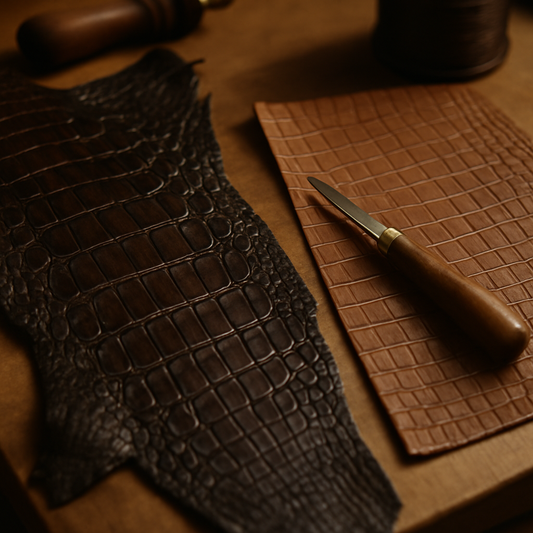
The central belly is usually the key cutting area for men’s crocodile leather boots because it supplies the broadest usable panels for vamps and other visible upper components. Crocodile belly scales commonly appear more rectangular and somewhat less regular than alligator belly scales. That character can look particularly strong on a boot, so panel placement matters as much as the leather itself.
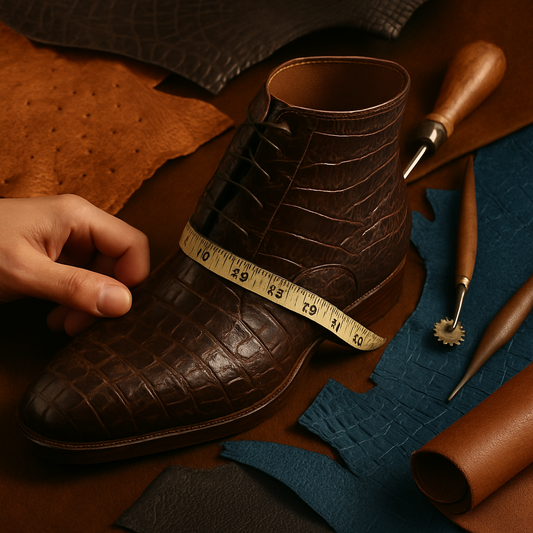
For office-oriented boots, look closely at the vamp: the area over the toes and instep. This is where scale size, direction, and matching are easiest to notice while walking or sitting. A well-planned pair generally has comparable scale scale sizes and pattern density from left boot to right boot, rather than one vamp looking much busier than the other.
At CrocodileViet, we plan corresponding visible panels for the left and right uppers because business footwear is viewed as a pair, especially from the front. Matching the scale rhythm across both boots helps the crocodile leather look deliberate while retaining the individual character of the hide.
Choose a boot shape that suits business clothing
The boot silhouette determines whether crocodile leather supports a business wardrobe or dominates it. A restrained toe shape and a shaft that sits cleanly under trousers generally place more emphasis on tailoring than on the exotic material.
For formal offices and client meetings
- Choose dark brown, deep black, or similarly restrained tones where the scale texture is visible without becoming the outfit’s main contrast.
- Use a plain or softly shaped toe rather than a strongly pointed or heavily extended profile.
- Pair with charcoal, navy, dark brown, or mid-grey tailored trousers.
- Keep the belt close in color family and surface character, rather than trying to duplicate every scale detail.
For business-casual workplaces
- Crocodile Chelsea boots can work with wool trousers, dark denim without prominent fading, and unstructured jackets.
- A slightly more visible belly-scale layout can suit knitwear, overshirts, and textured tailoring.
- Brown-toned boots often work well with navy, olive, tobacco, and cream clothing, provided the outfit has enough visual restraint elsewhere.
For travel, presentations, and long workdays
- Select a toe box and instep shape that match your actual foot dimensions rather than choosing a narrow profile for appearance alone.
- Favor a heel height and outsole arrangement you can use confidently on the surfaces you encounter during the day.
- Keep the trouser hem wide enough to fall over the boot shaft without catching repeatedly at the ankle.
Read the hide: pores, scars, and scale character
Many crocodile leathers show small sensory pores, often referred to as ISOs, within the scales. Their visibility can differ according to species, tanning, finishing, lighting, and the exact hide section. Pores are useful information to inspect, but one visible feature alone does not establish authenticity.
A practical assessment includes the scale structure, the pattern continuing across seams, the leather’s underside and edges where visible, the construction, and the documentation supplied for the product. Crocodilian leather is subject to wildlife-trade rules, so CITES and applicable local import requirements matter for lawful sourcing and cross-border shipment. Such paperwork concerns trade compliance; it should not be treated as a standalone authenticity test.
Alligator leather boots are sometimes confused with crocodile boots because both materials come from animals within the crocodilian order. Alligator belly tends to have a more regular, rounded, and balanced scale layout, while crocodile belly often has a more rectangular and varied arrangement. Alligator may also show an umbilical scar that crocodile lacks. These are comparative clues rather than a substitute for examining the complete item and its documentation.
Understand grade without confusing appearance with wear performance
Hide grades are not universal labels. A designation used by one tannery or supplier may not match another supplier’s terminology or thresholds. In practical boot cutting, the important question is how much blemish-free, usable leather is available in the relevant hide area.
Higher visual grades generally provide a larger usable central area with fewer noticeable scars, holes, or distortions. That can make it easier to cut matching boot panels. Lower visual grades may show more marks or irregularities, which can be acceptable in a more rugged design but may look out of place in a conservative business boot.
Visual grade and durability describe different things. A cleaner-looking hide can improve symmetry and presentation, but it does not by itself determine how a boot performs. Construction, fit, leather thickness appropriate to the component, use conditions, and ongoing care all influence service life.
| Decision factor | What to inspect on business boots | Why it affects the result |
|---|---|---|
| Species and scale structure | Scale shape, pore visibility, and overall pattern character | Crocodile can show a more varied, rectangular belly pattern that changes how formal the upper reads. |
| Usable hide area | Clean, sufficiently broad panels for the vamp and shaft | Boot uppers need panels that avoid prominent scars, holes, and heavy distortion. |
| Scale matching | Comparable scale size and direction across left and right boots | Matching gives the pair a more controlled appearance with tailored clothing. |
| Construction | Seam placement, upper shape, closure design, sole, and heel | These determine fit, movement, repair considerations, and suitability for your working routine. |
| Handwork | How the maker has aligned, shaped, and finished difficult visible panels | Handwork can affect pattern placement and the visual relationship between paired uppers. |
What affects the price of crocodile leather boots?
A price assessment should name the elements involved rather than relying on a broad claim about “quality.” Species affects the visual structure and market availability of the leather. Hide grade affects the amount of clean usable area available for cutting. A hide with a larger blemish-free belly section can yield more suitable panels for matching boot uppers than a hide with scars or damaged regions.
Scale matching also affects material use. Producing a visually coherent left-and-right pair may require reserving corresponding areas of the hide rather than cutting each component from whichever piece is available. Construction choices, including the upper pattern, closure style, outsole, heel, lining, and reinforcement approach, add further cost variables. Handwork involved in panel alignment and shaping can also affect the final price.
Ask what portion of the boot uses crocodile leather, which hide area forms the visible upper, and how the pair has been matched. These questions provide more useful information than a grade label alone.
Get sizing right: length, width, and instep all matter
A business boot should feel secure at the heel, allow appropriate room through the forefoot, and avoid excessive pressure across the instep. Length is only one measurement. A boot can be long enough while still feeling restrictive through the width or difficult to put on because the instep volume is too low for your foot.
EU, US, and UK size labels are different systems, so a number from one system should be translated through the maker’s own size information rather than assumed to match another label exactly. If you have a wide fit, state both foot length and forefoot width. If you have a high instep, mention that as well, particularly for pull-on styles such as crocodile Chelsea boots.
In-person try-on and remote measurement are equally useful routes when each is handled properly. For an in-person fitting, wear the sock thickness you expect to use at work and assess both boots while standing and walking. For a remote order, provide measurements for both feet, including heel-to-toe length, forefoot width at the widest point, and instep circumference where requested. Also share the size and fit experience of boots you already wear, while noting whether those boots run narrow, wide, short, or long for you.
Care for crocodile boots without over-treating them
Use a clean, dry cloth as the default after wear to remove surface dust. Pay attention to the scale edges, welt area, and the join between upper and sole, where debris can collect. Allow boots to dry naturally after rain or perspiration exposure, away from strong direct heat.
A lightly damp cloth is a last resort for localized dirt that does not lift with a dry cloth. Use minimal moisture, avoid soaking the leather, and let the surface dry fully before storage. Conditioners and cleaners should be selected for genuine exotic leather and used sparingly according to their product instructions; excessive product can build up around scales or alter the surface appearance.
Store the boots away from prolonged direct sunlight, high heat, and very dry or very humid conditions. A boot tree or suitable internal support can help retain the upper’s shape between wears. If the sole, heel, seam, or upper shows damage, have the issue assessed before it expands into a larger repair.
Questions to ask before ordering
Which crocodile hide section forms the visible vamp?
The answer helps you understand the scale layout you will see most often. Belly material is commonly important for prominent boot panels because the usable central area can provide broad scales and better opportunities for paired cutting.
How are the left and right boots matched?
Ask about comparable scale size, pattern direction, and placement across the two vamps. Matching does not mean the natural hide pattern becomes identical; it means the pair has been arranged with visual consistency in mind.
What sizing information is needed for a wide foot or high instep?
Provide length, width, and instep information rather than only your usual label size. This gives the maker a fuller basis for discussing the boot shape that may suit you.
What paperwork may apply to delivery across borders?
Ask about the relevant trade and import documentation for your destination before purchase or shipment. Requirements can vary by jurisdiction and change over time.
Choose with the workplace in mind
Men’s crocodile leather boots for business wear are strongest when the leather selection, panel matching, boot profile, and fit point in the same direction. A controlled crocodile belly layout, dark restrained color, and clean silhouette can suit professional settings without requiring the rest of the outfit to compete for attention.
View CrocodileViet’s boot collection to compare available boot styles and details. For fit measurements, leather questions, or ordering guidance, contact CrocodileViet via WhatsApp.