
How to Choose Alligator Leather Belt Men for Business Wear

Condividi
Choosing a Men’s Alligator Leather Belt for Business Wear
For business wear, a men’s alligator belly belt with regular, balanced scales, a restrained dark or mid-dark finish, and a 30–35 mm strap width generally sits more quietly under tailored trousers than a belt built around larger, more varied tiles.
An alligator leather belt for men should support the proportions of a suit, jacket-and-trouser combination, or formal office outfit rather than compete with them. The strongest business choices usually place the most balanced section of the hide across the visible front of the waist, keep the buckle compact, and use a color that works with the shoes and leather accessories already in rotation.
Start With the Alligator Belly Pattern
Alligator belly leather is valued for its comparatively regular scale pattern. The tiles tend to read as orderly across a belt strap, which is useful in business settings where the belt is visible in short sections between trouser loops rather than displayed as a large leather panel.
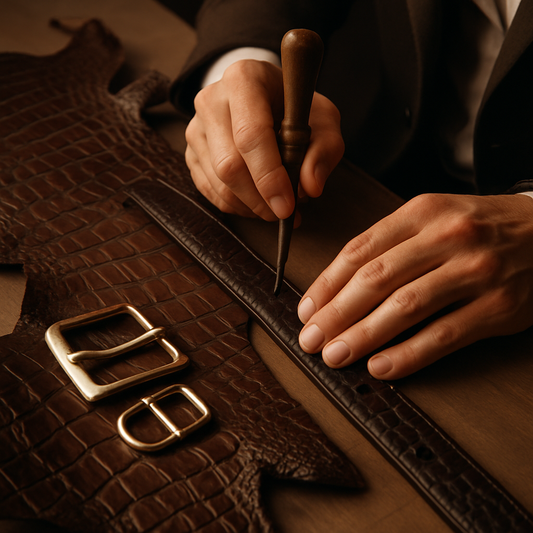
Look at the section that will sit across the front of the waist. A well-planned strap places scales that feel balanced in size and direction through this central area. Small differences in tile size are part of real hide, but abrupt shifts from tiny tiles to much larger ones can look visually busy with a clean worsted suit or pressed cotton trousers.
The side and back sections matter as well. A belt does not need identical scales from end to end, because a natural hide does not grow that way. What matters is controlled progression: the scale layout should feel intentional as it moves from the front panel toward the keeper and buckle end.
Confirm What “Alligator” Means Before Comparing Belts
Species and surface grade describe different things. “Alligator” identifies the animal leather; “full-grain” and “top-grain” describe how the grain surface has been handled. Full-grain leather retains its natural grain layer without sanding or buffing, while top-grain leather has been lightly sanded or buffed for a more even surface appearance.
For an alligator belt, full-grain and top-grain should not be used as substitutes for the species name. A product description should be clear about both the leather species and the surface treatment where that information is available.
Visual checks can be useful, but one detail alone does not authenticate a belt. Alligator belly scales commonly lack the tiny central sensory pore dots often visible in crocodile belly leather. Scale shape by itself is less reliable, since both materials may show square-shaped belly scales. The absence of a pore can support a species assessment, but it does not independently establish authenticity, legal origin, or workmanship.
Choose a Business-Appropriate Width and Buckle
Width changes how an exotic leather dress belt reads with office clothing. A narrow strap can look too slight against substantial tailoring, while a broad strap can crowd narrow trouser loops and draw attention to the waist.
| Decision factor | What to look for | Why it matters for business wear |
|---|---|---|
| Strap width | About 30–35 mm for many dress trousers | This range commonly works with formal and business-casual belt loops without looking overly casual. |
| Buckle scale | A compact frame buckle with a restrained finish | A smaller buckle leaves the alligator pattern as the main detail and reduces bulk beneath a jacket. |
| Scale layout | Regular, balanced belly tiles across the visible front | The belt appears composed when seen between trouser loops and against smooth tailoring fabrics. |
| Edge construction | Clean, even edges with no lifting or rough transitions | Edges receive repeated contact from belt loops, desk surfaces, and trouser waistbands. |
| Backing and reinforcement | A construction suited to supporting the alligator exterior | The visible hide is not the whole belt; the internal structure affects shape retention and daily comfort. |
For conservative offices, a plain metal buckle in a subdued finish is usually easier to wear than a large logo plaque or highly decorative hardware. A business belt should pass through the trouser loops smoothly and lie flat at the buckle without forcing the leather into a sharp bend.
Get the Length Right Before Choosing the Color
Fit affects both comfort and how the alligator scales present across the body. Ideally, the belt fastens around the middle hole or close to it, leaving a measured tail that reaches the first keeper without extending far beyond it. Fastening at the first or last hole can leave the belt looking either too short or too long and may place an awkward section of the scale pattern at the front.
Use an existing belt that fits well as a reference, measuring from the buckle fold to the hole currently used. Waist size alone can be misleading because trouser rise, where the belt is worn, and the thickness of the waistband all affect the required length.
EU belt sizes are commonly expressed in centimetres, while US and UK listings may use inches or local size conventions. The label is less useful than the measurement method behind it. For a remote order, provide the buckle-fold-to-used-hole measurement and state whether the belt will be worn with formal trousers, chinos, or jeans. In-person fitting is equally useful: wear the type of trousers intended for the belt and check that it moves freely through every loop.
Select Colors for Specific Business Contexts
Alligator leather has visible texture even in dark finishes, so color selection deserves more restraint than it might with smooth calfskin. The goal is not to make every leather item identical; it is to create enough coordination that the belt does not interrupt the outfit.
Formal meetings and dark suits
- Black or very dark charcoal-toned alligator works naturally with black shoes, black briefcases, and dark navy or charcoal suits.
- Deep espresso or dark brown can work with navy tailoring when the shoes sit in the same dark-brown family.
- Choose a compact buckle and a regular belly-scale panel to keep the belt visually contained.
Business casual offices
- Medium-to-dark brown suits chinos, tobacco suede shoes, dark-brown loafers, and navy sport coats.
- Warm brown alligator can bring useful texture to plain wool trousers and oxford shirts without requiring patterned clothing elsewhere.
- A restrained buckle remains preferable if the shirt is tucked in and the belt will be visible throughout the day.
Client dinners and evening work events
- Black alligator with a dark suit remains a low-risk option for formal restaurant or event settings.
- Dark burgundy-brown tones may work with deep brown shoes and neutral tailoring if the rest of the outfit stays controlled.
- Let the belt be the textured leather item; heavily textured shoes, a patterned tie, and a conspicuous belt can compete with one another.
Understand What Drives the Price
The price of an alligator belt is not determined by a broad claim of “quality.” It reflects specific material and construction decisions. Species is one factor, but the usable area of a hide can matter just as much. A belt requires a long, continuous strip, and not every part of an alligator hide provides scales that are suitable in size, condition, and visual flow for that purpose.
Hide grade also affects cost, though grade labels are not standardized across every tannery or supplier. One seller’s grade name may not match another’s. Ask what the grade description refers to: visible scars, scale consistency, surface marks, color absorption, or another criterion. Visual grade should not be confused with durability. A hide selected for a particularly balanced display pattern may command more because of appearance and usable yield, not because a less visually regular hide is automatically weaker.
Other cost factors include the degree of scale matching along the strap, the amount of material lost when cutting around marks, the belt’s internal construction, edge finishing, buckle hardware, and handwork. A belt with an aligned front panel and neatly resolved transitions requires more planning than one cut without regard to how the tiles will appear at the waist.
Inspect Construction Beyond the Visible Hide
Alligator is the face of the belt, but a business belt must also function as a belt. Check the underside, the buckle attachment, the keeper, the tip, and the edge line. The strap should flex without a loose surface layer, and the buckle end should feel secure without an unnecessarily thick fold that creates a bulge under a tucked shirt.
Pay particular attention to the edges. Belt loops repeatedly rub the sides of the strap, and poorly finished edges can show wear before the alligator panel itself does. A clean edge should follow the strap consistently, without visible gaps, uneven paint build-up, or sections that catch on the fingertip.
If comparing a crocodile leather belt with an alligator belt, assess construction on equal terms: species affects appearance, while backing, edge treatment, buckle attachment, and scale placement affect how a finished belt performs in daily use.
Care for an Alligator Belt Between Office Days
After wearing the belt, wipe it gently with a dry, soft cloth to remove surface dust. Let it rest flat or hang it without folding the strap tightly around the buckle. Repeated sharp bends can stress any finished leather surface, especially at the holes and buckle fold.
Use a slightly damp cloth only if dry wiping does not remove a small surface mark, and keep moisture away from the belt’s edges, backing, and buckle attachment. Dry the belt naturally at room temperature, away from radiators, direct sunlight, and hair dryers. Heat can dry leather unevenly and may affect finishes or edge materials.
Conditioning should respond to the leather’s actual condition, climate, and wear rather than a fixed calendar schedule. Before applying any conditioner, test it on an inconspicuous area or seek advice from the maker, since products that suit smooth leather may darken, soften, or alter the appearance of finished alligator.
Ask About Documentation for International Purchases
For cross-border commercial movement, crocodilian leather goods can require species identification and matching trade documentation. American alligator is listed on CITES Appendix II, and international export or re-export generally requires the appropriate CITES paperwork. Crocodilian skins may also require a locking CITES tag for legal export.
Documentation addresses trade compliance rather than proving the visual authenticity of a particular belt. A photo, invoice, or a single scale characteristic does not replace the documentation required for a commercial shipment. Buyers arranging international delivery should ask the seller which paperwork applies to the destination and transaction.
Choose the Belt as Part of the Whole Outfit
A business alligator belt works best when its scale pattern, width, color, and hardware have a clear role in the outfit. Choose regular belly scales for the visible front panel, measure from a belt that already fits, and assess the construction rather than judging the purchase from the hide alone. Those decisions produce a belt that reads as considered at the desk, in meetings, and with tailored clothing.
View CrocodileViet’s alligator and crocodilian belt collection to compare available strap styles and buckle treatments. For sizing or material questions, contact CrocodileViet through WhatsApp with your existing belt measurement and the trousers you plan to wear.