
Crocodile Briefcase Men vs Lizard Leather: Which Is Better?

Condividi
Crocodile Briefcase for Men vs. Lizard Leather: Which Suits You Better?
A crocodile briefcase for men is usually the better fit for a structured, formal carry, while lizard leather may suit buyers who prefer a different scale pattern and a less conventional material; neither is universally better for every use.
What “crocodile briefcase” should mean
A genuine crocodile briefcase should be made from crocodilian leather rather than embossed cowhide or printed calfskin. The species should also be identified where possible. Saltwater crocodile (Crocodylus porosus) and Nile crocodile (Crocodylus niloticus) are commonly used in high-end leather goods, while American alligator (Alligator mississippiensis) is traded as alligator leather. Alligator, crocodile, caiman, and lizard are separate trade categories.
Lizard leather is not a lower grade of crocodile leather. It comes from a different reptile category, with its own scale structure, hide size, grading practices, and documentation requirements. A seller using “exotic leather” without naming the species leaves an important part of the purchase unclear.
Crocodile vs. lizard leather for a men’s briefcase
| Decision factor | Crocodile leather | Lizard leather |
|---|---|---|
| Visual character | Belly panels can show a regular, balanced scale pattern. The appearance varies by species, with Nile crocodile often showing more elongated scales than some other crocodilians. | Shows a distinct lizard scale pattern and should be assessed as its own material rather than compared with crocodile as though the two were interchangeable. |
| Briefcase presence | Often selected for a structured, formal appearance and a more substantial visual surface. | Can create a more unusual and less commonly seen briefcase surface, depending on the lizard species, panel size, and finish. |
| Panel planning | The belly area offers broader usable sections, making scale alignment and central placement important during cutting. | Available panel dimensions and scale direction must be checked closely because the hide format differs from crocodile. |
| Price factors | Species, hide grade, usable belly area, scale matching, construction, hardware, and handwork all affect the final price. | Species, hide grade, usable area, scale consistency, construction, hardware, and handwork also affect pricing; a lower price does not identify the leather by itself. |
| Documentation | Commercial crocodilian products may require CITES documentation for export, import, re-export, or other cross-border transactions. | Lizard products may also fall under CITES controls, so documentation depends on the species and the trade route. |
Why crocodile is often chosen for a formal briefcase
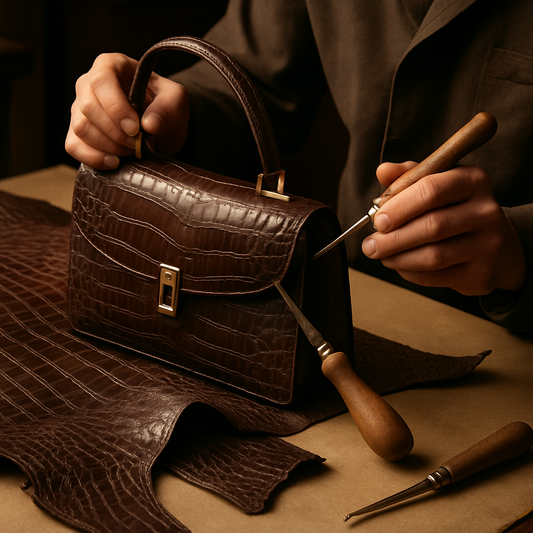
Crocodile belly leather is commonly selected for briefcases because the central scales can create a regular, balanced surface across the front panel. That visual order suits a case with broad rectangular faces, flap edges, handles, and gussets that need to look coordinated.
At CrocodileViet, a crocodile briefcase design may use belly sections where the goal is controlled scale direction and a flatter-looking central panel. The reason is practical: broad, balanced scales make it easier to place the focal area of the hide on the front of the case, while reducing a visually distracting change in scale direction between adjoining panels. This is a design and cutting decision, not a claim that every belly hide is automatically a higher grade.
Crocodile is also often positioned as more rigid and structured than alligator, although the final hand-feel depends on the leather, finishing, backing, construction, and lining. For a man carrying documents, a laptop, or a slim folder, that structured character can support the formal shape many buyers expect from a briefcase.
What lizard leather changes
Lizard leather brings a different scale language to the same type of bag. It should not be described as crocodile with smaller details, because the species, hide proportions, and working characteristics are different. The result depends heavily on the specific lizard species and how the panels are cut.
For a lizard briefcase, ask how the maker plans the front panel, flap, handle attachments, and side gussets. A pattern that looks controlled on a small accessory may require more panel planning on a full briefcase. The important questions are the actual species, the usable area of the hide, the direction of the scales, and whether the visible sections have been selected to work together.
Lizard can suit a buyer who wants a less familiar alternative to crocodile. It may be the better personal choice when the scale pattern, surface texture, or overall visual restraint matters more than the heavier presence associated with many crocodile briefcases. The material should still be judged by its own grade and construction rather than by assumptions based on the word “exotic.”
Grade is not the same as durability
Crocodilian hide grades commonly focus on the condition of the belly or central cutting area. Fewer blemishes and a higher usable yield can support a higher grade because the maker has more clean, workable surface for the visible panels. Some suppliers use numbered grades, but grading labels vary between suppliers and tanneries, so a Grade 1 label is not a universal industry definition.
A visual grade mainly describes the hide’s appearance and usable area. It does not, by itself, prove that one briefcase will withstand more use than another. Durability also depends on leather thickness, backing, edge construction, handle attachment, lining, hardware, stitching, and how the briefcase is carried.
Inspect the areas that receive stress rather than judging only the center panel. On a crocodile briefcase, check the handle bases, handle rolls, flap fold, corners, gusset joins, and closure attachments. For lizard leather, examine the same stress points while also checking that the scale surface has not been stretched or arranged in a way that looks inconsistent across the case.
Price: what you are actually paying for
A crocodile leather bag can vary substantially in price even when two products appear similar in photographs. The main factors include:
- Species: Saltwater crocodile, Nile crocodile, American alligator, and other reptilian materials are not interchangeable in trade or pricing.
- Hide grade: Cleaner central areas and higher usable yield can reduce the amount of material lost during cutting.
- Usable area: A large briefcase needs enough suitable leather for the front, back, flap, gussets, handles, and smaller components.
- Scale matching: Matching scale direction and visual rhythm across adjoining panels requires additional planning and can reduce usable yield.
- Construction: Reinforcement, lining, edge finishing, closure systems, handle attachment, and hardware influence the work involved.
- Handwork: Cutting, panel preparation, assembly, edge work, and finishing can affect the price when done with close manual control.
A quotation should state the material clearly and explain what is included. If the listing only says “crocodile style” or “reptile texture,” ask whether the surface is genuine crocodilian or lizard leather, or an embossed substitute.
Fit, capacity, and carrying comfort
The right briefcase should be assessed by the contents you carry, not just by its exterior material. Measure your laptop, documents, charger, notebook, and any case used around them. Then compare those measurements with the interior dimensions, including the space lost to padding, lining, dividers, and gussets.
Handle length matters as much as the body size. Check whether the handles allow a comfortable drop when worn with your usual jacket or coat. If you sometimes carry the briefcase on the shoulder, examine whether the strap length works over a shirt, knitwear, or outer layer. A structured crocodile case may sit differently from a softer bag, so the width of the gusset and the placement of the handle attachments affect comfort.
For an in-person fitting, bring the items you normally carry and test the handles with your usual clothing. For remote measurements, send the bag maker the length, width, and depth of your laptop and the approximate hand-to-floor distance you prefer for the handles. Remote measurement is equally useful when the product is made to order or when visiting the workshop is not practical.
Styling a crocodile briefcase for men
Business suits
- Use a black or deep brown crocodile briefcase with navy, charcoal, or dark grey tailoring.
- Keep the briefcase shape clean if the suit has a strong pattern.
- Coordinate the hardware with your usual watch, belt buckle, or shoe hardware without requiring an exact match.
Business-casual clothing
- Pair a brown crocodile briefcase with navy trousers, an Oxford shirt, and a textured jacket.
- Use a darker case with grey trousers and knitwear when you want the bag to anchor the outfit.
- Let the scale pattern remain the main material feature rather than adding several competing textures.
Lizard leather styling
- Choose simpler clothing when the lizard scale pattern is the most noticeable part of the outfit.
- Use muted tailoring and plain knitwear to keep the surface visible without crowding the overall look.
- For a less formal setting, a lizard briefcase can work with an unstructured jacket, trousers, and leather shoes in related tones.
Care for crocodile and lizard briefcases
Start with a dry, soft cloth to remove surface dust after use. Keep the briefcase away from prolonged heat, direct sunlight, and wet conditions, since drying or uneven exposure can affect the finish and shape. If a small amount of moisture reaches the surface, blot it gently rather than rubbing.
Use a damp cloth only as a last resort and only with restrained pressure. Do not apply household polish, alcohol-based cleaner, or an unverified conditioner. Crocodile and lizard finishes differ, so a care product suitable for one surface may alter another. For a stain, peeling finish, or hardened area, ask the maker or a leather specialist before treating it.
Store the briefcase upright or supported so the panels do not fold under their own weight. Empty it before storage, keep the handles from being compressed, and use soft internal support that does not force the gussets outward.
Trade documents and species identification
CITES documentation concerns regulated international trade; it does not prove that a bag is authentic. A document should be matched to the declared species, product, and shipment details, while authenticity also requires examining the material, construction, seller information, and purchase records.
Ask for the species name and clarification of whether the leather is genuine, embossed, or printed. Do not use one visual feature as proof. Alligator belly leather commonly has a regular, balanced scale pattern and may show an umbilical scar, while crocodile can vary more by species and often shows visible sensory pores, known as ISOs. These observations can support identification, but they should be considered alongside documentation and the maker’s records.
Our practical verdict
Choose a crocodile briefcase for men when you want a structured case, a controlled belly-scale layout, and a formal surface suited to business clothing. Choose lizard when its particular scale pattern and less familiar material appeal to you, provided the species, usable area, construction, and documentation are clearly explained.
For a CrocodileViet crocodile leather bag, view the available designs at CrocodileViet bags. You can also contact us through WhatsApp to discuss species, measurements, panel layout, and care before ordering.