
Navy Alligator Skin Shoes: Styling, Care and Buying Tips

공유
Navy Alligator Leather Shoes: Styling, Care, and Buying Advice
Navy alligator skin shoes pair most readily with navy, medium-grey, light-grey, and muted brown clothing because the blue reads as a restrained color while the alligator belly pattern supplies visible surface texture.
For a navy shoe, the material matters as much as the color. Alligator belly leather generally has a comparatively regular, balanced scale layout: larger scales through the center of the belly gradually become smaller toward the sides. On a dark navy finish, that progression can be subtle from a distance and more apparent under direct light, so a well-chosen pair should look balanced both across each shoe and between the left and right shoe.
What to Look for in Navy Alligator Skin Shoes
Buying alligator leather shoes starts with confirming what portion of the hide forms the visible upper. The belly is valued for its flatter surface and orderly scale field, which lets a shoemaker place the scale pattern across the vamp, toe, and quarters with more control. In navy, this placement has an outsized visual effect: highly mismatched central scales can show through dark dye as uneven blocks of reflected light.
Alligator is not interchangeable with crocodile or caiman in material descriptions. Crocodile leather often shows visible sensory pore dots on individual scales, while alligator generally does not. Alligator bellies also lack the ventral bony osteoderms commonly associated with crocodile belly skin. These are useful points for evaluating a seller’s material description, but no single visual trait establishes authenticity on its own.
Check the Pattern Before Focusing on Shine
A navy finish can be glossy, semi-gloss, or more muted. The surface treatment changes how strongly the scales reflect light, but it does not replace sound pattern selection. Examine the shoes as a pair and look for:
- A similar scale scale and direction across the two vamps, especially around the toe box.
- A centered visual field rather than one shoe showing mostly side scales while the other shows broad center scales.
- Reasonable continuity where leather panels meet, without expecting the scales to line up as though they came from a printed sheet.
- Color that appears consistent across the pair under natural daylight as well as indoor lighting.
- A toe shape that does not pull the belly scales sharply out of form when the shoe is tried on.
Small variations are part of genuine alligator leather. The point is not identical scales from shoe to shoe; it is intentional placement that produces a composed pair rather than a visually accidental one.
How Navy Alligator Shoes Work With Different Outfits
Navy alligator shoes have more texture than plain navy calf leather, so they tend to work best where the rest of the outfit has clear, controlled lines. The goal is to let the scale pattern register without combining it with competing shine, loud prints, or several unrelated leather finishes.
Business and Formal Settings
- Mid-grey suit: Navy shoes create a cooler contrast than black footwear and keep the outfit within a professional color range.
- Charcoal suit: A darker navy shoe can work with charcoal, particularly with a white or pale-blue shirt. A very bright navy may appear disconnected against near-black charcoal.
- Navy suit: Choose shoes that are visibly darker or slightly different in tone from the suit. Shoes and trousers in nearly identical navy can blur together under low light.
- Light-grey or stone tailoring: Navy provides definition at the bottom of the outfit without the hardness of black.
Smart Casual Wear
- Dark indigo denim with an oxford shirt, fine-knit polo, or unstructured navy blazer.
- Olive chinos with an off-white, pale-blue, or chambray shirt.
- Tobacco or medium-brown trousers with a navy knit, creating a warm-and-cool color contrast.
- Light stone trousers with a navy overshirt or textured blazer, where the shoes repeat the outfit’s darker note.
For belts, a navy leather belt can create a coordinated result, while a dark brown belt may work with brown trousers or a brown watch strap. Exact color matching is not required; the belt should relate to the shoe’s depth and finish rather than introduce a disconnected bright blue.
Situations That Need More Restraint
Navy alligator skin shoes can become visually busy alongside high-gloss patent accessories, strongly patterned trousers, or large reptile-pattern bags. For evening events, a dark, low-contrast navy shoe may be more adaptable than a bright blue finish. For daytime social wear, a clearer navy can be effective with lighter trousers and simple fabrics such as cotton, linen, or wool.
Buying Factors That Affect Price and Appearance
| Buying factor | What it changes in navy alligator shoes | What to ask or inspect |
|---|---|---|
| Alligator species and hide source | Material terminology, scale character, documentation requirements, and cost can differ by source. | Ask for a clear alligator material description and any applicable trade documentation. |
| Hide grade | Scars, scratches, shading, scale deformities, and other marks within the visible pattern area can affect the leather’s appearance and price. | Ask where visible marks occur and whether they fall on the vamp or another prominent panel. |
| Usable belly area | Broad, clean belly sections provide more room for matching the toe and vamp panels between shoes. | Look at scale placement across both shoes, not at one close-up image alone. |
| Scale matching | Matching affects how intentional the pair appears, especially on dark navy leather where reflected light outlines each scale. | Request photographs of both shoes side by side in even light. |
| Construction and handwork | Last shape, upper cutting, closing, sole attachment, finishing, and edge work influence fit, repair options, and labor cost. | Ask what “handmade” refers to in the specific pair rather than treating the term as a fixed construction standard. |
Price is not determined by “quality” as one broad label. Species, hide grade, usable belly area, scale matching, construction, and the amount of handwork all contribute. A visually clean alligator belly section with enough usable width for paired uppers is a different input from a hide with marks in the primary display area.
Some suppliers use a 1-to-5 grading approach in which Grade 1 commonly indicates no belly defects and lower grades indicate increasing clusters of visible defects. Those labels are not universal across every tannery or supplier, so the grade number should be read alongside photographs and a description of the visible area. Grade is primarily a visual classification, not a durability guarantee. Grading commonly focuses on the prime belly or midsection pattern area rather than the head, back, or tail.
For genuine alligator shoes for men, CITES-related paperwork concerns lawful international trade compliance. It should be reviewed where applicable, but it does not by itself verify the material’s visual identity or establish the workmanship of the finished shoes.
Fit and Sizing for Alligator Leather Shoes
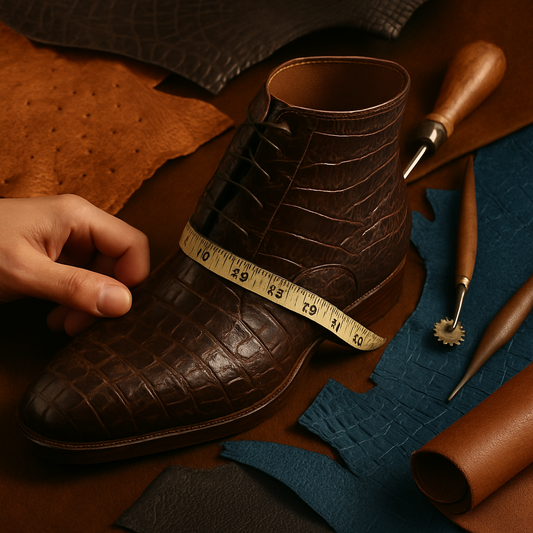
Fit should be assessed by length, width, instep volume, toe shape, and the way the vamp sits across the foot. EU, US, and UK sizes use different conversion systems, and a conversion chart is a starting reference rather than a substitute for a measurement. A person who routinely wears one numeric size may need a different size or width in a narrow, pointed, rounded, or high-instep last.
For alligator hides, belly width is commonly measured in centimeters across the smooth belly at its widest point. That hide measurement is relevant to leather cutting and usable panel size; it is not a shoe-size measurement. Wider usable belly leather can give a maker more scope to place large, balanced scales on broad shoe components.
In-person try-on and remote measurement are equally useful routes. In person, stand and walk long enough to check heel hold, toe clearance, instep pressure, and whether the shoe creases naturally. For a remote purchase, measure both feet from heel to longest toe while standing, record the widest point of each foot, and note a high instep, wide forefoot, orthotic use, or a preference for thicker socks. Share these measurements with the seller alongside the EU, US, or UK size normally worn.
A leather upper may adapt modestly with wear, but it should not be purchased with severe toe pressure or painful instep compression in the expectation that the alligator will solve the fit issue later. Excessive strain can also distort the scale field across the vamp.
Care for Navy Alligator Skin Shoes
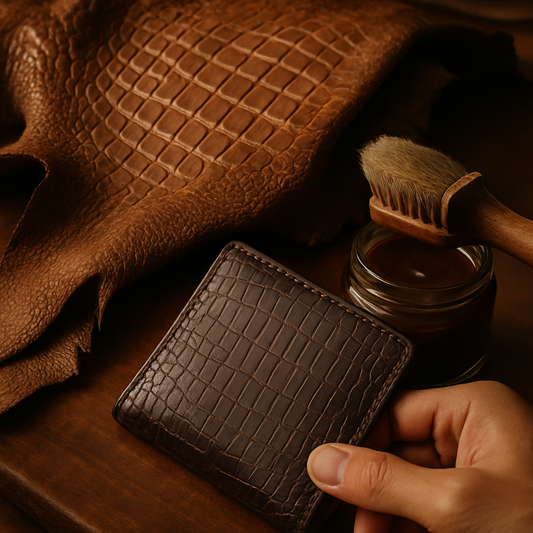
After wear, wipe navy alligator leather with a clean, dry, soft cloth to remove dust and surface residue. This is the default care step because unnecessary moisture can leave marks, alter surface sheen, or affect the finish unevenly across the scales.
Use a slightly damp cloth only as a last resort for a localized mark that does not lift with dry wiping. Keep the cloth barely damp rather than wet, avoid soaking the scale edges, and allow the shoes to dry naturally away from direct sun, radiators, hair dryers, and other heat sources. Do not use household cleaners, alcohol-based wipes, or heavy cream products without confirming that they suit the shoe’s particular finish.
Conditioning should respond to the leather’s condition and the product guidance for its finish, rather than a fixed calendar schedule. Test any suitable leather-care product in an inconspicuous area first, because navy dye and surface treatments can react differently from one pair to another. Use shoe trees that support the heel and forefoot without forcing the upper outward, and store the shoes in a cool, dry area away from prolonged strong light.
If a deep scratch, loose scale edge, substantial water mark, or finish change appears, professional assessment is usually safer than repeated home treatment. A repairer can judge whether the issue is confined to the surface finish or affects the leather beneath it.
Choosing a Navy Pair With Long-Term Wear in Mind
A navy pair earns its place in a wardrobe when its tone works with the clothing already worn most often. Dark navy is generally easier to rotate with office tailoring and darker denim. A more saturated blue can suit daytime events and lighter trousers, but it may be less adaptable with formal charcoal clothing.
Before ordering, request clear images of the actual pair from above, both sides, and close range. Ask about the last’s width, toe shape, and instep volume; whether the sole is intended for formal indoor-heavy use or regular street wear; and what the term handmade alligator shoes means for that model’s construction. Specific answers are more useful than broad claims about luxury.
Find the Right Pair
View CrocodileViet’s current shoe selection to compare available styles and request material or sizing details; navy availability can vary.
For remote sizing support or questions about a particular pair, contact CrocodileViet through WhatsApp with your foot measurements and usual EU, US, or UK size.