
Custom Luxury Exotic Leather Wallet: Size, Color, Finish and Personalization Guide

공유
Custom Luxury Exotic Leather Wallet: A Guide to Size, Color, Finish and Personalization
A custom luxury exotic leather wallet is defined by four practical choices: its closed dimensions, crocodilian skin section, surface finish, and personalization details.
What This Custom Wallet Guide Covers
This guide focuses on custom wallets made from alligator or crocodile skin, with particular attention to wallet size, color, finish, scale placement, personalization, price factors, fit, care, and styling. It does not treat alligator and crocodile as interchangeable materials, because their scale patterns and visible features can differ by species and individual skin.
Start with the Wallet’s Intended Use
Before choosing a color or monogram, decide what the wallet must carry. A cardholder, slim billfold, standard bifold, and travel wallet require different panel layouts. A design that holds several cards and folded notes will need more internal volume than a compact card wallet, while a passport or travel format requires greater length and width.
For a custom order, provide the following information:
- The number of cards you normally carry.
- Whether you carry folded or flat banknotes.
- Whether coins, receipts, SIM cards, or business cards need a separate compartment.
- The pocket where the wallet will be carried: trouser, jacket, shirt, handbag, or briefcase.
- Whether a slim profile matters more than maximum capacity.
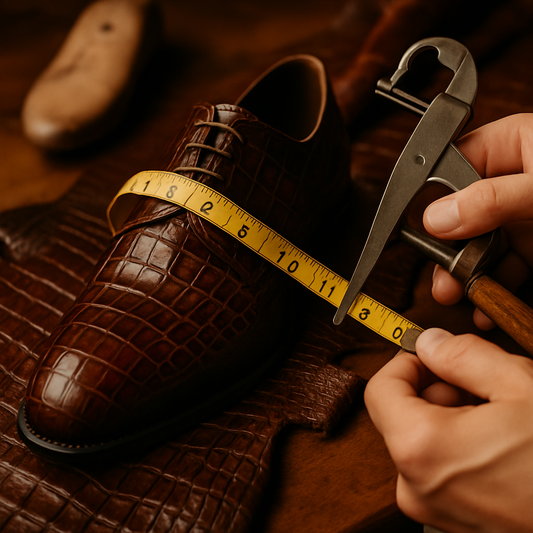
Remote measurements are useful when ordering from outside Vietnam. Measure the inside width and height of the pocket rather than relying only on the dimensions of an old wallet. Also measure the packed thickness of your current wallet. A new wallet with the same length and width can still feel too large if its card slots are tighter or its fold is fuller.
Choosing Alligator or Crocodile Skin
Alligator and crocodile are distinct materials, even though both belong to the crocodilian family. Alligator belly skin typically has a regular, balanced arrangement of more rectangular scales. It also generally lacks the conspicuous sensory pores commonly visible on crocodile scales.
Crocodile belly skin often shows visible sensory pores, sometimes called integumentary sensory organs or ISOs. The amount and appearance of these pores vary by species and individual skin, so one visual feature should not be treated as proof of authenticity by itself. Crocodile also covers several species, including saltwater crocodile (Crocodylus porosus) and Nile crocodile (Crocodylus niloticus). “Porosus” is a species reference, not a grade.
A belly panel is commonly selected for refined wallet fronts because its scales are relatively flat and even. By contrast, “hornback” refers to the raised, bony back portion of the animal; it is not another name for belly leather. The choice between belly and hornback is therefore a design decision involving texture, scale structure, and the visual character of the finished wallet.
An alligator wallet for men intended for business wear often suits a regular belly pattern and restrained finish. A crocodile leather wallet with visible pores can provide a more textured appearance. Neither surface automatically indicates greater durability or higher quality.
Scale Placement and Panel Design
For a custom wallet, the usable cutting area matters as much as the species. The wallet front is usually the most visible panel, so the maker must decide whether to center a broad scale, align a scale row across the fold, or use matching sections on the front and back.
Large, balanced belly scales can create a calmer appearance on a bifold. Smaller scales may suit a cardholder or narrow panel. A curved wallet edge can also change how the scales are perceived, which is why a pattern that looks balanced on a rectangular skin may need a different layout for a compact design.
Alligator skin may show an umbilical scar, while crocodile commonly lacks this feature. The scar is a natural characteristic rather than a simple pass-or-fail indicator. Its placement may influence whether a panel is centered, cut around it, or used for a less visible component.
Hide grading should be discussed with the supplier before production. Grading systems generally describe cosmetic defects and usable cutting area, not one universal scale of quality. Labels and numbering vary by species, tannery, and supplier. In one American-alligator convention, Grade 1 indicates no defects in the belly, while lower grades permit more defects or defects in more central areas; the head and tail may be excluded from that grading assessment.
Color Options for a Custom Luxury Exotic Leather Wallet
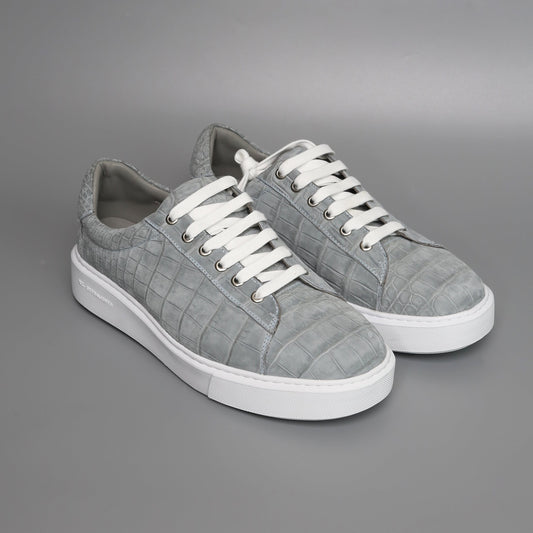
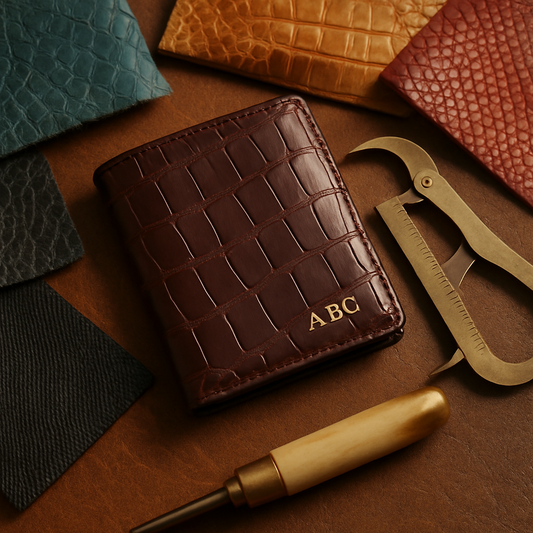
Color affects how clearly the scale structure is seen. Black, deep brown, and dark navy can produce a restrained appearance and are practical for business wardrobes. Cognac, tan, burgundy, or other lighter shades make the scale layout more visible and can show greater variation between individual skins.
Because crocodilian skin is a natural material, the same named color may differ slightly between skins. The final result can also change with the base color, dyeing method, surface finish, and the scale area selected. Ask to see a current leather sample or finished reference in the intended color instead of choosing from a name alone.
For a versatile custom piece, coordinate the wallet with the colors already used in your shoes, belt, briefcase, or watch strap. A dark wallet can blend into formal clothing, while a warm brown or burgundy wallet can work as a visible accessory with neutral tailoring. A contrasting interior is another option: a dark exterior with a brown, red, or natural-toned lining creates separation without changing the outward character of the wallet.
Finish: Matte, Glossy, or Lightly Polished
A matte finish reduces reflected light and usually makes the scale pattern easier to read as a surface texture. It can suit a wallet used daily with casual tailoring or understated business clothing.
A glossy finish reflects more light and makes the scale shape more prominent. It can suit formal accessories, but surface reflections may also make scratches, handling marks, or uneven color more noticeable. A lightly polished finish sits between these options and can preserve visible scale detail while adding some sheen.
Finish is not a durability ranking. A glossy surface is not automatically stronger than a matte one, and a matte surface is not automatically more resistant to wear. The useful question is whether the finish matches the way you carry and handle the wallet.
Personalization That Works with the Skin Pattern
Personalization can include initials, a name, a date, a discreet logo, or a selected interior color. Keep the placement proportional to the wallet. Small initials often work near an outer corner or inside a bill compartment, while a larger mark may compete with the scale pattern on the front panel.
Monogram position should be chosen after the skin layout is set. Pressing text across a prominent scale row can interrupt the pattern; placing it near a flatter border may make the lettering clearer. Ask whether the personalization will be blind debossed, foil-stamped, painted, or otherwise applied, because each method changes the visual result.
For a gift, confirm the exact spelling, capitalization, initials, and date before production. Also confirm whether the recipient prefers visible personalization or a private mark inside the wallet.
Price Factors Without Guesswork
A custom wallet price depends on several concrete variables rather than on the word “luxury” alone:
| Decision factor | How it can affect price | What to confirm |
|---|---|---|
| Species and skin section | Alligator belly, crocodile belly, and hornback involve different material characteristics and cutting considerations. | Ask for the exact species or material description and whether the panel is belly or hornback. |
| Usable cutting area | A larger, cleaner section may provide more freedom for centered panels and scale matching. | Ask how the supplier defines its grade and whether the stated grade covers the belly only or the whole skin. |
| Wallet construction | More card slots, compartments, folded gussets, and larger dimensions require more material and labor. | Confirm the number of slots, note compartments, coin sections, and finished measurements. |
| Finish and color | Different surface effects and color treatments may require different leather preparation and finishing work. | Request a sample or reference showing the intended color and sheen. |
| Personalization | Monograms and custom layouts add preparation and finishing requirements. | Confirm the lettering, location, size, and application method before approval. |
Do not compare two quotations by price alone. Check whether they describe the same species, skin section, dimensions, interior material, number of compartments, finish, and personalization. “Skin” is customary industry terminology for crocodilians, while consumer-facing sellers may also say “hide”; neither word indicates species or quality by itself.
Fit, Sizing, and Remote Measurements
Wallet measurements should be given as length × width × thickness when closed. For a bifold, also ask for the open length, because it determines how the wallet sits in the hand and whether it fits comfortably on a desk or inside a bag.
European, US, and UK clothing sizes do not provide a reliable wallet measurement system. Wallets are normally specified in centimeters or millimeters, so provide actual measurements rather than a clothing size. If the intended user wears wide-fit trousers, carries a thick phone, or has a high-instep shoe that affects pocket comfort, those details may help explain how much room is available in daily use, but they do not replace measuring the pocket.
For remote orders, send measurements of the preferred pocket, the current wallet when empty, and the current wallet when filled. Include photographs with a ruler if possible. This gives the workshop a better basis for discussing length, width, fold clearance, and card-slot capacity before a custom layout is confirmed.
Care for Alligator and Crocodile Wallets
Use a dry, soft cloth as the default cleaning method. Wipe away surface dust and fingerprints without pressing hard across the scales. Keep the wallet away from prolonged moisture, heavy rain, direct heat, and hot vehicle interiors, as rapid drying can affect the leather and finish.
Do not apply household polish, alcohol-based cleaner, solvent, or an untested conditioner. Products intended for smooth cowhide may not suit crocodilian skin or its finish. If the wallet becomes wet, blot it gently, remove the contents, and let it dry naturally away from heaters and strong sunlight.
There is no useful fixed care schedule for every wallet. Frequency depends on climate, handling, pocket friction, and the finish applied. Inspect the surface when it looks dry or collects residue, and ask the maker which product, if any, is compatible with that particular finish.
Styling a Custom Exotic Wallet
For business clothing, a dark alligator or crocodile belly wallet with a moderate sheen pairs easily with navy, charcoal, black, and brown accessories. A matte finish can keep the wallet visually quiet, while a glossy finish can coordinate with polished shoes or a formal leather briefcase.
A lighter brown, burgundy, or textured crocodile wallet can work with relaxed tailoring, denim, knitwear, or a casual leather bag. If the wallet will be removed frequently at meetings or dinners, coordinate its color with one other leather item rather than trying to match every accessory exactly.
Keep the wallet’s thickness appropriate to the clothing. A heavily filled wallet can distort a jacket or trouser pocket regardless of the skin used. A slim cardholder may be better for formal occasions, while a larger bifold or travel wallet may suit a briefcase or handbag.
Documentation and Species Questions
International trade in crocodilian specimens and products is controlled under CITES, but permit requirements depend on the species, source, and circumstances of the trade. CITES documentation does not by itself prove a wallet’s authenticity. For an international purchase, verify the exact scientific species and the documentation required for the destination market.
A genuine crocodile wallet should be supported by clear material information from the seller, but no single sensory feature—such as pores, scale shape, smell, or softness—proves authenticity. Ask for the species description, material section, grading convention, and any applicable trade paperwork before ordering.
Frequently Asked Questions
Is alligator belly better than crocodile belly for a custom wallet?
Neither is automatically better. Alligator belly usually has a regular, balanced rectangular scale pattern, while crocodile belly commonly shows visible sensory pores and more variation by species and individual skin. The better option depends on the appearance, texture, species documentation, and wallet design you want.
What measurements should I send for a remote custom wallet order?
Send the preferred closed length, width, and thickness, plus the open length for a bifold. Measure the target pocket and your current wallet both empty and filled. Also list the cards, notes, coins, and other items the new wallet must carry.
Does a higher wallet grade mean the leather will last longer?
Not necessarily. Grading generally concerns cosmetic defects and usable cutting area, and grading labels vary by supplier, tannery, and species. Visual grade should not be treated as a direct durability rating.
Do I need CITES paperwork for every crocodile leather wallet?
Permit requirements depend on the species, source, and trade circumstances. Ask for the exact scientific species and check the rules for the destination market. CITES documentation supports regulated trade compliance, but it is not by itself proof that a wallet is authentic.
View Custom Wallet Options
Browse the CrocodileViet wallet collection to compare available formats and materials. For dimensions, color, finish, personalization, or documentation questions, contact CrocodileViet through WhatsApp before placing an order.