
Luxury Crocodile Dress Shoes Care: How to Protect Texture, Shape and Finish

공유
How to Care for Luxury Crocodile Dress Shoes: Protecting Texture, Shape, and Finish
Crocodile leather shoes that become wet should be blotted rather than rubbed, then dried at room temperature with shoe trees or clean paper inside to support their shape.
Luxury crocodile dress shoes need care that respects the structure of genuine reptile leather: overlapping scales, a finished surface, and a shaped upper that can distort if it is soaked, overheated, or stored carelessly. A routine built around gentle dry cleaning, controlled drying, and correct storage helps preserve the texture and finish without forcing products into the scales.
Know Which Surface You Are Caring For
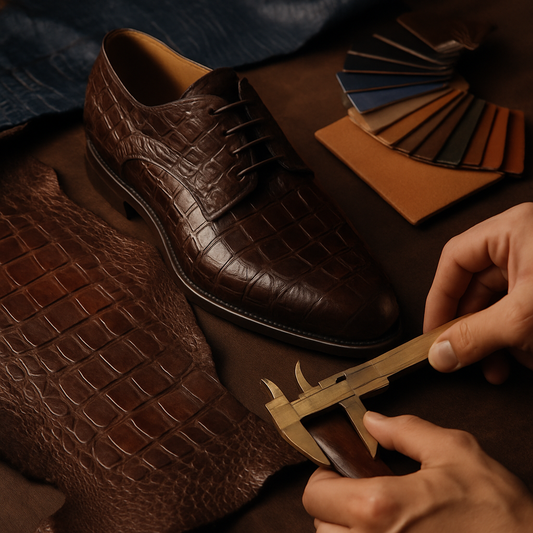
Genuine crocodile shoes have a scale structure rather than an embossed print. On many crocodile hides, small sensory pore dots can be visible near the centers of scales, although their visibility varies by species, hide area, finish, and viewing angle. These pores are one useful characteristic, not standalone proof of authenticity.
Embossed croc-grain calfskin is different material: it is cowhide or calfskin pressed or printed with a reptile-like pattern. It may need a different cleaning approach from crocodile leather, particularly around the raised pattern. For luxury crocodile dress shoes, use care methods intended for actual crocodilian leather rather than assuming that a textured-looking shoe is genuine reptile skin.
The finish also changes the approach:
Glazed crocodile leather has a polished, higher-shine surface. It benefits from a light touch because aggressive rubbing can disrupt the polished appearance.
Matte or natural-finish crocodile leather has less surface shine and generally calls for more conservative cleaning. A product that changes sheen may leave an uneven result across the scales.
Textured areas and larger scutes can collect dust at scale edges. Cleaning should follow the direction in which the scales lie rather than catching or lifting them.
Routine Cleaning: Dry Cloth First
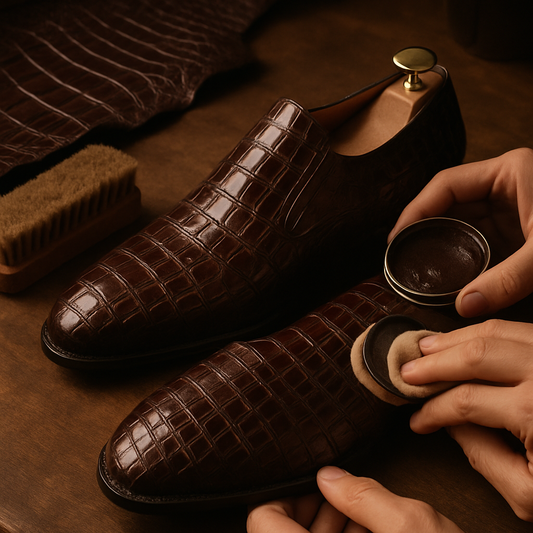
After wearing crocodile leather shoes, let surface moisture dissipate at room temperature before putting them away. Then use a soft, dry cloth to remove dust from the vamp, quarters, heel area, and along scale edges. Work with the scale direction using light strokes.
A damp cloth is a last resort for a localized mark that a dry cloth cannot lift. The cloth should be only lightly damp, not wet enough to saturate the leather. Wipe the affected area gently, avoid repeated scrubbing, and support the shoe with a shoe tree or paper while it air-dries at room temperature.
Avoid alcohol, solvents, household cleaners, and heat. These can affect the finish, dehydrate the leather, or leave uneven shine. Direct sunlight, radiators, hair dryers, and hot car interiors create the same risk by drying one area faster than another.
Cleaning Around the Scales
Crocodile leather should not be treated like smooth calfskin. Pressing hard across the grain, rubbing back and forth, or forcing cloth into the scale edges can stress the surface. Use a soft cloth with minimal pressure and move in the direction the scales naturally overlap.
If dirt has collected in a narrow edge between scales, it is better to have the shoes assessed by a leather-care professional than to dig at the area with a sharp tool. A small scratch or lifted scale is far more difficult to correct than ordinary dust.
What to Do If Crocodile Shoes Get Wet
Rain exposure does not automatically ruin crocodile leather, but the response matters. Blot water from the surface with a clean, absorbent cloth. Rubbing can push moisture across the finish and create unnecessary friction over the scales.
Remove surface water by blotting, including around the welt and heel.
Insert cedar shoe trees if they fit without stretching the upper, or use plain, clean paper to hold the toe and vamp in shape.
Dry the pair indoors at room temperature, away from concentrated heat and direct sun.
Wait until the shoes are fully dry before wearing, storing, or applying any leather-care product.
Supporting the upper during drying matters because damp leather can conform to pressure points and lose the clean lines created by the last. Paper is useful if shoe trees are unavailable, provided it is changed if it becomes damp and is not packed so tightly that it stretches the toe box.
Protecting Shape Through Fit and Wear
Correct fit is part of crocodile shoe care. A shoe that is too short can crease heavily across the vamp; one that is too narrow may put pressure on the instep and side seams; an overly loose shoe can flex unpredictably at the heel and throat. These are wear issues, not merely comfort issues.
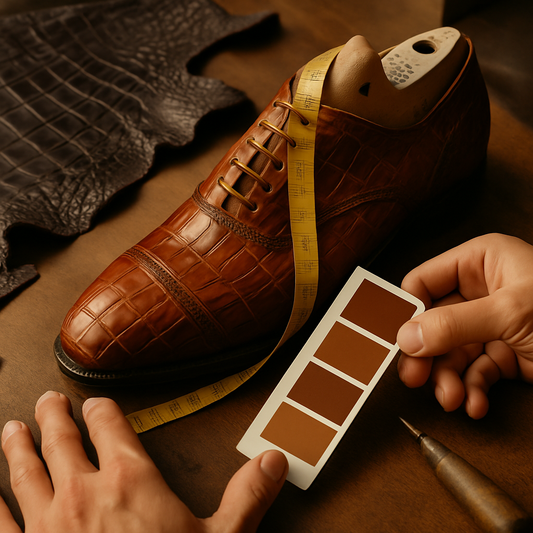
For genuine crocodile shoes for men, assess length, width, instep room, and heel hold together. A wide fit may need more than simply going up in length, since extra length can shift the flex point away from the natural bend of the foot. In-person fitting gives the clearest assessment, while remote orders should use measured foot length and width, the intended sock thickness, and the brand’s stated EU, US, or UK sizing reference with equal care.
Use shoe trees after wear once the shoes have aired briefly. They help the upper keep its intended shape and reduce the tendency for moisture from normal wear to settle into creases. A tree should support the shoe without aggressively expanding it.
Conditioning and Finish Care
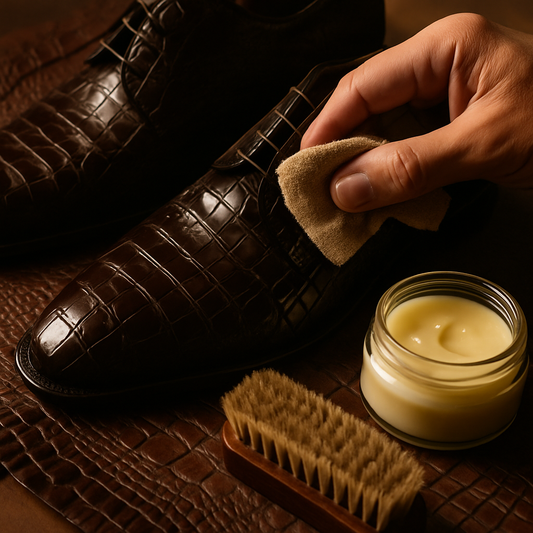
Crocodile leather does not benefit from indiscriminate product layering. Conditioning needs depend on the finish, climate, wear frequency, and how dry the leather appears or feels. There is no fixed calendar interval that suits every pair.
Before applying a conditioner or finish product, confirm that it is appropriate for genuine crocodilian leather and for the shoe’s specific surface treatment. Test it on a small, discreet area first, then allow that area to dry before treating a larger section. This is particularly important on glazed leather, where a product can alter reflectivity or leave a different sheen at the edges of scales.
Use only a small amount and avoid allowing product to pool between scales. If the leather develops cracking, a lifted scale, separation near the sole, or a patchy finish, professional assessment is preferable to repeated home applications. More product does not necessarily solve a structural or finish-related problem.
Storage Between Wears
Store crocodile leather shoes clean, dry, and supported. Shoe trees or light paper stuffing help maintain the toe shape and vamp line. Keep each shoe away from hard objects that could press into the scales, especially during travel.
A breathable shoe bag can reduce dust and scuffing. Before long storage, inspect the pair for moisture and let it air at room temperature if needed. Putting away shoes while damp can create shape problems and complicate later cleaning.
Rotate dress shoes where practical rather than repeatedly wearing the same pair before the upper has had time to air. This helps reduce the build-up of moisture from normal use and gives the leather a chance to recover its shape around the flex points.
Why Crocodile Shoe Prices and Repairs Vary
The price of handmade crocodile shoes, and the cost of specialist repair work, can reflect more than the visible shine of the finished pair. Species, hide grade, usable pattern area, scale matching across the two shoes, construction method, and the amount of handwork all affect material selection and production effort.
Hide grade commonly focuses on the central belly or midsection, where the pattern area is most visible and blemishes have the greatest effect on yield. A higher visual grade generally means fewer defects in that prime section and more usable leather. It should not be treated as a durability rating: a visually clean hide and a well-maintained shoe are separate considerations.
Grading labels also vary between suppliers and tanneries. A label by itself does not provide a universal comparison across every source. For dress shoes, scale placement at the vamp and toe, paired visual balance, and the amount of usable leather available for matching are more informative questions than a grade name alone.
Documentation and Material Claims
Commercial crocodilian leather trade is regulated internationally under CITES. Species documentation and appropriate permits can be relevant to cross-border shipments. CITES documentation concerns trade compliance; it does not, by itself, establish the authenticity or finish quality of a particular shoe.
Ask sellers clear material questions if you are comparing crocodile leather shoes: whether the upper is genuine crocodile rather than embossed bovine leather, what finish is used, and what care products are suitable for that finish. Clear answers help you choose an appropriate care routine from the start.
Common Care Mistakes to Avoid
Rubbing a wet upper briskly instead of blotting it.
Drying the shoes near a heater, with a hair dryer, or in direct sun.
Using alcohol, solvent-based cleaners, or general household cleaning products.
Scrubbing against the scale direction or prying dirt from scale edges.
Applying large amounts of conditioner without checking finish compatibility.
Storing damp shoes without shape support.
Assuming an embossed croc pattern needs the same care as genuine crocodile leather.
Care Support From CrocodileViet
For our current selection of luxury crocodile dress shoes, visit CrocodileViet’s shoe collection. You can also contact us on WhatsApp to discuss finish-specific care, sizing, or suitable shoe support for your pair.