
How to Choose Crocodile Leather Types for Business Wear

공유
Choosing Crocodile Leather Types for Business Wear
For business wear, crocodile belly leather generally gives the smoother, more varied scale field suited to restrained accessories, while hornback crocodile leather has raised dorsal scales that create a visibly rugged surface.
The phrase crocodile leather types can refer to several different things: the crocodile species, the part of the hide being used, and the visual sorting of the available panels. For a business belt, briefcase, document holder, shoe, or wallet, these distinctions matter because they change the scale layout across the finished piece—not merely its label.
In the luxury leather trade, “crocodile leather” commonly refers to farmed saltwater crocodile (Crocodylus porosus) or Nile crocodile (Crocodylus niloticus). They are both crocodile species, but a seller should be able to state the species rather than using “crocodile” as a broad term for any exotic reptile skin.
Start with the Hide Section, Not a Generic Grade Name
For business pieces, the principal choice is usually between the belly and the back. These sections have very different scale structures, so using one in place of the other changes the character of the item.
Crocodile Belly Leather
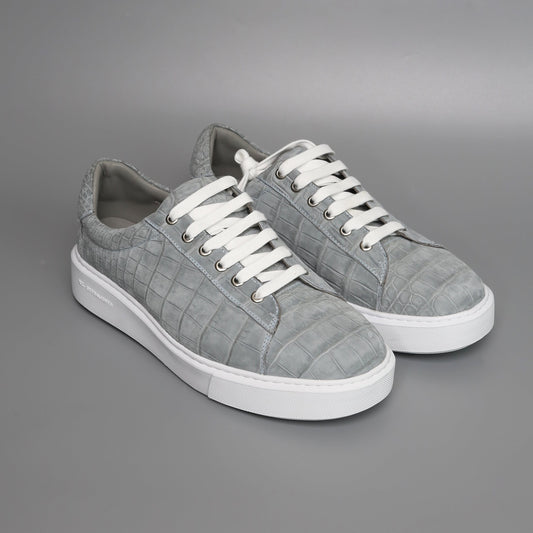
Crocodile belly leather comes from the smoother underside of the hide. Its scales are generally finer than the dorsal scales and show more variation in geometry across the usable area. A central belly panel may show broad, comparatively even scales, while sections nearer the sides become smaller and more irregular.
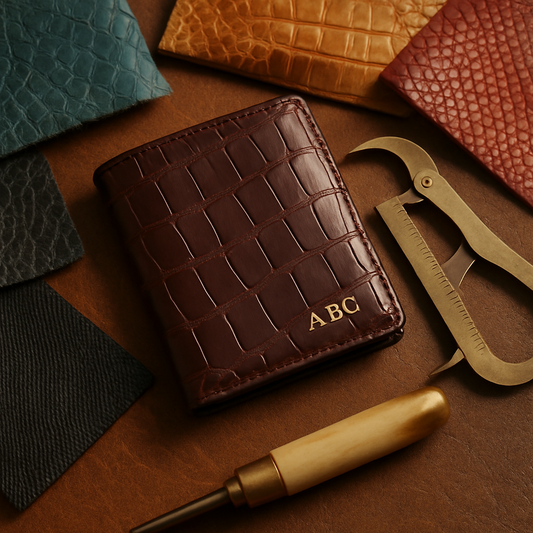
This variation gives a maker options during pattern layout. On a business wallet or document holder, a broad central panel can be positioned where the eye falls first, while smaller side scales may be used on narrower parts. On a belt, the useful question is whether the scale progression will look intentional along its visible length, especially near the buckle and adjustment holes.
Belly leather is often chosen for business accessories because it offers a flatter surface and a more controlled visual read than the raised back. That does not make every belly panel visually identical. Scale size, shape, pore visibility, and the amount of usable unmarked area still differ from hide to hide.
Hornback Crocodile Leather
Hornback crocodile leather refers to the dorsal or back section, where raised scales form the rugged ridge-like texture associated with crocodilian backs. It gives a business accessory more surface relief and a stronger visual contrast than belly leather.
Hornback works best where the design leaves room for the scale structure to be seen: a briefcase panel, a document case flap, or a controlled accent on a larger accessory. A narrow strap or small folded component may cut across the raised scales so frequently that the pattern becomes harder to read. This is why pattern planning matters: the hide section must suit the dimensions and bends of the component, rather than simply being selected for its dramatic appearance.
For conservative office settings, belly leather usually presents more quietly. Hornback can still work in business wear, particularly with plain clothing and an accessory shape that keeps the textured panel as the main visual element.
How to Assess Crocodile Leather Types for a Business Item
| Decision factor | What to inspect | Why it matters for business wear |
|---|---|---|
| Species | Ask whether the leather is saltwater crocodile or Nile crocodile. | Species identification supports accurate description and may affect trade documentation. |
| Hide section | Confirm whether the visible panel is belly or hornback. | Belly is smoother and more varied in scale geometry; hornback is raised and rugged. |
| Scale placement | Look at where the largest, most visually balanced scales fall on the item. | The front of a briefcase, belt centre, or shoe vamp should not look like an accidental offcut. |
| Usable panel area | Assess the uninterrupted area available for the pattern pieces. | Larger business accessories require more leather that can be cut without disrupting the scale field. |
| Pattern matching | Compare adjacent panels, paired pieces, and left-right components where applicable. | Matching affects visual continuity, particularly on shoes, bags, and structured cases. |
| Construction requirements | Consider folds, edge turns, reinforcement areas, and parts under repeated stress. | A visually striking section may be less suitable for a component that must bend tightly. |
What Sensory Pores Can—and Cannot—Tell You
Crocodile body scales often show small sensory pore dots, also called integumentary sensory organs or ISOs. These dots are a useful visual characteristic when comparing crocodile with alligator, although their visibility varies with the hide, finish, lighting, and scale location.
A sensory pore pattern should be treated as one identifying feature, not as stand-alone authentication. Species description, provenance, documentation where relevant, workmanship, and the full scale structure all contribute to a sound assessment.
For buyers comparing alligator vs crocodile leather, the difference matters aesthetically. Crocodile belly leather is typically finer and more varied in scale geometry. Alligator belly skin is generally smoother with a more regular, balanced scale pattern. Alligator body scales do not show the same visible sensory pores, and an alligator hide may display an umbilical scar that crocodile lacks.
Those traits help explain why the two materials should not be treated as interchangeable descriptions. A business buyer who wants a regular, balanced grid-like appearance may be drawn to alligator belly skin; a buyer seeking more variation in individual scale geometry may prefer crocodile belly leather. They are separate materials with separate species identities.
Visual Grade Is Not a Durability Rating
Terms such as “Grade 1,” “top grade,” or similar labels need context. Exotic-leather sorting often focuses on the cut, the visible pattern, the amount of usable area, and the consistency of the panels available for a particular design. There is no single public grading language that applies identically across every tannery or supplier.
For business wear, ask what the stated grade actually describes. It may refer to surface appearance, the placement of visible marks, pattern consistency, or the amount of usable hide—not a universal measure of how long the item will wear. Visual grade and durability describe different questions.
“Top grain” also deserves precise use. In leather terminology, it means the natural grain layer has not been cut away. It does not identify the species and does not establish that a skin is crocodile rather than another leather. A clear species statement and a clear explanation of the hide section are more useful than a broad marketing term.
Price: What Changes the Cost of a Crocodile Business Accessory
There is no responsible single price for crocodile business wear without specifying the item and leather. Cost is affected by the crocodile species, the hide’s visual grade as defined by the supplier or tannery, the usable area available for cutting, and the scale matching required across visible panels.
Construction also has a substantial effect. A large briefcase panel may require a broad uninterrupted section of belly leather, while a belt requires enough length for a coherent scale progression. Handwork can add cost where pattern pieces must be individually positioned, paired, edge-finished, or assembled around the natural direction of the scales. Hardware, lining, internal structure, and the complexity of folded components also change the final amount.
A lower price can reflect a smaller usable panel, less demanding scale placement, simpler construction, or a different species and source. It does not provide enough information by itself to judge the leather type or its suitability for office use.
Fit, Size, and Proportion for Business Wear
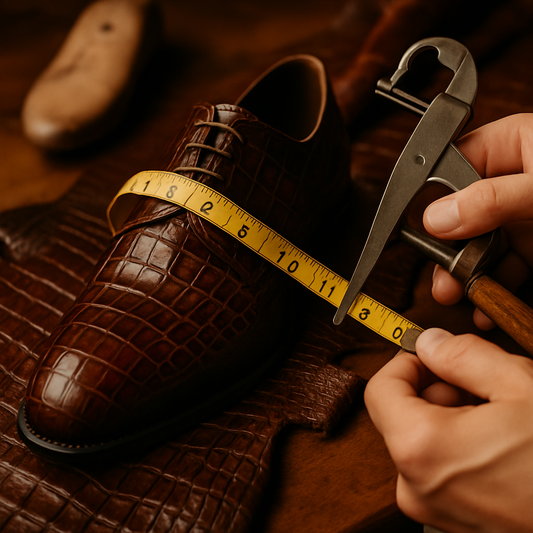
For belts and shoes, fit should be evaluated alongside the leather section. A belt that is too narrow may fragment a large-scale belly pattern; a wider belt gives more room for the scale geometry but should still suit the trouser loops and office dress code. Measure the belt from the buckle fold to the hole normally used, rather than relying only on a marked size.
For footwear, length, width, instep volume, and the sizing system all matter. EU, US, and UK sizes do not convert with complete consistency between makers. An in-person try-on and remotely supplied foot measurements or a foot tracing are equally useful starting points, especially for customers who cannot visit a workshop. Wide feet and high insteps need particular allowance because the upper must sit comfortably without placing unnecessary strain on the fitted shape.
For a briefcase or document holder, proportion is more relevant than body fit. Compare the internal width and height with the papers, laptop, charger, and folders actually carried to work. A well-sized case avoids forcing a structured crocodile panel to bulge around contents it was not designed to hold.
Care for Crocodile Belly and Hornback Surfaces
Use a dry, soft cloth as the normal cleaning method for crocodile leather. It removes ordinary surface dust without adding moisture to the scales or finish. If a mark requires more than dry wiping, use a barely damp cloth only as a last resort, work gently, and avoid soaking seams, folds, and edges.
Do not apply conditioner on a fixed calendar schedule. The appropriate product and frequency depend on the finish, the environment, how often the item is handled, and the maker’s care instructions. Before using any conditioner, ask for finish-specific guidance and test any recommended product in an inconspicuous area.
Store the item away from prolonged heat, direct sunlight, and sustained humidity. For hornback pieces, avoid pressing the raised scales against hard objects in storage. For belly pieces, avoid overfilling structured accessories, since repeated distortion can interrupt the intended flat scale presentation.
Documentation for Cross-Border Purchases
Crocodilian leather trade is regulated under CITES, but the requirements can differ by species and, in some cases, by population of origin. Two skins with a similar appearance may have different regulatory treatment depending on their species and source country.
If a crocodile leather business accessory will cross borders, ask about the paperwork required for the destination and shipment route before purchase. CITES documentation relates to regulated trade compliance and traceability; it should not be treated as a stand-alone statement about the visual authenticity or grade of the finished leather.
Choosing the Right Direction
Choose crocodile belly leather when the business piece needs a smoother surface, finer scales, and a scale layout that can be planned across broad visible panels. Choose hornback where a raised, rugged texture suits the design and there is enough panel space for the dorsal structure to read clearly.
For more leather education and current workshop notes, visit CrocodileViet’s journal. You can also contact CrocodileViet through WhatsApp to discuss species, hide section, measurements, and documentation needs before ordering.