
How to Choose Bespoke Crocodile Leather Shoes for Business Wear

공유
Choosing Bespoke Crocodile Leather Shoes for Business Wear
Bespoke crocodile leather shoes for business wear are usually best specified in central belly leather, the pattern area that offers the cleanest cutting field and the most visually balanced scales.
Business shoes ask more of crocodile leather than a casual statement piece. The hide must work across a pair of vamp panels, quarters, and toe shapes without distracting scars, abrupt scale changes, or mismatched left-to-right patterning. A successful commission is therefore not simply a matter of choosing “crocodile leather”; it depends on the species, the selected belly zone, the shoe last, the intended office setting, and how the cutter allocates the usable hide.
Start with the Business Setting and Shoe Format
Specify the occasions for the shoes before choosing a toe shape or finish. Crocodile has natural scale variation, so a restrained design often gives the leather room to read clearly without making the shoe feel out of place in a conservative workplace.
Conservative offices, client meetings, and formal presentations
- Closed-lace shoes with a clean vamp are usually the most reserved format.
- Dark brown, black, deep burgundy, or similarly low-contrast finishes tend to sit more quietly with dark tailoring.
- A medium or softly rounded toe can keep the scale pattern from looking compressed at the front of the shoe.
- Request a less reflective finish if most of your workwear is matte wool, flannel, or textured suiting.
Business-casual offices and hospitality work
- Open-lace shoes, loafers, and restrained slip-ons can work with tailored trousers, chinos, and unstructured jackets.
- Brown and mid-tone finishes show the contours of the scales more readily than very dark finishes.
- A slightly broader toe shape may provide more usable vamp area for a regular scale layout.
Travel, events, and evening business functions
- A darker shoe with a controlled shine can move between a dinner, reception, and formal work event.
- Choose a construction and sole arrangement suited to the amount of walking expected rather than selecting only by appearance.
- If luggage capacity is limited, a dark brown or near-black pair can coordinate with several suit colors without needing a highly decorative design.
Choose the Crocodile Leather Area, Not Only the Color
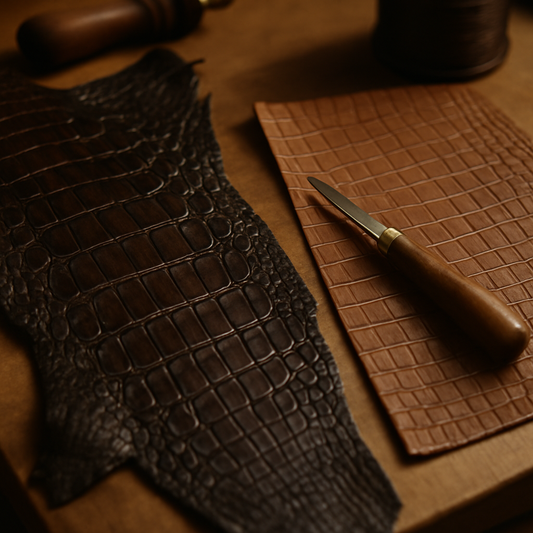
The belly, also called the pattern area, is generally the highest-value section of a crocodile hide for footwear because it provides the clearest and most visually consistent area for cutting. Within that area, the central belly commonly carries the greatest cutting value. It is not enough to ask for “belly leather”: the shoe design should determine which panels receive the most balanced sections.
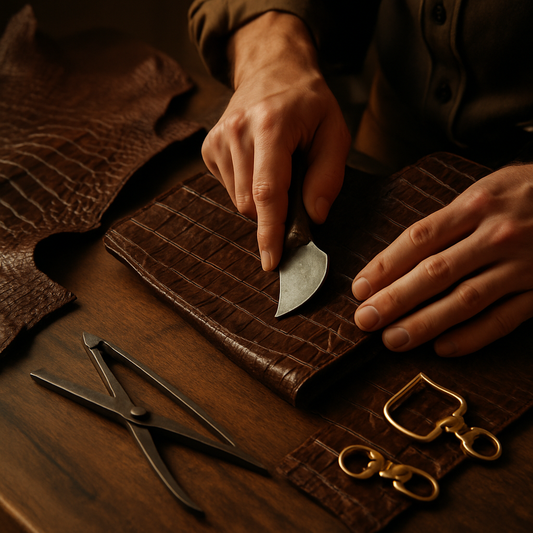
In our cutting planning, we reserve the cleaner, more balanced belly sections for the most visible shoe panels because the vamp is where uneven scale direction, marks, or poorly placed transitions are noticed first. Less central usable leather may suit smaller components where its variation will not interrupt the overall reading of the pair.
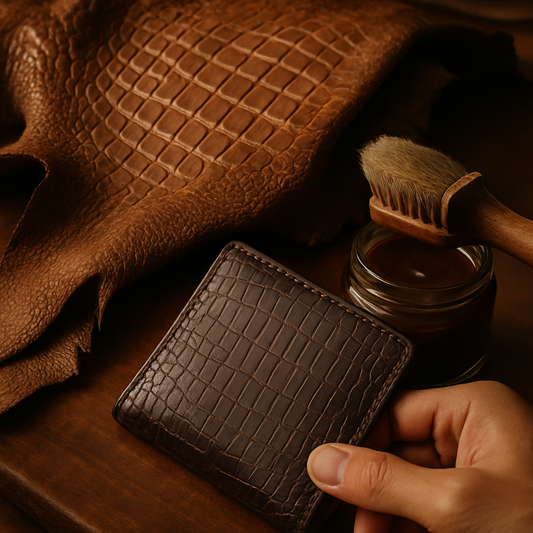
Crocodile scales vary by species and across a single hide. Many genuine crocodile skins show visible sensory pores, often as a small dot within a scale, but pores alone do not establish authenticity or determine leather grade. A business shoe should be judged as a complete pair: scale layout, cut placement, finishing, fit, and construction all matter.
Ask How the Pair Will Be Pattern-Matched
Pattern matching is one of the defining differences between a generic crocodile shoe and a properly planned bespoke commission. The left and right shoes do not need to be mirror images in every scale, which may not be feasible with a natural hide, but their visible panels should carry comparable scale size, direction, and visual weight.
| Decision factor | What to specify for business shoes | Why it matters |
|---|---|---|
| Vamp layout | Ask for a balanced central belly selection on both vamps. | The vamp is the broadest and most immediately visible area while standing or seated. |
| Left-right matching | Request comparable scale character across the pair rather than identical scales. | Natural hides vary, but comparable panels prevent one shoe from appearing substantially busier. |
| Toe shape | Match the last shape to the scale field available and to your foot shape. | A sharply narrow toe can crowd scales and may reduce the calm appearance sought for workwear. |
| Visible defects | Discuss scars, scratches, holes, cuts, scale slip, and blemishes before final hide allocation. | These are key factors in hide grading and in deciding which areas can be used on prominent panels. |
| Finish level | Choose matte, low-lustre, or higher shine according to your work wardrobe. | Finish changes how strongly scale contours and color variation appear under office lighting. |
Understand Grade Without Treating It as a Durability Score
Hide grades commonly reflect the number, location, and severity of visible defects, particularly in the critical belly area. Scars, cuts, holes, scratches, blemishes, and scale slip can reduce the amount of clean leather available for a shoe’s main panels. A higher visual grade can give the maker more flexibility for matching two vamps, but it does not automatically mean the finished shoe is more durable.
Grade labels are not universal. Suppliers and tanneries can use different terminology and thresholds, so ask what a stated grade means in practical terms: how much clean central belly is available, what defects are present, and whether the hide can support a visually comparable pair in your chosen size and design.
How Bespoke Crocodile Shoe Pricing Is Determined
A quoted price can vary substantially because the material cost is only one part of the work. Rather than relying on a broad label such as “quality,” ask which specific variables are shaping the quote.
- Species: Crocodile species differ in scale character, availability, and trade conditions, which can affect sourcing cost.
- Hide grade: A hide with a larger blemish-free belly area gives more options for visible shoe panels and pair matching.
- Usable area: A large hide is not necessarily efficient for a specific shoe size if its clean pattern area is limited or interrupted by defects.
- Scale matching: Allocating comparable sections to both shoes can require more of the hide than a less controlled layout.
- Construction: The selected shoe construction, sole arrangement, and complexity of the pattern influence labor and material use.
- Handwork: Hand cutting, leather selection, fitting adjustments, and finishing time affect the amount of skilled work required.
For international orders, ask about the relevant species documentation and permits before shipment. Crocodile leather is commonly subject to CITES-regulated trade requirements; those documents address lawful cross-border trade compliance, rather than serving as a standalone proof of product authenticity.
Get the Fit Right Before Final Cutting
Fit should lead the commission because crocodile leather is being cut for a specific last and pattern, not selected afterward as a replaceable upper. Provide your usual size only as a starting point. EU, US, and UK sizes use different systems, and a numerical conversion does not account for foot volume, width, or instep height.
In-person try-on and remote measurements are equally important routes for a bespoke order. An in-person fitting helps assess heel hold, toe room, forefoot width, and how the last follows your foot. For a remote order, supply measurements of both feet, taken while standing: overall length, the broadest forefoot width, ball girth, instep girth, heel circumference, and any relevant notes about high insteps, wide fit requirements, orthotics, or pressure points.
Measure both feet because they may differ. The larger foot should inform the starting size, while the smaller side may need an adjustment through the last, insole, or fitting approach. Also state the socks you expect to wear with business suits; thin dress socks and heavier socks change the space required inside the shoe.
Care for Crocodile Shoes Used During the Workweek
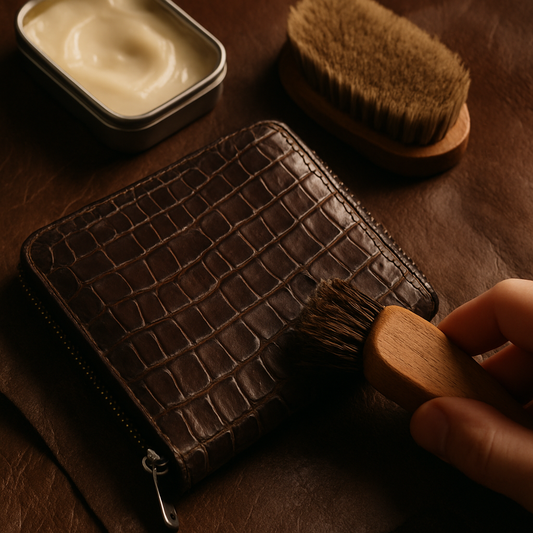
After wear, remove surface dust with a soft dry cloth and allow the shoes to air away from direct heat and strong sunlight. A dry cloth is the default care method because unnecessary moisture can affect the finish and collect around scale edges.
Use a lightly damp cloth only as a last resort for a localized mark, and avoid soaking the leather, aggressive rubbing, household cleaners, or heavy wax buildup. Test any leather-care product on an inconspicuous area first, since finishes can respond differently. Conditioning should be based on the leather’s actual dryness and the product instructions rather than a fixed calendar schedule.
Use shoe trees that support the shape without forcing the upper outward, particularly across the vamp where the crocodile pattern is most visible. Rotate pairs where practical, and keep the shoes away from radiators, hot cars, and prolonged rain exposure.
Questions to Settle Before Ordering
Which area of the hide will be used on the vamp?
Ask whether the vamps will be cut from central belly sections and how the maker plans to keep the pair visually comparable. This question is more useful than asking only for a high grade because it addresses the visible result on the finished shoes.
Can a business shoe use pronounced scale variation?
It can, depending on the office and the design. A quieter workplace may suit a more regular belly layout and a dark finish, while a creative or client-facing environment may accommodate greater variation. The key is to place the variation intentionally rather than allowing it to dominate the vamp.
How should a belt or watch strap be coordinated?
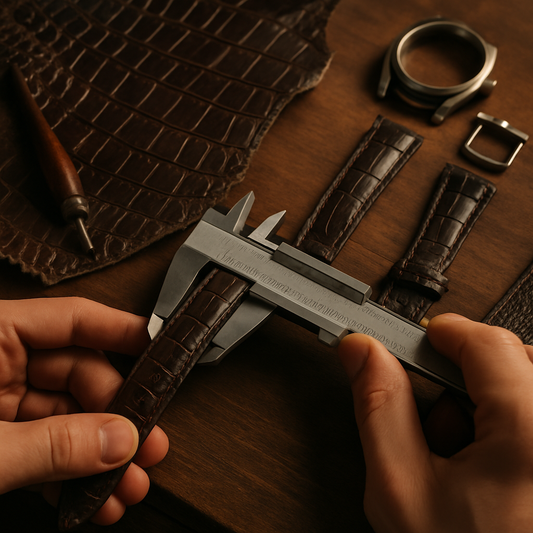
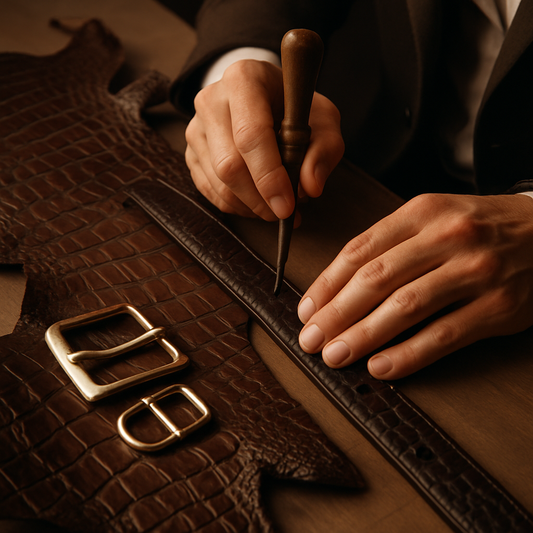
A custom crocodile belt can be selected in a related color family, but exact color and scale matching is not required. A custom alligator watch strap may be coordinated by overall tone, although it is a different material and should be judged on its own scale pattern and finish.
Commission with Clear Specifications
For bespoke crocodile leather shoes, bring together your business setting, preferred shoe format, foot measurements, desired finish, and expectations for belly-cut pattern matching. The more clearly these decisions are made before cutting, the easier it is to allocate the hide where its scale layout will serve the pair.
To discuss a custom commission, measurements, or material preferences, contact CrocodileViet. You may also reach out through WhatsApp with photos of your preferred business-shoe style and your sizing information.