
How Crocodile Leather Types Are Made: From Hide Selection to Hand Finishing

공유
How Crocodile Leather Types Are Made: From Hide Selection to Hand Finishing
Crocodile leather types are determined mainly by the species, the section of hide, the usable pattern area, and the way each selected panel is cut and finished.
What “crocodile leather types” means in practice
The phrase can describe several different distinctions. It may refer to the animal species, such as crocodile or alligator; the hide section, such as belly or hornback; the visible grade of the pattern area; or the finished product made from the leather.
These categories should not be mixed. Alligator, crocodile, and caiman are separate species groups, and their hides do not produce the same scale structure. A belly cut is also different from a hornback cut even when both come from a crocodilian hide. The hide section affects the surface, flexibility, scale arrangement, and the type of design that can be built from it.
In a workshop, the selection stage begins by identifying the material and then assessing which part of the hide can support the intended product. That matters because a small leather product needs a controlled section of usable skin, while a larger panel may require scale matching across more than one piece.
Species differences: crocodile, alligator, and caiman
Crocodile leather
Crocodile hides vary more noticeably by species. Many crocodile skins show visible sensory pores, often called integumentary sense organs or ISOs, along the scales. These pores are a characteristic feature of crocodilian skin, but one sensory feature by itself does not prove the identity or authenticity of a hide.
The scale arrangement can change across the belly, tail, neck, and flank. Some grading standards assess several of these areas, while others focus more narrowly on the central belly pattern. For that reason, a supplier’s description should state which section has been used rather than relying only on a general word such as “crocodile.”
Alligator leather
Alligator belly skin is known for a comparatively regular and balanced scale pattern. The central belly rows can create a calm, orderly surface that works well for products requiring repeated panels or a restrained visual layout.
Alligator often has an umbilical scar in the belly area, while crocodile generally lacks the same feature. That mark is one point used during identification, but it should be assessed together with species documentation, the overall scale structure, and the supplier’s records.
This is the practical difference in the alligator versus crocodile leather question: alligator belly skin often gives a more regular scale layout, while crocodile can show greater variation in pattern and visible pores. Neither description automatically indicates durability. Visual grade and durability are related to different assessments.
Caiman leather
Caiman is not a substitute term for crocodile. Caiman hornback leather has a more heavily armored, bony appearance because it comes from the back section with raised scutes. It produces a much more pronounced surface than a smoother belly cut.
If a product description uses “hornback crocodile leather,” ask whether the material is actually crocodile or another crocodilian species. Species-sensitive naming protects the buyer from comparing unlike materials under one label.
Belly leather and hornback leather: how the hide section changes the result
Belly cuts
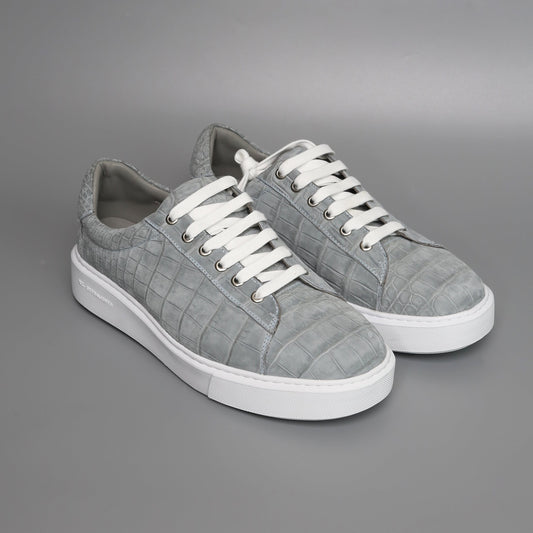
Belly skins are often selected for products that need a smoother surface and a more classic finish. The scales are flatter than the raised scutes on the back, making the material easier to use where a clean front panel is required. Whether a belly section is more valuable depends on factors such as species, grade, usable area, scale size, surface marks, and market demand.
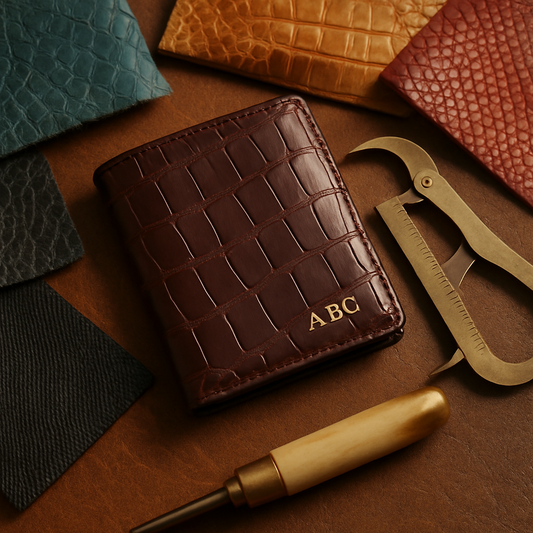
We use belly sections for designs that benefit from visual balance and scale control. The reason is practical: the central belly offers a more predictable arrangement, so the large visible face of a wallet, belt, bag panel, or similar item can be planned around the scale rows instead of being dominated by irregular raised armor.
A balanced pattern does not mean that every scale is identical. Natural variation, minor marks, and changes toward the tail or sides are part of the hide. The important question is whether those characteristics fall inside the visible pattern area and whether they suit the planned cut.
Hornback cuts
Hornback crocodile leather comes from the back and includes raised scutes. The surface is more textured and visually assertive, so it is selected for a different design purpose from belly leather.
In production, the scutes affect how a panel sits, folds, and joins with other materials. A maker must account for the raised structure when deciding where the hide can be cut and how the finished item will be handled. Hornback is not a lower version of belly leather; it is a different material direction with a different surface character.
How hide selection affects the finished type
After species and hide section are identified, the key working area is the pattern area: the part of the hide intended to appear on the finished product. Defects inside this area usually have a greater effect on grading than flaws outside it. A mark outside the visible cutting zone may be acceptable depending on the supplier, tannery, market, and product design.
We assess more than the label attached to a hide. The usable area, scale size, scale matching, surface marks, and the number of pieces needed for the design all affect the result. A hide with attractive scales but limited usable area may not suit a wide panel. A hide with a less regular outer section may still work when the design places that area under a fold or near an edge.
Grading labels are not universal. Suppliers and tanneries may use different tier names and different standards for judging defects, pattern area, belly coverage, tail, or neck sections. A stated grade should therefore be read as that seller’s or tannery’s classification, not as a single worldwide scale.
From selected hide to cut panels
Once a suitable section has been chosen, the pattern of the product determines which scales will be visible and where seams will fall. This is especially important for crocodilian leather because the scales form the identity of the surface. Cutting across a pattern without planning can leave one side visually heavier than the other.
For a front-facing item, we look for a panel whose scale rows support the shape of the design. For multiple panels, the scale direction and size need to be judged together. This does not mean forcing every piece into an identical arrangement; it means placing adjoining sections so that the change in scale does not distract from the construction.
Usable area also affects price. The cost is influenced by the species, hide grade, surface area that can actually be cut, scale matching, construction complexity, and the amount of handwork required. A larger hide is not automatically more valuable for a particular product if much of its surface cannot be used in the visible pattern.
What hand finishing contributes
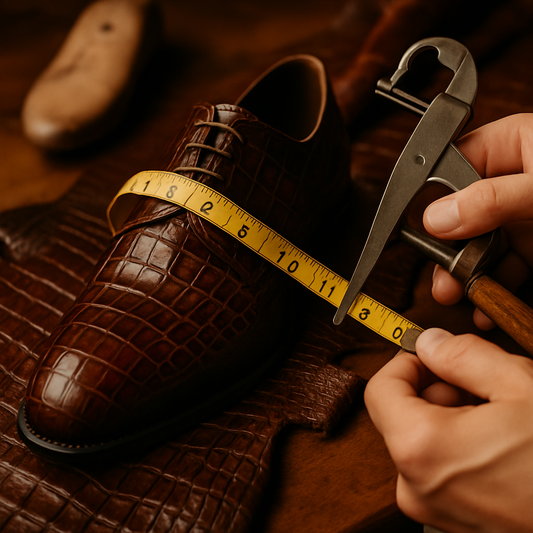
Hand finishing is the final stage in which the chosen leather and the construction are brought into a consistent finished form. Depending on the product, this can involve refining edges, checking joins, aligning panels, inspecting the visible scale layout, and completing small surface or hardware details.
During production, makers can assess the leather while it is being turned into the finished item rather than treating hide selection as a separate sales decision. That matters when a panel needs to be repositioned for better scale flow, when a seam would interrupt a prominent row, or when the selected section does not give enough usable width for the planned dimensions.
Handwork does not change the species or grade of the hide. It improves how the selected material is presented and assembled. It also cannot remove every natural mark. A buyer should expect the surface to retain the characteristics that distinguish real crocodilian leather from a printed or embossed pattern.
Choosing a type for a specific use
- For a regular front panel: alligator belly skin or a well-selected crocodile belly section can provide more controlled scale placement.
- For visible texture: hornback crocodile leather offers raised structure, so the scutes become part of the design rather than a surface irregularity to hide.
- For compact small leather products: prioritize the usable pattern area and scale size because a small template may show only a few central rows.
- For larger panels: ask how the maker will manage scale direction, joins, and changes between belly, tail, or side sections.
- For a restrained appearance: a balanced belly pattern is generally easier to plan than a heavily raised back section.
Care for crocodilian leather
Keep the surface away from prolonged moisture, strong heat, and rough contact with abrasive materials. For routine care, use a clean, dry cloth to remove dust. If a mark needs more than dry wiping, a lightly damp cloth can be used with restraint, followed by gentle air drying away from direct heat.
Do not apply a conditioning product simply because a fixed calendar date has arrived. The right approach depends on the finish, handling, climate, and the maker’s care instructions. Test any product on a concealed area or ask the workshop before applying it to visible scales, especially on hornback surfaces where the raised structure can hold residue.
Trade documents and authenticity
Crocodilian trade can involve CITES requirements, but the rules depend on the exact species, the countries involved, the shipment type, and the laws of the exporting, importing, and transit jurisdictions. Depending on the species and applicable national rules, international trade in Appendix-II reptile skins or products may require an export permit, a re-export certificate, or other documentation. Requirements should be confirmed with the relevant CITES management authorities before shipment.
CITES documentation concerns lawful trade compliance. It does not by itself prove that a piece is genuine, nor does a pore pattern, umbilical scar, or scale arrangement alone establish authenticity. For a purchase, ask for species information, material details, and any documentation relevant to the shipment and destination.
Questions to ask before ordering
- Which species is the leather, and is the description referring to crocodile, alligator, or caiman?
- Is the item made from belly, side, tail, neck, or hornback leather?
- Which part of the hide forms the visible pattern area?
- How are natural marks positioned in relation to the product template?
- Which grading terminology is being used, and whose standard defines it?
- What are the finished dimensions and construction details?
- What care method is recommended for the specific finish?
- Which trade documents apply to the species and destination?
To discuss crocodile leather types and available construction options, visit CrocodileViet. You can also contact us through WhatsApp for product questions.