
Alligator Vs Crocodile Leather: Style Guide for 2026–2027

공유
Alligator vs. Crocodile Leather: A Style Guide for 2026–2027
Alligator belly leather typically has a more regular, balanced scale layout and lacks the visible integumentary sensory organ pores commonly retained by true crocodile belly leather after tanning.
That distinction helps explain why alligator vs crocodile leather is not simply a question of which material looks more expensive. The species, hide area, scale arrangement, finishing, grade convention, and intended product all affect the final appearance and price.
This style guide focuses on how to compare the two leathers visually and practically for belts, wallets, watch straps, bags, footwear, and other leather goods. It also separates belly-cut leather from hornback crocodile leather, since these come from different parts of the hide and create very different design results.
Alligator vs crocodile leather at a glance
| Factor | Alligator leather | Crocodile leather |
|---|---|---|
| Common commercial reference | Often refers to American alligator, Alligator mississippiensis | May refer to several species, including saltwater crocodile and Nile crocodile |
| Belly scale layout | Often more regular and balanced across the central belly area | Varies by species and hide; saltwater crocodile may show a tight, regular grid, while Nile crocodile scales may be larger |
| ISO pores | Belly scales typically lack the visible pores found on true crocodile belly scales | Visible sensory pores are commonly retained on belly scales after tanning, although finishing can make them harder to assess |
| Umbilical area | Often shows an umbilical scar | Typically lacks the same umbilical scar feature associated with alligator |
| Typical style impression | Balanced, orderly, and relatively calm in a large central panel | Can range from neat and structured to more varied and visibly textured, depending on species and hide area |
| Grading | May be graded by belly defects, usable cutting area, and the supplier’s own system | Assessment also depends on defects, species, hide area, and the seller’s grading convention |
These are working tendencies rather than a substitute for examining a specific hide. Scale shape and regularity vary between animals, and a strongly polished or coated finish may reduce the visibility of pores, scars, and surface texture.
How the two leathers look in finished products
Alligator belly skin
Alligator belly skin is often selected for products that benefit from a controlled, even visual rhythm. The central scales commonly form a balanced pattern, which can suit a belt face, wallet exterior, watch strap, or a broad bag panel where the leather is displayed without heavy interruption.
The pattern is not necessarily made from perfectly rounded scales. Avoid treating scale shape as a species test by itself. The more useful visual impression is the regularity of the belly arrangement, assessed together with other features such as pores and the umbilical area.
On a finished item, alligator can work well with restrained hardware and clean panel layouts. A matte finish may emphasize the scale structure, while a high-shine finish can make the color appear deeper and the scale edges more pronounced. The finish changes the style substantially, so species alone does not determine whether an item looks formal or casual.
Crocodile leather types and visual variation
“Crocodile leather” covers more than one species. Saltwater crocodile, also called Crocodylus porosus, is often associated with a tight and regular belly grid. Nile crocodile, Crocodylus niloticus, may show larger scales and a different overall rhythm. Other crocodile species can produce further variation.
True crocodile belly scales commonly retain visible ISO pores. These small sensory openings are a useful identification clue, but they should be examined alongside the scale pattern, the hide area, and documentation. A pore pattern by itself does not prove authenticity, species, legality, or quality.
Crocodile may suit designs where a little more visual variation is welcome. On a compact wallet, the changing scale sizes can create a lively surface. On a wide belt or bag, the maker must position the hide so that the pattern supports the product rather than looking interrupted by uneven scale transitions.
Do not confuse crocodile with caiman
Caiman is a separate alligatorid, not another name for crocodile. Caiman flank scales are commonly described as more uneven in size and spacing than alligator scales, and the leather can have a different hand and visual character.
For that reason, a listing that uses “crocodile” loosely deserves clarification. Ask for the stated species, the part of the hide used, and the supplier’s documentation rather than relying on a broad appearance-based label.
Belly cut and hornback are different style directions
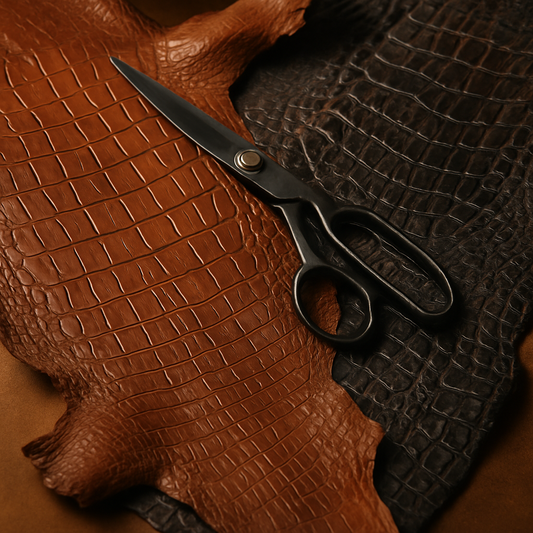
A belly cut uses the central belly area, where the scales tend to form the broadest and most orderly panel. This is the area most people have in mind when they picture a smooth crocodilian belt, wallet, watch strap, or bag exterior.
Hornback crocodile leather comes from the dorsal area and includes the raised back scutes. Those ridges create a pronounced texture and a more rugged profile. Hornback can work for belts, boots, bags, and statement panels where the raised structure is intended to remain visible.
Neither area is automatically better. Belly leather usually supports a cleaner, flatter design; hornback provides a stronger relief pattern. They should not be presented as interchangeable styles, because the scale structure, cutting approach, comfort, and visual effect differ.
How grade affects appearance and price
Grade is not a universal number system. Some suppliers grade alligator hides according to defects in the belly or midsection, while others use different rules for the head, tail, flank, and usable cutting area. Whether those sections count can vary by seller or tannery.
Typical defects include scars, scratches, holes, uneven shading, and scale deformities. A hide with fewer defects in its main cutting area may produce a larger uninterrupted panel and less waste. That can affect the price of a finished item because the maker may have more usable material and more flexibility when positioning the pattern.
Grade does not identify the species, confirm tanning quality, or predict durability on its own. A supplier’s “Grade 1” label has meaning only when the grading convention is explained. When comparing two products, ask what the stated grade measures and whether it refers to the full hide or only the belly section.
Price: what you are actually paying for
The price difference between alligator and crocodile goods comes from several factors rather than a single species label:
- Species and origin: Different crocodile species and alligator supply chains have different material costs and documentation requirements.
- Hide area: A central belly cut with a broad usable panel may cost more than a narrow flank section or a design using smaller pieces.
- Grade and usable area: Fewer central defects can reduce waste and make large uninterrupted panels possible.
- Product dimensions: A wide belt, large bag, or long strap consumes more leather than a card holder or small wallet.
- Construction: Lining, edge finishing, hardware, stitching, and the number of joined panels affect labor and material use.
- Finishing: Matte, glazed, polished, or color-treated surfaces may require different finishing work and create different visual results.
- Compliance and documentation: CITES controls apply to crocodilian leather, and requirements depend on species, origin, transaction, and shipment.
Ask for a product-specific explanation rather than assuming that a higher price proves a higher grade. At CrocodileViet, an in-house workshop can discuss the actual leather area and product construction behind a quotation, which is useful because those details connect the material cost to the finished design.
Choosing a style for work and formal clothing
For a quiet office accessory, a regular alligator belly panel can coordinate easily with plain tailoring, smooth calfskin shoes, and simple metal hardware. Black, deep brown, and dark burgundy often read as restrained because the color limits the contrast between individual scales.
Crocodile belly leather can also suit business wear, particularly when the pattern is tight and the finish is not overly reflective. A smaller item, such as a wallet or watch strap, lets the pores and scale variation provide texture without dominating the outfit.
Hornback works differently. Its raised scutes are more visible from a distance, so it may pair better with casual tailoring, denim, boots, or other clothing that can support a stronger surface texture. For formal settings, a narrow hornback detail may be easier to wear than a large hornback panel.
Fit and sizing for crocodilian leather goods
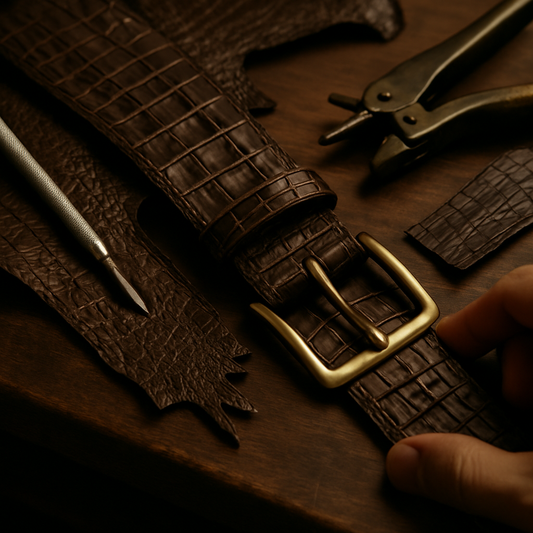
Material choice does not replace accurate measurements. For a belt, measure the distance from the buckle’s pin or attachment point to the hole you use most often, rather than measuring an old belt from end to end. Also record the desired belt width, since a wide belt may not pass through every trouser loop.
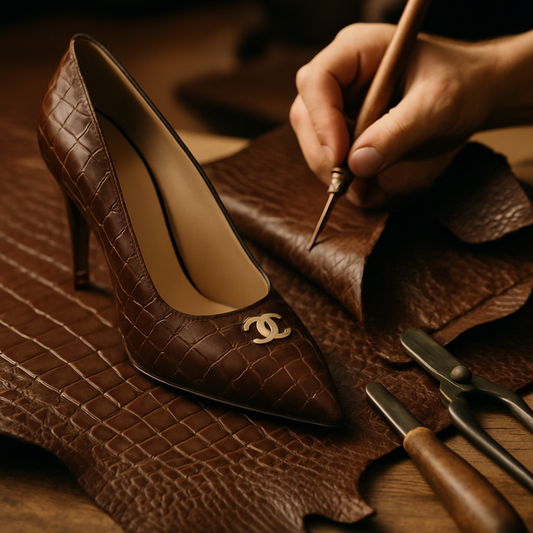
For footwear, provide the usual EU, US, or UK size together with foot length and the widest part of the foot. Width, instep height, and toe shape can affect fit more than the nominal size. A person with a high instep or wide fit may need a different last or an adjustable design.
For watch straps, measure lug width in millimeters, wrist circumference, buckle size, and the preferred short-side and long-side lengths. For remote orders, send measurements taken against the body or the item being replaced, along with photographs that show the measuring point. A workshop can then assess whether the requested length and width are practical before production begins.
Care for alligator and crocodile leather
Use a dry, soft cloth as the default cleaning method. Wipe away dust and skin oils with light pressure, especially around scale edges and near hardware. Keep the item away from prolonged moisture, strong heat, and direct sun, since these can affect the leather, finish, color, and adhesives.
If the leather becomes wet, blot it rather than rubbing it, then allow it to dry at room temperature. Avoid household oils, alcohol wipes, silicone sprays, and untested conditioners. Products intended for ordinary smooth leather may darken or soften crocodilian leather unpredictably.
There is no useful fixed care schedule for every item. Usage, climate, finish, and handling matter more than a calendar. If the surface becomes dry-looking, sticky, cloudy, or unusually dull, ask the maker or a specialist about a compatible product before applying anything.
How to check a listing before ordering
- Confirm whether the material is alligator, true crocodile, caiman, or another leather.
- Ask whether the item uses belly, flank, tail, or hornback leather.
- Request the supplier’s definition of grade rather than relying on a number alone.
- Check whether the stated color and finish apply to the actual item or only to a sample.
- Ask how the product dimensions are measured, including belt length or strap length.
- For international orders, confirm the relevant CITES and shipping documentation for the species, origin, and destination.
Regulatory paperwork matters, but CITES documentation should not be treated as proof of authenticity by itself. Species identification uses several features, including ISO-pit patterns, and legal requirements can differ according to the transaction and shipment.
For a broader material comparison, see Alligator Vs Crocodile Leather: Complete Guide for 2026–2027. If your priority is office dressing, How to Choose Crocodile Leather Types for Business Wear covers the style decision in that specific setting.
Frequently Asked Questions
How can I visually compare alligator and crocodile belly leather?
Look at several features together: alligator belly leather often has a more regular, balanced scale pattern and may show an umbilical scar, while true crocodile belly leather commonly retains visible ISO pores. Finishing can obscure details, so appearance alone should not serve as conclusive identification.
Is hornback crocodile leather the same as crocodile belly leather?
No. Belly leather comes from the central underside and generally creates a flatter, more orderly panel. Hornback comes from the dorsal area and includes raised back scutes, producing a stronger three-dimensional texture.
Does a higher leather grade guarantee a more durable product?
No single grade label guarantees durability. Grading often relates to defects and usable cutting area, while durability also depends on tanning, thickness, construction, edge treatment, hardware, and use.
What measurements should I send for a remote custom order?
For belts, send the preferred buckle-to-hole measurement and width. For footwear, include EU, US, or UK size, foot length, width, and instep information. For watch straps, provide lug width, wrist circumference, buckle size, and preferred strap lengths.
See CrocodileViet’s leather work
Browse the CrocodileViet workshop collection at CrocodileViet to compare available leather goods and material styles. For measurements or product questions, contact us through WhatsApp.