
Alligator Vs Crocodile Leather: Complete Guide for 2026–2027

Share
Alligator vs. Crocodile Leather: A Complete Guide for 2026–2027
Alligator leather usually refers to American alligator (Alligator mississippiensis), while crocodile leather most often refers to saltwater crocodile (Crocodylus porosus) or Nile crocodile (Crocodylus niloticus) in the luxury-leather trade.
Although the names are frequently used loosely in product listings, alligator and crocodile are different animals with distinct scale patterns, belly-panel characteristics, and visual markers. The species affects how a finished leather item looks, the amount of usable hide, and how makers select panels for a consistent front surface.
Alligator vs. Crocodile Leather at a Glance
| Decision factor | Alligator leather | Crocodile leather |
|---|---|---|
| Common trade species | Usually American alligator (Alligator mississippiensis) | Often saltwater crocodile (Crocodylus porosus) or Nile crocodile (Crocodylus niloticus) |
| Belly-scale appearance | Comparatively regular, broad rectangular or square scales | Often smaller scales with more variation in shape and texture |
| Center-of-scale sensory pores | Belly scales typically appear smooth at the center | Visible sensory pores or dots often appear near the center of scales |
| Umbilical marking | An umbilical scar may be visible on the belly panel | Crocodile belly panels generally do not show the same alligator umbilical scar |
| Pattern character | Orderly, broad geometry that suits a clean panel layout | More varied scale character, depending on species and hide section |
| Trade documentation | International trade is regulated under CITES Appendix II | Major trade species are also regulated under CITES Appendix II |
How Alligator Belly Skin Differs from Crocodile Belly Leather
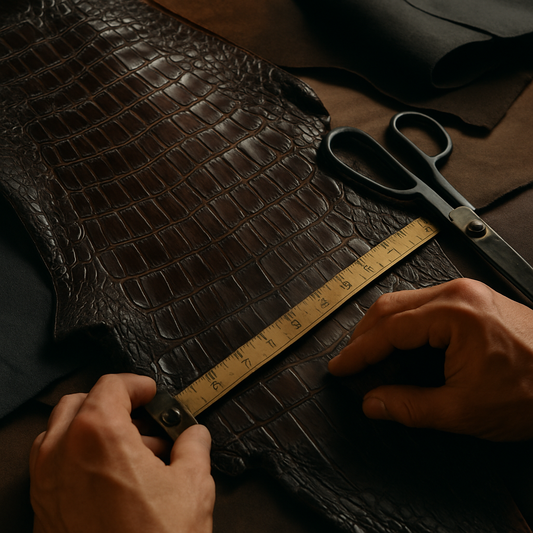
The belly is the main comparison point in alligator vs. crocodile leather because it is generally the most sought-after usable section of the hide. Belly scales lie flatter than raised back scales and provide a larger continuous panel for items where the front face needs a controlled pattern.
Alligator belly skin is known for a comparatively regular scale arrangement. Its scales commonly form broad rectangles or squares, with a more orderly progression. This allows for more precise placement of scales on visible parts of a product.
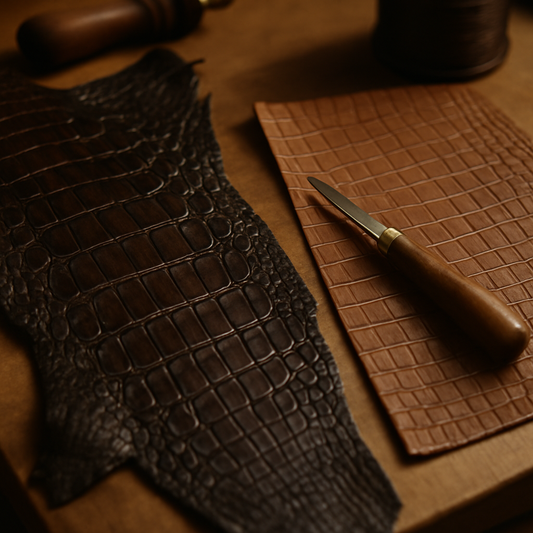
Crocodile belly leather can look more varied. Depending on whether the hide is from saltwater crocodile or Nile crocodile, the scales may appear smaller, more irregular in outline, or more sharply defined at their edges. This variation is a species and hide-character difference that should be assessed in relation to the product design.
For example, a bag flap with a wide uninterrupted face may benefit from an alligator belly panel with a regular scale field. A smaller accessory may suit crocodile leather if its design uses the scale variation as part of the visible character. The choice is not about one material being universally better; it is about whether the scale layout supports the intended panel size and construction.
Sensory Pores: A Useful Clue, Not a Standalone Test
A commonly discussed difference is the small sensory pore, also called an integumentary sensory organ or ISO. Crocodile leather often shows a visible dot near the center of individual belly scales. On finished leather, these dots may be easier to see under angled light or in close photographs.
Alligator belly scales usually look smoother in the center and typically do not show the same visible pore pattern. This is one reason alligator belly panels can appear cleaner and more regular from a distance.
However, a sensory pore alone should not be treated as conclusive proof of authenticity or species. Finishing, dye depth, glazing, photography, wear, and the particular hide section can alter what is visible. The soundest assessment combines several observations: species labeling, scale shape, pore pattern, panel layout, and the seller’s documentation.
The Umbilical Scar on Alligator Leather
Another marker associated with alligator belly skin is the umbilical scar. It can appear as a distinct irregular area within the belly scale field. In a product that uses a large central panel, the placement of this scar can materially change the visual result.
Some buyers prefer a panel without a visible scar on the front. Others value it as a recognizable part of alligator hide character. Neither preference defines the durability of the leather. It is primarily a visual and layout decision.
Crocodile belly leather does not generally present the same umbilical scar feature. This can make a crocodile belly panel appear more continuous in the center, even though its individual scales may show more species-related variation than alligator scales.
What “Grade” Means for Alligator and Crocodile Leather
In commercial leather grading, the belly panel usually carries the most weight because it is the highest-value usable area. A hide is commonly assessed for scars, scratches, holes, healed marks, irregular scale areas, and other visual interruptions within that panel.
Many suppliers use a Grade 1 through Grade 5 convention, where Grade 1 commonly refers to the cleanest belly area and higher numbers indicate progressively more visible defects or irregularities. That convention is useful as a broad reference, but it is not a universal standard. Some tanneries use Grade I through Grade III, while others describe hide quadrants or use labels such as 1/2, 2/3, or 3/4.
For that reason, the grade name on its own does not tell the full story. A buyer should ask which area was graded, what counts as a defect under that supplier’s system, and whether the intended product panel comes from the clean portion of the hide.
Visual grade should also not be confused with durability. A cleaner belly panel may command a higher price because it offers better pattern presentation and fewer visible marks in a large display area. It does not automatically mean that a lower visual grade is structurally weak. The practical question is whether the marks fall within the part of the hide that will be visible on the finished item.
Where Hornback Crocodile Leather Fits In
Hornback crocodile leather refers to the dorsal, or back, section of the hide, where raised osteoderms and pronounced ridges create a much stronger relief than the belly. It is visually different from crocodile belly leather and should not be judged by belly-panel standards alone.
Because hornback crocodile leather has a raised surface, it changes how a product reads at close range and how much of the texture can be used on a flat panel. A maker planning a hornback-facing design needs to account for the ridge direction and the limited area that can be placed cleanly on the product. Belly leather is generally selected where flatter scale presentation and a broader continuous panel are needed; hornback is selected for its raised texture.
Comparing alligator belly skin directly with hornback crocodile leather can therefore be misleading. The first comparison should be belly to belly if scale regularity, pores, and front-panel layout are the main concerns.
Why Alligator and Crocodile Leather Prices Differ
The cost of a finished piece can change significantly according to the exact species, the visual grade of the usable hide area, and the amount of clean leather available for the required panel.
- Species: American alligator, saltwater crocodile, and Nile crocodile have different scale structures and supply channels.
- Hide grade: Cleaner usable belly sections generally have greater value because fewer marks interrupt visible product panels.
- Usable area: A hide may be large overall but have limited clean belly area suitable for a broad front panel.
- Scale matching: Pairing two sides of footwear, matching bag panels, or centering scales on a wallet requires more selective cutting.
- Construction: The number of panels, edge finishing, lining, reinforcement, and hardware affect the finished item’s cost.
- Handwork: Work that requires controlled panel placement, seam alignment, and detailed edge treatment adds labor beyond the raw hide price.
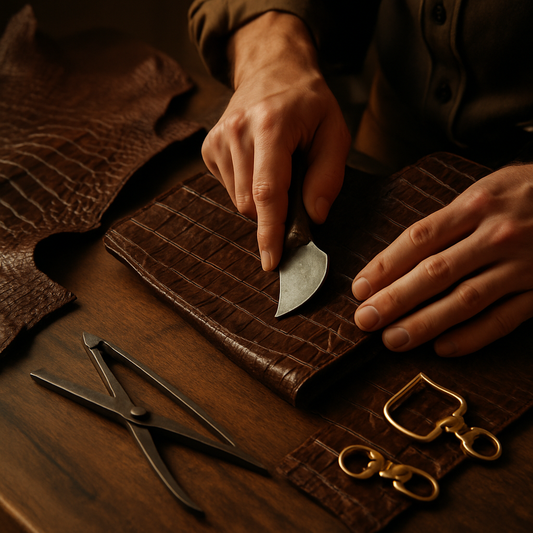
For a workshop, panel planning matters because a visually clean hide can still be unsuitable for a particular pattern if its best scales do not fall where the design needs them. A wide front panel, for instance, requires both enough usable area and an appropriate scale field; simply selecting a high visual grade does not solve a scale-placement problem.
Choosing Between Alligator and Crocodile for Different Styles
Business and formal settings
Alligator belly leather suits designs that benefit from a regular scale rhythm: restrained briefcases, slim wallets, formal footwear, and watch straps with a clean central layout. The broader scales can read clearly without requiring a heavily textured surface.
Crocodile belly leather can work well in the same settings, especially where the design benefits from more active scale variation. Darker finishing can reduce the visual contrast of individual scales, while lighter or more transparent finishing can make the species character easier to see.
Casual and textured designs
Crocodile leather is often chosen where visible pores, more varied scale shapes, or hornback relief are central to the design. Small accessories, compact bags, and pieces with a deliberately textured front can use this character without needing a large uninterrupted belly panel.
Large display panels
For a large bag front or other broad visible surface, inspect the actual panel layout rather than relying only on the species name. Look at the scale size, symmetry, scars, central marks, and the point where seams will cut through the scale field. This is more useful than assuming either alligator or crocodile will produce the same result on every pattern.
Care for Alligator and Crocodile Leather
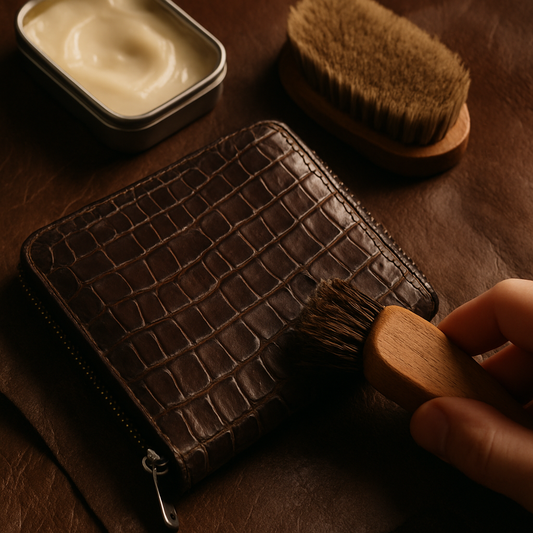
Dry dusting with a soft cloth is the safest default for both alligator and crocodile leather. Wipe lightly along the surface rather than pressing hard into scale edges or raised hornback areas.
Use a barely damp cloth only when dry wiping is not enough, and keep moisture away from seams, edges, linings, and unfinished leather areas. Do not soak the leather, use household cleaners, or apply an untested conditioner over the surface. Finishes vary, and a product that works on one leather may darken, streak, or change the sheen of another.
If the item receives a stain, deep scratch, or noticeable finish change, a leather specialist should assess it before treatment. This is especially important for dyed exotic leather, where home repair can alter color consistency across the scales.
Species Names and CITES Documentation
Accurate naming matters. “Alligator” and “crocodile” should not be used as interchangeable descriptions, particularly where a buyer is comparing scale character or sourcing documentation. The product description should identify the species as precisely as possible.
American alligator and major crocodile species used in trade are regulated under CITES Appendix II. CITES documentation concerns regulated international trade; it should not be presented as a standalone authenticity test. Species-specific labeling, credible sales records, material inspection, and applicable trade documentation together provide a more reliable basis for assessment.
Final Comparison
Choose alligator leather when the appeal lies in comparatively regular belly scales, a broad orderly panel, and the possibility of an alligator umbilical scar as part of the hide’s visible character. Choose crocodile leather when you prefer more varied belly scales, commonly visible sensory pores, or the raised surface of hornback crocodile leather.
The most useful comparison is not simply alligator versus crocodile. It is the exact species, hide section, visual grade system, usable panel area, and the way those factors are placed in the finished design.
For more material notes and product-leather education, visit CrocodileViet’s leather journal.