
7 Things to Check Before You Buy Alligator Mules For Men Online

공유
7 Things to Check Before Buying Alligator Mules for Men Online
The first check is species: in trade usage, “alligator” usually means American alligator (Alligator mississippiensis), which is different from crocodile and caiman. That distinction affects the scale pattern, surface details, product description, and sourcing information you should expect from an online listing.
1. Confirm that the leather is actually alligator
Online sellers sometimes use broad phrases such as “exotic leather” or “reptile leather” without identifying the animal. For alligator mules for men, look for the species name rather than relying on a photograph alone. A clear description should identify alligator leather and, where relevant, state that the material is American alligator.
Alligator belly skin usually has a regular, balanced scale arrangement. It also commonly shows a relatively rapid transition from larger belly scales to smaller flank scales. Crocodile skin tends to transition more gradually and often shows visible sensory pores, known in the trade as integumentary sensory organs, or ISOs, on the scales. These visual clues help you ask better questions, but one feature by itself does not prove authenticity.
Crocodile leather mules are a different material category, not an interchangeable name for alligator mules. If the listing uses both terms, ask the seller to clarify the species, hide section, and documentation before paying.
2. Check which part of the hide forms the upper
The cut of the hide has a direct effect on the appearance and feel of a mule. Belly leather is usually the preferred section for dress-oriented footwear because it is softer, flatter, and more regular than hornback or back leather. The scale layout is also easier to control across a pair of uppers.
Hornback refers to the raised dorsal strip along the spine. It has thicker, more pronounced scales and usually produces a rugged surface rather than the flatter appearance associated with belly-cut mules. A seller should identify whether the upper uses belly, flank, hornback, or a combination of sections.
At CrocodileViet, we favor a belly-focused layout for designs where the customer expects an even scale rhythm across the vamp. That placement gives us better control over the visible pattern and helps the leather sit flatter over the front of the foot. It also lets us match the left and right uppers more closely than a random section of hide would allow.
Ask for clear photographs of both mules, including the vamp, side panels, opening, and heel area. The pair should be assessed together rather than from a single close-up of the best-looking section.
3. Ask how the hide grade is defined
Hide grade is not the same as durability. Grading commonly focuses on defects in the belly or midsection, such as scars, marks, uneven areas, or other surface interruptions. It describes the visible and usable condition of that section; it does not automatically tell you how long the finished mule will serve.
Some suppliers use a five-level system in which Grade 1 represents a belly section with no visible defects and lower grades contain progressively more defects. Other sellers use a three-level system or their own letter-based scale. Because the labels vary, ask:
- Which grading system is being used?
- Does the grade refer to the whole hide or only the section used for the mules?
- Are natural marks shown in the product photographs?
- Will the pair in the photographs be the pair supplied?
For online purchases, the written grade should be supported by close, unedited images. A high grade can improve visual consistency, but construction, fit, sole materials, and daily use still affect how the finished footwear performs.
4. Inspect construction details, not only the scale pattern
A striking scale pattern cannot compensate for an unsuitable foot opening, weak attachment, or poor shape. Examine the upper edge, vamp, side seams, insole, outsole, and heel from the listing photographs. The product description should explain how the mule is assembled without using vague claims about workmanship.
Concrete construction questions include:
- How are the upper edges finished?
- Are the seams visible, and where are they positioned?
- What material forms the lining and insole?
- What is the outsole material and tread pattern?
- Is the footbed structured or soft?
- How much of the alligator is visible on the upper?
Handwork can affect the price and the appearance of a pair, but “handmade” does not describe every part of construction by itself. Ask which operations involve handwork and why that work is used. At our workshop, the important comparison is how the finished upper sits on the last, how the scale layout is controlled across both mules, and whether the opening remains clean after assembly.
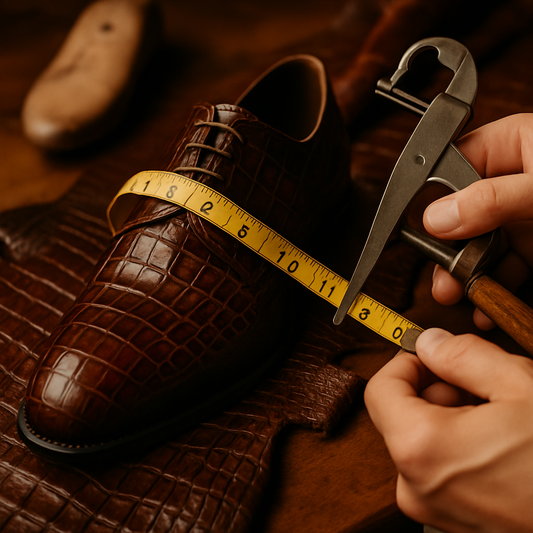
5. Verify the size using length, width, and instep measurements
Mules can feel different from enclosed footwear because the heel is open and the foot depends on the vamp and opening for support. Do not choose a size from the length number alone. Check the seller’s size chart in EU, US, and UK sizing, then compare it with your foot length and width.
Measure both feet while standing, wearing the type of socks you expect to use. Record the longer foot, then ask for the internal length of the mule if that measurement is available. Width matters just as much as length for a broad forefoot, and the instep matters when the vamp sits high or has a firm opening.
For a wide fit, ask whether the last is narrow, regular, or broad through the toe area. Also ask whether the upper can accommodate a high instep without forcing the foot forward. A mule that is too short may let the heel hang over the edge; one that is too loose may allow the foot to slide during walking.
Remote measurement should have the same importance as an in-person try-on. If you cannot try the pair on, send the seller your foot length, widest width, instep measurement, and usual EU, US, or UK size. Compare those numbers with the actual product measurements rather than relying on a general statement that the mules “fit true to size.”
6. Evaluate the price through specific cost factors
There is no reliable price benchmark based on the word “alligator” alone. The cost of alligator mules for men can reflect the species, hide grade, usable area, scale matching, construction, handwork, lining, outsole, and the amount of leather visible on each upper.
Species affects the starting material. Hide grade affects how much of the belly section can be used without visible defects. Usable area matters because a large, clean section may be needed to cut a balanced pair rather than two uppers with unrelated scale layouts. Scale matching can require more material and more sorting, while complicated patterns or additional seams can increase construction time.
Ask for a price breakdown in plain terms:
- Which species and hide section are included?
- Does the price cover a matched pair?
- Is the listed grade based on the visible upper?
- What construction and sole materials are included?
- Are taxes, delivery, or size adjustments separate?
- Is the photographed pair the pair you will receive?
Regulatory information also matters. Alligator and crocodile are controlled exotic materials, so the seller should describe species-specific sourcing and trade compliance accurately. CITES documentation, where applicable, relates to lawful trade compliance; it is not, by itself, proof that a particular photograph or pair is authentic.
7. Plan care and styling before placing the order
Care for alligator mules
For normal surface dust, start with a dry, soft cloth. Wipe lightly along the leather rather than scrubbing across the scales. If a mark requires more than dry cleaning, use a barely damp cloth as a last resort, then let the mules dry naturally away from direct heat.
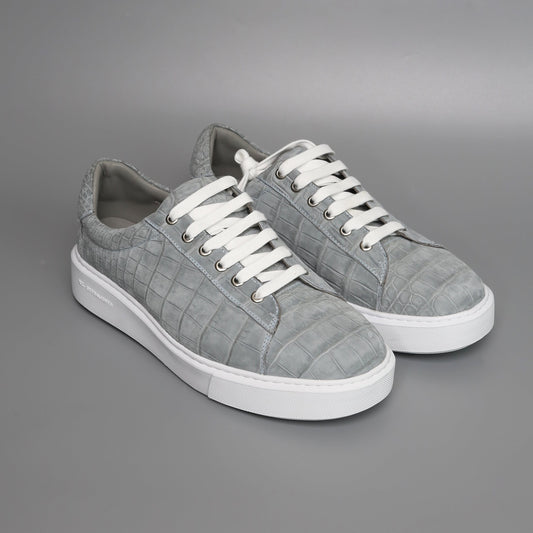
Do not apply an unverified conditioner, wax, alcohol-based cleaner, or household polish to nubuck alligator mules. Nubuck has a matte, brushed surface, so a product intended for smooth leather may change the finish or leave uneven patches. Ask the workshop or seller which care product suits the specific finish before applying anything.
There is no useful fixed conditioning schedule for every pair. Care depends on the finish, climate, frequency of wear, exposure to moisture, and storage conditions. Store the mules in a dry, ventilated place and avoid compressing the upper under heavier footwear.
Styling alligator mules for men
- Office settings: Pair a dark brown or black pair with tailored trousers, a fine-gauge knit, and a simple belt with a restrained texture.
- Warm-weather tailoring: A natural tan or lighter brown pair can work with cream, stone, olive, or navy trousers and an untucked linen or cotton shirt.
- Smart casual evenings: Use the mules with dark denim or clean-cut trousers, a plain shirt, and an unpatterned overshirt so the scale pattern remains the main texture.
- Relaxed travel: Choose trousers with enough hem width to fall cleanly over the vamp, and check that the mule remains secure when walking rather than relying on a loose fit.
Men searching for luxury slip-on loafers may encounter mules described with similar language, but the open heel changes both fit and styling. Judge the footwear as a mule: the vamp, instep, foot length, and walking security matter more than a label used for search visibility.
For a pair made with a natural tan nubuck alligator upper, review the material, measurements, construction details, and available photographs on CrocodileViet’s product page. You can also contact CrocodileViet through WhatsApp to discuss species, measurements, hide section, and care before ordering.