
What Makes Luxury Crocodile Dress Shoes Worth Buying? Quality, Craft and Longevity — Part 2

シェア
What Makes Luxury Crocodile Dress Shoes Worth Buying? Quality, Craftsmanship, and Longevity — Part 2
Luxury crocodile dress shoes tend to justify their price when the hide, shoe construction, fit, finishing, and aftercare work together rather than relying on the leather name alone.
What “luxury” should mean in crocodile dress shoes
Luxury crocodile dress shoes are not defined by a reptile pattern alone. The material should be correctly identified as crocodile, the usable belly area should be assessed honestly, and the leather should suit the shoe’s intended shape and level of formality.
“Crocodile” should not be used as a general label for every reptile hide. Caiman is a separate material and may show bony deposits, crinkling, or uneven dye absorption. Alligator is also distinct from true crocodile. Species matters because the scale structure, surface features, and usable areas can differ substantially.
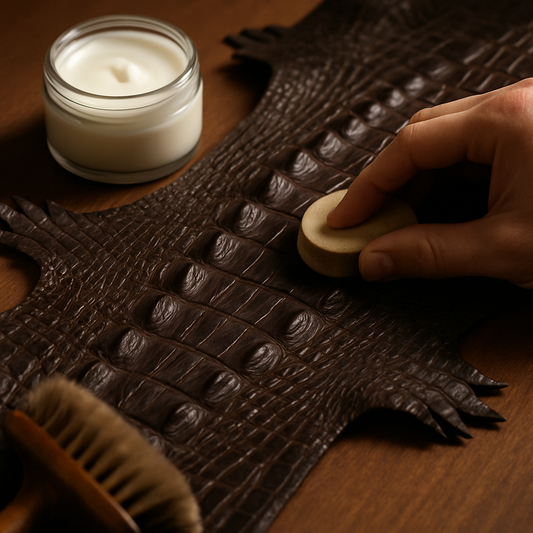
Belly leather refers to the flatter ventral hide commonly selected for refined goods. Hornback is the ridged dorsal portion, not a higher or lower grade of belly leather. A buyer comparing dress shoes should therefore ask which species and which hide section were used before comparing appearance or price.
How to assess the leather
Scale layout and usable area
On alligator belly leather, the scale pattern is comparatively regular and balanced. Crocodile belly leather can vary more by species and individual hide, so rows may show more variation from one pair to another. Neither pattern automatically proves better quality; the question is whether the scale layout suits the shoe panel and has been placed attractively across both shoes.
For a formal pair, the front quarters and vamp usually receive the most visual attention. A workshop assessing a hide for this use needs to look beyond a small attractive section and consider how much usable leather is available for the complete pair. A large uninterrupted area can reduce the need for awkward joins, while scars or irregular sections may affect panel placement.
Surface features and species identification
Visible sensory pores, often called integumentary sensory organs or ISOs, may appear on crocodile scales. An alligator often has an umbilical scar, while crocodile generally lacks that feature. These details can help with identification, but one surface trait should not be treated as conclusive proof of authenticity or species.
Documentation and a seller’s material description remain important. CITES regulates international trade in crocodilians, and the applicable permissions depend on the species and population. Buyers should check provenance paperwork and trade documentation rather than assume that every crocodile product can be freely shipped across borders. A finished shoe may not retain a visible skin tag, since non-reusable tags are associated with skins entering international trade.
Why craft and construction affect service life
A high-quality hide does not, by itself, guarantee a long-lasting shoe. The leather must be supported by a construction method suited to the design, a stable upper, sound attachment of the sole, accurate lasting, and finishing that does not obscure the scale texture or leave the surface excessively dry.
Fit is part of durability. A shoe that pinches the forefoot can place repeated stress on the upper. A shoe that is too loose may crease heavily as the foot moves inside it. With crocodile leather, these stresses matter because the scale pattern and skin structure do not behave like ordinary calf leather in every area.
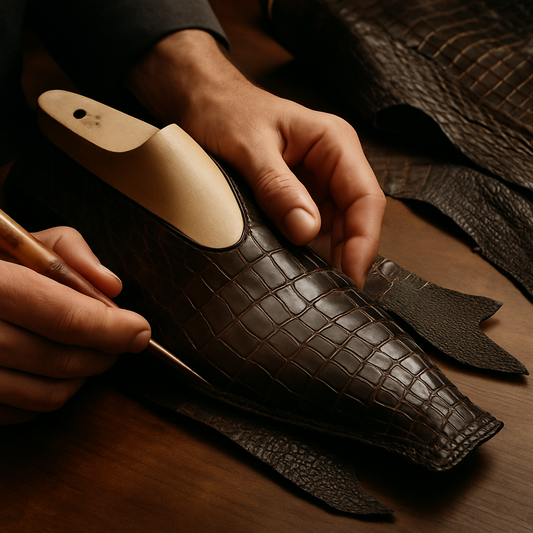
In our own in-house manufacturing work, hide assessment and shoe design need to be considered together. This matters because a panel that looks attractive on a flat hide may not sit correctly once shaped over a last. Matching the available scale layout to the shoe’s pattern helps reduce visual imbalance and avoids forcing unsuitable sections into prominent areas.
Finishing also affects the result. Color should sit evenly enough to support the scale pattern, while the surface should retain a controlled texture rather than looking heavily coated. Minor variation can occur in genuine reptile leather, so a completely artificial-looking regularity is not a reliable sign of better workmanship.
Price: what you are actually paying for
The price of luxury crocodile leather shoes is shaped by several concrete factors:
- Species and hide section: True crocodile, alligator, and caiman are not interchangeable materials. Belly leather usually carries different selection considerations from hornback leather.
- Usable hide area: A pair requiring broad, well-positioned panels may consume more suitable leather than a design using smaller sections.
- Scale arrangement: The amount of matching and panel planning affects cutting time and material efficiency.
- Construction: The upper, lining, insole, sole, heel, and attachment method all contribute to cost beyond the hide itself.
- Finishing work: Dye consistency, edge treatment, polishing, and final inspection require labor and can vary between workshops.
- Fit service: Remote measurement support or adjustments may involve additional work because small sizing errors can affect comfort and creasing.
- Documentation and sourcing: Responsible legal sourcing may require species and trade records, particularly for international orders.
There is no single universal crocodile-hide grading scale used consistently across every supplier or tannery. A label such as “top grade” has meaning only when the seller explains its criteria. Ask whether the grade refers to scale regularity, scars, color consistency, usable area, or another internal standard.
For a practical comparison of business footwear requirements, see How to Choose Genuine Crocodile Shoes For Men for Business Wear.
Fit and sizing for crocodile dress shoes
Start with foot length and width, then check volume over the instep. EU, US, and UK sizes are not identical systems, and a nominal size can fit differently depending on the last. A buyer should ask for the maker’s own size chart instead of converting from a familiar size without checking measurements.
Measure both feet while standing, preferably at the end of the day. Record heel-to-longest-toe length, the widest forefoot measurement, and the circumference around the instep if the shoe has a closed vamp. The larger foot usually determines the working size.
Wide feet may require a broader last rather than simply buying a longer shoe. Increasing length to gain width can leave excess space in front of the toes and encourage unwanted foot movement. A high instep can also require more volume through the upper, particularly in lace-up or slip-on styles with a structured vamp.
For remote orders, send measurements in centimeters together with the foot outline and details about existing fit problems. A workshop can use this information to recommend a last, but remote measurement cannot reproduce a physical fitting session. Mention bunions, unequal foot length, orthotics, high instep, or a preference for thicker socks before production or final selection.
Care that supports longer use
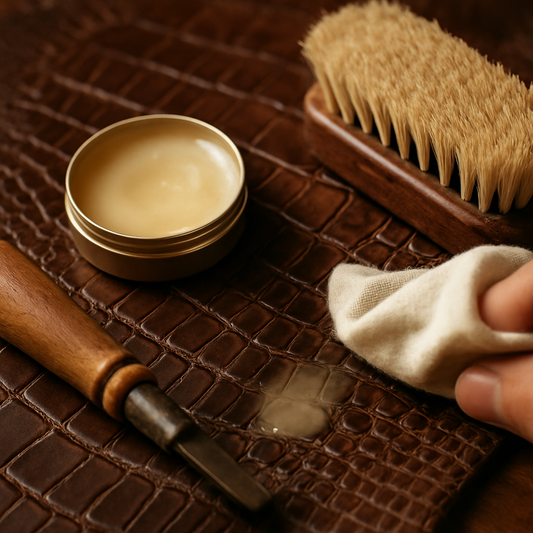
After wearing crocodile leather shoes, remove surface dust with a clean, dry cloth. This is the safest default for ordinary maintenance because it avoids adding moisture or an unsuitable product to the scale surface.
- Allow shoes to air naturally after wear and keep them away from direct heat, radiators, and strong sunlight.
- Use shoe trees that support the shape without stretching the upper aggressively.
- Rotate pairs so each pair has time to air between wears.
- Do not apply household oils, alcohol, waxes, or generic leather creams without confirming that they are suitable for crocodile leather.
- Blot water promptly with a dry cloth rather than rubbing the scales.
- For heavy staining, cracking, or dull patches, ask a specialist before attempting treatment.
There is no useful fixed care schedule for every owner. Climate, frequency of wear, perspiration, storage, and exposure to rain all change the maintenance needs. A dry cloth after use and periodic condition checks are more reliable than applying products on an automatic timetable.
Styling luxury crocodile dress shoes
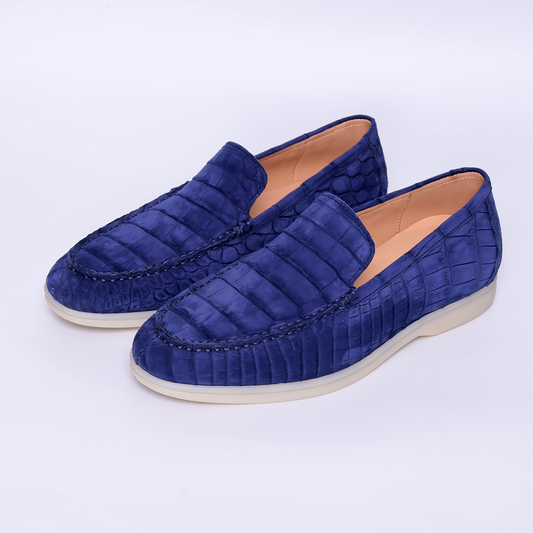
Dark crocodile shoes work naturally with navy, charcoal, and medium-gray tailoring. A brown or cognac pair can coordinate with navy, tan, cream, and earthy separates, provided the belt and other leather accessories are close enough in color to look intentional rather than identical.
For business settings, a restrained silhouette and moderate scale pattern usually work more easily with plain suits than a highly contrasting finish. With tailored trousers, check that the hem does not cover the vamp completely; the shoe should be visible without forcing a shortened trouser break.
For less formal wear, crocodile loafers or a simpler lace-up design can work with dark denim, wool trousers, or an unstructured jacket. Keep the rest of the outfit comparatively quiet if the shoes have strong color contrast, large scales, or a high-gloss finish. The goal is coordination between texture, color, and setting rather than treating the shoes as a separate costume element.
Frequently Asked Questions
How can I tell whether luxury crocodile dress shoes use crocodile rather than caiman?
Ask for the stated species, hide section, and sourcing documentation. Caiman may show bony deposits, crinkling, or uneven dye absorption. Scale appearance alone is not conclusive, and one sensory feature should not be treated as proof of authenticity.
Is a regular scale pattern a sign that crocodile shoes are better?
Not by itself. Alligator belly is comparatively regular and balanced, while crocodile patterns can vary more by species and hide. The important questions are whether the scale layout suits the shoe panels, whether scars are controlled, and whether the leather is supported by sound construction.
What should I ask about a crocodile leather shoe’s grade?
Ask the seller to define the grade using specific criteria such as scale regularity, visible scars, color consistency, and usable area. Grading labels vary by supplier and tannery, so a label without criteria is difficult to compare.
Can crocodile dress shoes be ordered safely using remote measurements?
Remote ordering can work when you provide both-foot length, width, instep information, foot outlines, and details about previous fit problems. Confirm the maker’s EU, US, and UK size references and ask about wide-fit or high-instep options before ordering.
View CrocodileViet’s crocodile leather shoes collection to compare available dress-shoe designs and materials. For sizing or material questions, contact CrocodileViet through WhatsApp.