
Is Crocodile Leather Sustainable? What a New Global Reptile-Trade Study Says

シェア
Is Crocodile Leather Sustainable? What a Global Reptile-Trade Study Says
The global study analyzed more than 70 million legally traded reptile skins from 2000 to 2020 and found that trade appeared biologically sustainable for most of the species it studied.
That finding gives useful context for crocodile leather sustainability, but it is not a blanket certification for every crocodile species, farm, tannery, product, or supply chain. The research examined conservation and ecological sustainability across reptile trade. It did not assess animal welfare, leather-production pollution, worker conditions, or wider social impacts.
What the reptile-trade study actually found
The study reviewed international trade data covering multiple reptile groups, not crocodile skins alone. Its conclusion was that legal trade appeared biologically sustainable for most studied species during the period examined. In practical terms, the result suggests that regulated trade can operate without clear evidence of population depletion for many species included in the analysis.
It does not mean that every crocodilian population is secure. Habitat loss, climate change, and disease remain important threats to reptiles. It also does not show that a particular hide was legally obtained, responsibly managed, or processed with low environmental impact.
| What the study supports | What it does not establish |
|---|---|
| Legal reptile trade appeared biologically sustainable for most studied species. | Every crocodile species or supply chain meets the same standard. |
| Trade data can help assess conservation outcomes at a broad level. | Animal welfare, tannery pollution, worker conditions, or social impacts. |
| Regulated trade can be compatible with species conservation in some cases. | That one hide is authentic, legal, or environmentally low-impact. |
Why legal trade and sustainable leather are different questions
Legality is one part of responsible sourcing. CITES controls international trade in crocodilian specimens, and applicable permits or certificates and identification tags are important parts of regulated skin trade. Tags can include the country of origin, a unique serial number, and a species code.
However, CITES documentation should not be presented as proof of authenticity by itself. It indicates that a specimen is covered by the relevant trade-control system; it does not independently verify every claim about the hide, tanning process, environmental performance, or finished product.
For a buyer assessing responsibly sourced crocodile leather, useful questions include:
- What exact species is identified on the paperwork?
- Does the supplier provide the required tag, permit, or certificate for the destination market?
- Can the seller explain the country of origin and the chain of custody?
- Are environmental or social claims supported by specific documentation rather than general wording?
A seller who cannot identify the species or explain the relevant documentation leaves an important gap in the purchase decision. A broad statement that reptile trade is sustainable cannot fill that gap.
Species and hide identification matter
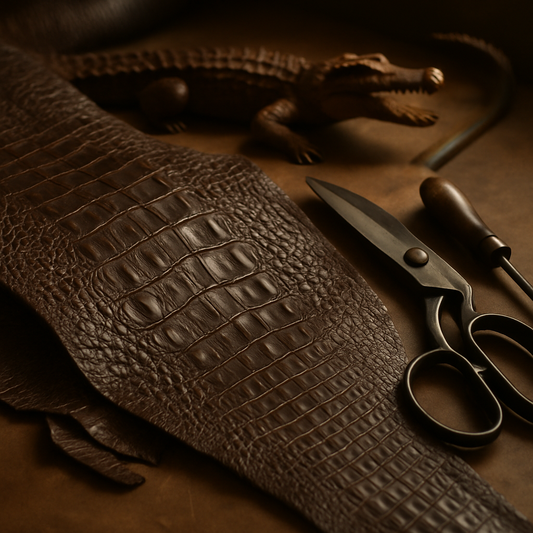
“Crocodile leather” and “alligator leather” are not interchangeable labels. Alligator belly scales tend to shift more abruptly into smaller flank scales, while crocodile scales generally transition more gradually. Alligator skin often has an umbilical scar, a feature associated with alligator rather than crocodile skin.
Crocodile scale appearance also varies by species and hide region. Caiman has its own scale characteristics, so one visual description should not be applied to every crocodilian leather. Visible sensory pores, known as integumentary sensory organs or ISOs, may be seen in many crocodile skins, but a single sensory trait is not proof of authenticity.
These distinctions matter for sustainability because accurate species identification supports correct trade documentation. They also help prevent a buyer from treating a generic product label as sufficient evidence about origin or legality. For a broader material comparison, see Alligator Vs Crocodile Leather: Complete Guide for 2026–2027.
What commercial grading can and cannot tell you
Leather grades are not one globally standardized scale. Labels and criteria can vary by supplier or tannery. A visual grade may describe scale regularity, blemishes, scars, color consistency, or usable surface area, but it should not be treated as a direct measure of conservation performance or durability.
Similarly, a higher visual grade does not automatically mean that a hide was sourced through a better-managed operation. Sustainability questions require traceability and sourcing information, while leather-grade questions concern the appearance and usable condition of the material.
Price factors linked to responsible purchasing
The price of crocodile leather can reflect species, hide size, belly-area width, scale pattern, visible marks, tanning method, dyeing, finishing, labor, and the amount of usable leather in the finished piece. Documentation and compliance work may also affect the cost of legally traded material.
Price alone cannot prove sustainability. A costly item may have limited traceability, while a less costly item may still be correctly documented. Ask what the quoted price covers, whether the item is made from a full hide or selected panels, and whether any required trade documents are available for the destination country.
Fit, sizing, and reducing avoidable replacement
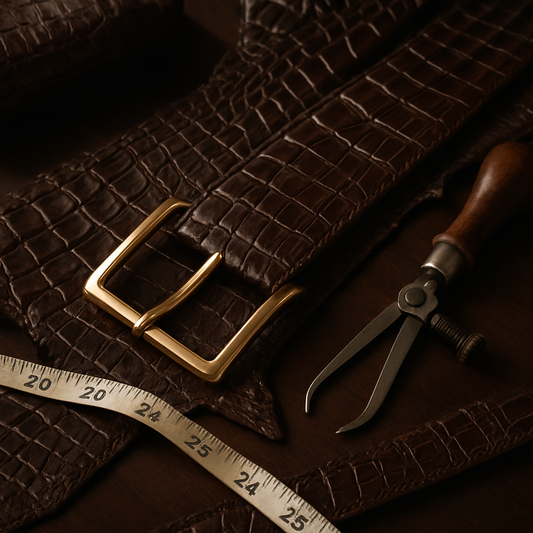
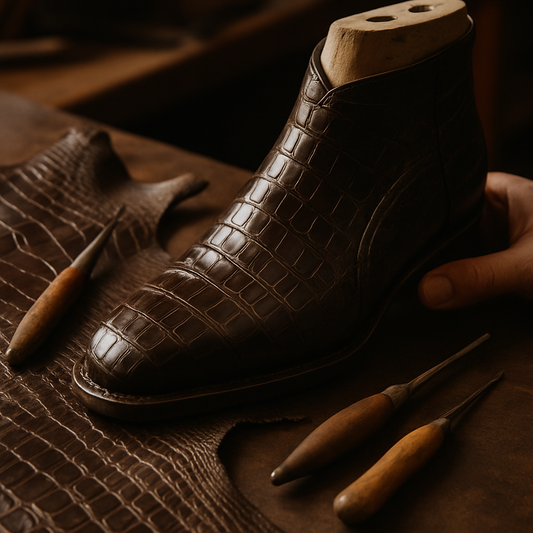
Choosing the correct dimensions can support longer product use because a poorly fitted item is more likely to be replaced. For belts, measure the distance from the buckle’s fastening point to the hole used most often, then check both the strap length and width. A wide-fit belt may need extra room, and a high instep can affect the fit of crocodile-leather footwear.
For remote orders, provide measurements rather than relying only on EU, US, or UK size labels. Those systems can differ between makers. Ask for the product’s actual length, width, opening, or adjustable range, especially when the item uses a structured leather panel that will not stretch substantially.
Care that can extend useful service
Start with a dry, soft cloth to remove surface dust. Keep crocodile leather away from prolonged moisture, strong heat, and direct sun, since these conditions can affect the finish, color, and structure. If the leather becomes wet, allow it to dry naturally rather than applying concentrated heat.
Do not apply an unfamiliar conditioner or polish without checking that it is suitable for crocodile leather and the item’s finish. Test any product on a concealed area first. There is no reliable fixed care schedule for every crocodile product; frequency depends on handling, climate, finish, and storage.
Styling a longer-use crocodile leather item
For regular wear, a crocodile belt, wallet, or bag can be paired with plain wool, cotton, denim, or tailored clothing so the leather works with items already in the wardrobe. Brown and black are often easier to coordinate across business and casual clothing, while stronger colors may suit a smaller accessory used less frequently.
The sustainability benefit of this approach is practical: an item worn across several settings is less likely to become a single-purpose purchase. Match the scale of the leather panel to the product’s size, and coordinate the hardware with other metals when a consistent outfit is the goal.
So, is crocodile leather sustainable?
The most accurate answer is conditional. The global reptile-trade study provides evidence that legal trade appeared biologically sustainable for most species it examined, but it does not certify every crocodile-leather supply chain. A more complete assessment combines species identification, regulated trade documentation, traceability, habitat and population information, and transparency about tanning and social impacts.
For buyers, the strongest position is neither to accept every sustainability claim nor to dismiss all regulated reptile leather. Ask specific questions, separate legal sourcing from environmental performance, and treat the study as broad conservation evidence rather than a product-level guarantee.
Frequently Asked Questions
Does the global reptile-trade study prove that all crocodile leather is sustainable?
No. It found that trade appeared biologically sustainable for most studied species, but it covered multiple reptile groups and did not certify every crocodile species, hide, or supply chain.
Does a CITES tag prove that a crocodile hide is authentic and sustainable?
No. CITES controls international trade, and required tags, permits, or certificates support regulated movement of specimens. They do not by themselves prove authenticity, low pollution, animal welfare, or complete environmental sustainability.
What should I ask for when buying responsibly sourced crocodile leather?
Ask for the exact species, country of origin, applicable identification tag, permit or certificate, and an explanation of the supply chain. For environmental or social claims, request specific supporting information rather than relying on a general sustainability statement.
Can leather grade show whether crocodile leather was sustainably sourced?
No. Commercial grading labels vary by supplier or tannery and usually describe visible condition, scale features, or usable surface. Visual grade is separate from conservation performance, legality, and durability.
View CrocodileViet’s crocodile leather collection at crocodile leather. For sourcing questions or product measurements, contact CrocodileViet through WhatsApp.