
Custom Exotic Leather Scale Patterns: Size, Color, Finish and Personalization Guide

シェア
Custom Exotic Leather Scale Patterns: A Guide to Size, Color, Finish, and Personalization
Custom exotic leather scale patterns are determined mainly by the hide region, the crocodilian species, the scale size, and the finishing method used after tanning.
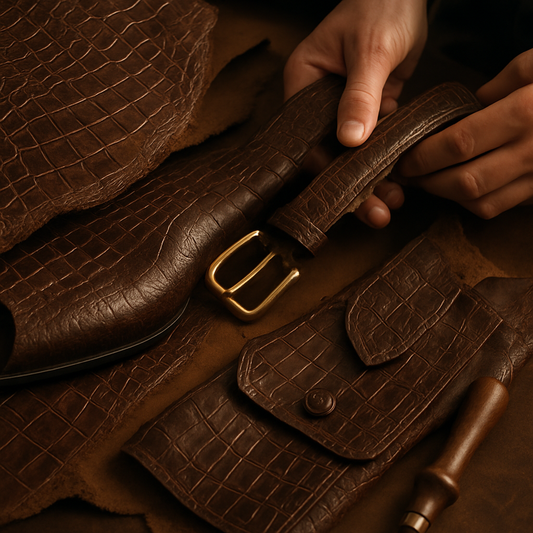
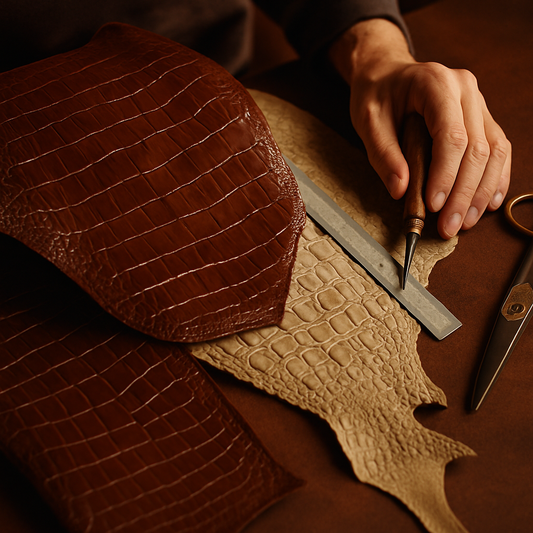
For a custom belt, wallet, bag, watch strap, or pair of shoes, the pattern is not a separate graphic placed on the leather. It is the visible structure of the hide itself. The workshop can select a suitable area, orient the leather, and adjust color or surface treatment, but the underlying scales remain connected to the animal’s species and body region.
This distinction matters when comparing Alligator Vs Crocodile Leather: Complete Guide for 2026–2027. It also helps explain why two items described with the same leather name can look noticeably different.
What “custom scale patterns” can and cannot change
Customization can influence the visual presentation of a hide in several practical ways:
- Choosing belly, flank, or dorsal leather.
- Selecting larger or smaller scales for the product’s dimensions.
- Orienting the pattern centrally or allowing it to follow a natural asymmetry.
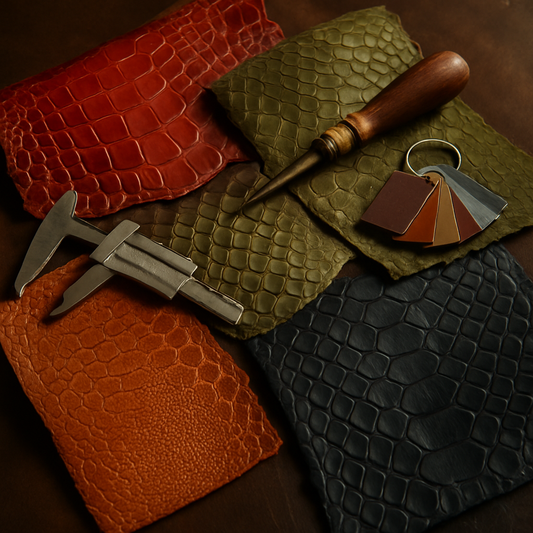
- Requesting a color family, such as black, brown, tan, navy, or a brighter dyed shade, subject to available hides and production confirmation.
- Choosing a finish with a softer sheen, stronger gloss, or more visible surface variation.
- Adjusting product measurements so the scale layout suits the item.
Customization does not turn crocodile into alligator, remove every natural mark, or make one scale pattern proof of species. Scale shape and symmetry vary according to species, hide location, tanning, dye, and finishing. Pores or a particular arrangement may support an assessment, but a finished item should not be authenticated from one sensory or visual clue alone.
Hide regions and the pattern they create
Belly leather
Belly leather is usually selected for its comparatively regular, balanced rectangular or square-like scale layout. Alligator belly skin is commonly associated with this orderly appearance, although the exact pattern varies with the hide and its position. A natural umbilical scar may also appear on an alligator belly. This feature is a useful point of comparison because crocodile belly leather generally lacks the same alligator umbilical mark, but it is not a stand-alone authentication test.
Crocodile belly patterns can vary more by species and individual hide. Some crocodile leather also retains small integumentary sensory-organ pores, often called ISOs, after tanning. Heavy glazing or pigment can make these pores less visible, so their absence from a photograph does not establish a different species.
For a wallet or belt, a balanced belly layout often works well because the central panel is easy to see. On a larger bag, the same layout can create a broad repeated field across the front. The correct choice depends on the product’s panel width and the amount of leather needed without joining multiple sections in a visually distracting way.
Flank leather
Flank leather comes from the side of the animal and generally has smaller, less rectangular scales than the central belly. It can provide more variation across a panel and may suit customers who do not want a strongly geometric appearance.
Alligator flanks typically show dense, evenly sized scales. Caiman flanks tend to have more uneven and widely spaced scales. This is one reason the word “crocodilian” is useful when speaking broadly about alligator, caiman, crocodile, and gavial. “Crocodile” should not be used as a catch-all name for every crocodilian species.
Dorsal or hornback leather
Dorsal leather comes from the back and may retain raised bony structures or hornback features. Its appearance is more pronounced than belly or flank leather, with a stronger ridge-and-scale effect. It can suit a belt, panel, or accessory designed around visible texture, but it may require different construction planning because the raised center changes how the material folds and sits.
Before accepting a custom request, the product dimensions should be compared with the usable area of the chosen hide section. A pattern that looks attractive in a small sample may need different placement on a long belt or a wide bag front.
Scale size and pattern placement
Scale size should be judged against the finished item rather than in isolation. Large belly scales can look visually dominant on a narrow wallet, while very small scales may lose their structure on a broad bag panel. A medium scale layout can provide a more proportional appearance on products with moderate surface area.
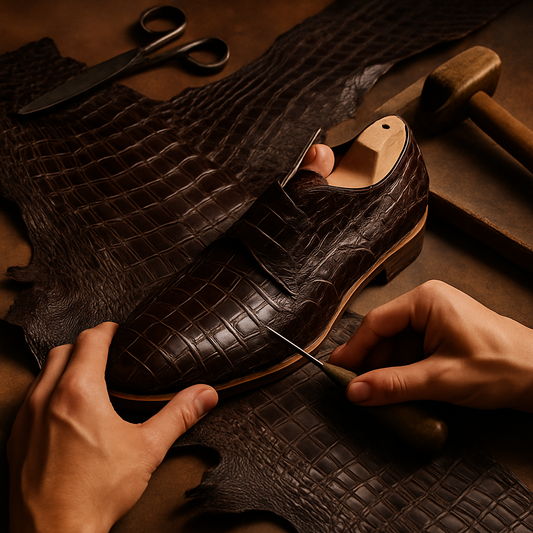
At CrocodileViet, an in-house workshop can assess the hide against the requested product dimensions before cutting because the usable pattern, not only the total hide size, determines the finished appearance. This helps reduce the chance that a central feature, natural mark, or transition between scale sizes falls in an awkward position.
Customers can also request different placement approaches:
- Central alignment: the middle of the belly is placed along the centerline of the product.
- Natural alignment: the hide follows its existing direction, even if the two sides are not visually identical.
- Feature-led placement: a scar, pore field, or scale transition is kept visible as part of the material’s character.
- Low-contrast placement: the pattern is positioned where seams, folds, or hardware make it less prominent.
Regularity is not the same as durability. A balanced scale layout may be preferred for appearance, but strength also depends on the leather thickness, construction, edge treatment, stress points, and how the finished product is used.
Color, dye, and finish
Color changes the way scales are perceived without changing their original structure. Dye can distribute relatively evenly across smooth crocodilian bellies, making the scale layout easy to read. Dark colors may visually reduce contrast between adjacent scales, while lighter or brighter colors can make individual plates more noticeable.
Finish is a separate decision from color. A smooth polished surface can reflect more light and make the pattern appear sharper. A lower-sheen finish can show more of the leather’s surface variation. Heavy glazing or pigment may cover small pores and soften the visible difference between neighboring scales.
When requesting a custom color, it is sensible to approve a physical leather sample rather than relying only on a screen image. Lighting, display settings, dye absorption, and the scale relief can alter the perceived shade. The final color should be confirmed against the available hide before production; stock and color availability should not be assumed from a catalogue image.
Personalization options for an in-house product
Personalization can involve more than initials. A practical specification may include:
- Product type and intended use.
- Hide species and section, such as alligator belly, crocodile belly, flank, or dorsal.
- Preferred scale size and the amount of pattern visibility.
- Color family and surface sheen.
- Stitching color, lining color, edge color, and hardware tone.
- Logo, initials, or placement of an engraving.
- Measurements and any fit requirements.
For personal measurements, photographs with a ruler, a tracing, or a previously well-fitting item can help communicate proportions when an in-person fitting is not possible. Remote measurements should include length and width, not only a general size label, because sizing conventions differ between makers.
Price factors for customized exotic leather
The price of a custom item depends on several concrete factors rather than a single “grade” label:
- Species: alligator, crocodile, caiman, and other crocodilians can differ in sourcing, usable area, and material cost.
- Hide section: a broad, balanced belly panel may be priced differently from flank or dorsal leather.
- Usable size: a larger bag panel requires more suitable leather than a card holder.
- Pattern requirements: centered layouts may require more material than a design that accepts natural variation.
- Color and finish: special dye requests, glazing, pigment, or a particular sheen may affect the work required.
- Construction: lining, number of compartments, hand finishing, hardware, edge work, and stitching all influence the quotation.
- Personal measurements: unusual belt lengths, wide fits, high insteps, or special panel proportions may require additional material and pattern adjustment.
Terms such as “Grade A” or “A–C grade” are not universal standards across species, tanneries, and suppliers. A quotation should identify the actual leather section, dimensions, color, finish, and construction details instead of relying on a label alone. Visual grade also does not predict durability by itself.
Fit and sizing for custom leather goods
For belts, provide the measurement from the buckle fold to the hole used most often, rather than only your trouser size. State the desired hole range and whether the belt will be worn over light clothing or a thicker layer. A wide-fit request should include the intended belt width because a wider strap can change both comfort and the scale layout.
For shoes or sandals, EU, US, and UK sizes are not interchangeable without checking the maker’s sizing system. Include foot length, ball width, heel width, and instep measurement. A high instep or wide forefoot can require a different pattern even if the nominal size is correct.
For bags and cases, send outside length, width, depth, handle drop, and the items that must fit inside. A remote order is easier to evaluate when measurements are accompanied by a ruler photograph or a tracing. This is especially useful when the scale pattern must be centered on a particular front panel.
Care for finished crocodilian leather
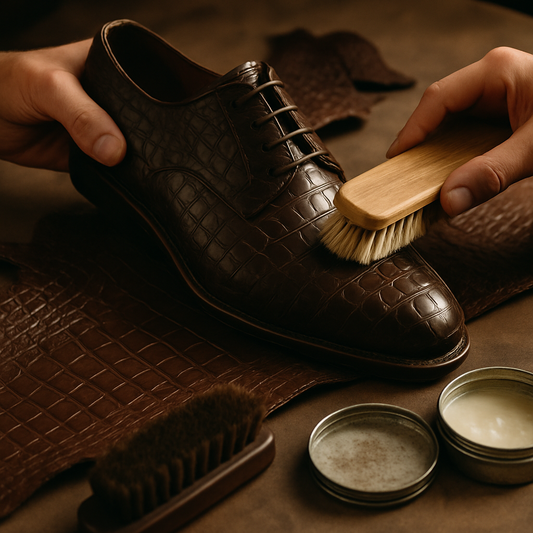
Use a dry, soft cloth as the default cleaning method. Wipe away dust with light pressure and keep the item away from prolonged moisture, high heat, and direct strong sunlight. Do not apply household polish, alcohol, oil, or an untested conditioner, since these products can alter dye, glazing, or the visibility of pores.
There is no useful fixed cleaning schedule for every item. Wipe the leather when surface dust or marks appear, and follow the workshop’s product-specific care instructions if the finish requires special handling. If the leather becomes wet, blot it rather than rubbing it and allow it to dry gradually at room temperature.
Styling custom scale patterns
A large belly pattern can work with simple clothing because the leather already provides visible structure. A smaller-scale flank design can be easier to coordinate with patterned shirts, textured jackets, or other accessories. Dark, low-contrast finishes usually suit restrained business combinations, while lighter or brighter colors can become the main color reference for the outfit.
Match the item’s hardware and stitching with the rest of the wardrobe rather than treating the scale pattern as an isolated feature. A belt can repeat the shoe or watch strap color, while a bag can use a quieter finish if the clothing already includes strong patterns.
Documentation and regulated trade
Crocodilian species are covered by CITES Appendices I or II, and international trade in skins or recognizable skin pieces generally requires applicable permits or certificates, subject to species-specific rules and exemptions. In regulated international trade, individual non-reusable tags may also be required; U.S. rules include tagging and permit requirements for imports, exports, and re-exports.
CITES paperwork supports regulated trade compliance. It does not, by itself, prove that a finished item is authentic. Species assessment should consider documentation, supplier records, hide characteristics, and the construction of the item together.
Frequently Asked Questions
Which hide section gives the most regular exotic leather scale patterns?
Belly leather generally gives the most balanced scale layout, especially on a central product panel. Alligator belly is often chosen for its comparatively regular arrangement, while crocodile belly can vary more by species and hide. Flank and dorsal sections create different visual effects.
Can pores prove that a finished item is crocodile leather?
No. Some crocodile leather retains visible integumentary sensory-organ pores, but dye, glazing, pigment, photography, and finishing can change how they appear. Pores should be treated as one observation, not proof of species or authenticity.
Can I request a specific scale size and color for a custom product?
You can request a preferred hide section, approximate scale size, color family, and finish. The workshop must confirm the available hide and check whether the requested pattern will fit the product dimensions before production. Screen color should be verified against a physical sample where possible.
How should I measure a custom belt or shoe order remotely?
For a belt, provide the buckle-to-usual-hole measurement, desired width, and hole range. For shoes, provide foot length, ball width, heel width, instep measurement, and your EU, US, or UK reference size. A ruler photograph or tracing can clarify measurements.
Request a custom pattern discussion
View CrocodileViet’s latest workshop and product information at CrocodileViet news and collections. For a custom scale layout, color, finish, or measurement request, contact us through WhatsApp with the product type and your dimensions.