
Buying Alligator Leather Goods: What CITES Tags and Traceability Actually Tell You

シェア
Buying Alligator Leather Goods: What CITES Tags and Traceability Tell You
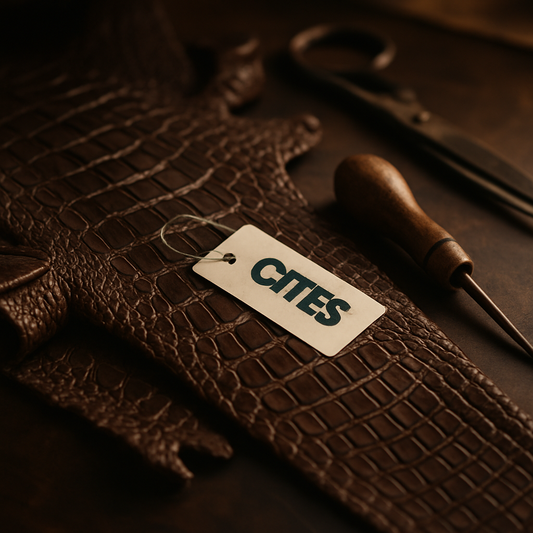
A CITES alligator leather tag identifies a regulated skin or recognized skin section through information such as its country-of-origin code, species code and unique serial number.
That information matters, but it answers a narrower question than many buyers expect. A tag can support identification and regulated-trade traceability; it does not, by itself, prove that every part of a finished wallet, belt or bag is authentic, legally sourced or made from the species claimed by a seller.
What a CITES alligator leather tag is designed to show
A crocodilian CITES tag is a non-reusable, tamper-resistant tag used to identify a skin in international trade. Required information commonly includes:
- the country-of-origin code;
- a unique serial number;
- a species code; and
- the harvest or production year where applicable.
For U.S. American alligator (Alligator mississippiensis) skins, the export tag includes the species code MIS, a state or tribal harvest abbreviation, the year and a unique serial number. U.S. regulations require individual tagging of skins, flanks and chalecos for export or re-export.
These details create a connection between the physical skin and trade documents. A buyer can therefore ask the seller to explain how the tag number relates to the relevant provenance records, rather than treating the tag as a decorative label or a complete certificate of the finished product.
What the tag can and cannot establish
A tag can help establish that a particular regulated skin or named skin section entered a documented trade process. It can also help distinguish an alligator specimen from another crocodilian when the species code is valid and the supporting records match.
However, the tag alone does not establish alligator leather authenticity for a finished item. It does not automatically confirm:
- that every leather panel in a multi-piece product came from the tagged skin;
- that the item was assembled by the seller named in a trade document;
- that the item’s construction, lining or hardware matches the seller’s description; or
- that the product qualifies for a particular import or personal-effects exemption.
CITES regulates international trade in listed specimens and products. It is not simply a test of whether leather is genuine. Requirements can vary according to the species, specimen, origin and transaction. Some personal effects may qualify for an exemption, while other shipments require specific documentation.
It is also not safe to assume that every finished crocodilian-leather item must carry its own hide tag. Tagging rules address skins and specified sections such as flanks and chalecos. The documentation that applies to a finished good depends on the specimen and trade circumstances.
How to ask for useful traceability information
A seller who makes a legal alligator goods claim should be able to explain what the item is made from and what documentation applies to the sale. Ask focused questions rather than requesting a vague “certificate of authenticity.”
- Is the item made from American alligator or another alligator species?
- Does the source material come from a full skin, flank or chaleco?
- What species code appears on the relevant tag?
- Is the tag number associated with trade documents that can be shown or summarized?
- Does the destination country require an import document for this transaction?
- Is the product being sold as a personal effect, a commercial shipment or another category?
For international orders, documentation should be checked before payment and shipment. The seller may need information from the buyer about the destination, intended use and shipping method. A tag supports traceability, but the legality of a transaction depends on the complete set of applicable rules and records.
Why appearance is only one part of alligator leather authenticity
Alligator and crocodile are different animal groups, so their leather names should not be used interchangeably. An alligator belly commonly has a regular, balanced scale pattern. Alligator skin often also shows an umbilical scar, while crocodile commonly lacks that feature. Crocodile scale patterns vary more by species and often show visible sensory pores, known as integumentary sense organs or ISOs.
These traits can help an experienced leather worker inspect a piece, but none should be treated as a single decisive authenticity test. Cutting, finishing, embossing, lighting and the specific skin section can change what is visible. A CITES tag and supporting records address traceability; visual inspection addresses material characteristics. The two forms of checking answer different questions.
For a broader visual discussion, read How to Choose How To Spot Real Alligator Leather for Business Wear.
Price factors beyond the word “alligator”
There is no responsible single price for alligator leather goods without knowing the product and source material. Cost can be affected by:
- the alligator species and lawful source;
- whether the item uses belly, flank or another skin section;
- the usable area and scale size required for the design;
- how much matching or positioning is needed across panels;
- the item’s dimensions and construction complexity;
- lining, edge treatment, closures and hardware;
- workshop labor and finishing time; and
- shipping, customs handling and documentation requirements.
Visual grade is not the same as durability. Grading labels also vary by supplier and tannery, so a label such as “select” or “top grade” should be accompanied by a clear explanation of the actual skin section, surface condition and construction used in the product.
Fit and sizing for alligator leather goods
For belts, measure the distance from the buckle’s usual attachment point to the hole you wear most often, rather than relying only on your trouser size. Send the measurement in centimeters or inches and state whether it is a body measurement, an existing belt measurement or the total belt length. Those figures are not interchangeable.
For shoes or structured footwear, provide foot length and width, the widest forefoot measurement and, where relevant, instep height. State your usual EU, US or UK size, but treat that size as a reference because regional sizing and shoe shapes differ. A wide fit or high instep may require a different last even when the length is correct.
For bags, sleeves and cases, measure the object that must fit inside: length, width and depth. If measurements are taken remotely, photographs beside a ruler can reduce misunderstandings, but the written dimensions should remain the main reference.
Care after purchase
Use a dry, soft cloth to remove dust after handling. Keep alligator leather away from prolonged moisture, direct heat and solvents, including alcohol-based cleaners that may affect the finish. Do not place a damp item beside a heater; let it dry gradually at room temperature.
There is no useful fixed cleaning schedule for every product. Frequency depends on handling, climate, finish and exposure. Ask the maker which conditioner, if any, suits the specific finish before applying a product, and test it on a concealed area if the maker approves its use.
Styling alligator leather goods
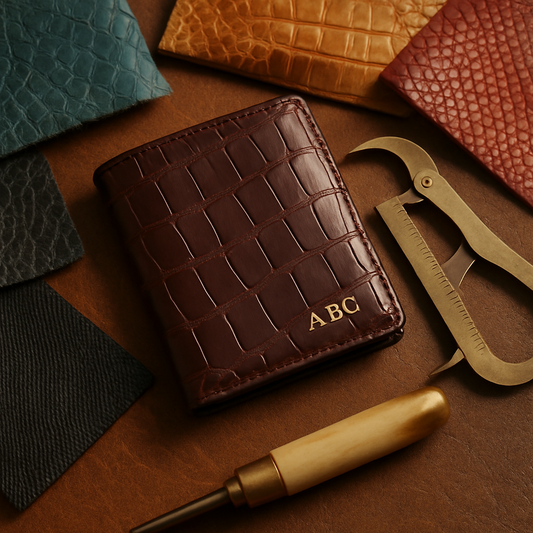
A small alligator cardholder or belt can work with plain wool trousers, denim or business tailoring when the rest of the outfit is restrained. A larger bag with pronounced scale contrast usually receives more visual attention, so pairing it with simple textures can keep the materials from competing.
Match the color temperature and hardware to the clothes you already wear: dark brown and black often coordinate with formal footwear, while lighter brown or muted colors can sit comfortably with casual cotton, linen and denim. The practical choice is the item whose size, finish and level of scale visibility fit your regular wardrobe—not simply the one carrying the strongest grade label.
Frequently Asked Questions
Does a CITES alligator leather tag prove that a finished wallet is genuine?
No. It supports identification and regulated-trade traceability for the relevant skin or section, but it is not by itself complete proof of the finished item’s authenticity or legal supply chain. Ask for supporting provenance information and details about how the tagged material relates to the product.
Must every alligator leather item have its own CITES tag?
Not necessarily. Rules specifically address skins and recognized sections such as flanks and chalecos, while documentation for finished goods depends on the specimen and trade circumstances. Some personal effects may qualify for an exemption.
What should the species code on a U.S. alligator export tag show?
For U.S. American alligator, the species code is MIS. The export tag also includes a state or tribal harvest abbreviation, year and unique serial number. The relevant tag number is associated with trade documents.
Can scale pattern alone confirm alligator leather authenticity?
No. A regular, balanced belly pattern and a possible umbilical scar can support a visual assessment, but neither is conclusive alone. Material inspection, product construction and traceability records should be considered together.
Browse CrocodileViet’s alligator leather collection to compare finished goods and their product details. For questions about measurements, provenance documents or international shipping, contact CrocodileViet through WhatsApp before ordering.