
Alligator Leather Watch Band vs Lizard Leather: Which Is Better? — Part 2

シェア
Alligator Leather Watch Band vs. Lizard Leather: Which Is Better?
Neither alligator nor lizard leather is automatically better for a watch band: alligator belly usually provides a more regular scale layout, while lizard offers more variation because its appearance depends heavily on the species and cut.
What the comparison covers
This comparison focuses on alligator leather watch bands and lizard leather watch bands for everyday watches, dress watches, and custom strap orders. It covers scale pattern, material characteristics, price factors, fit, care, styling, and legal sourcing. “Alligator” and “lizard” describe different reptile leathers, not grades or surface finishes.
The term “lizard” needs extra care. It can refer to several species, and trade names may differ between suppliers. A lizard strap should therefore be assessed by its actual species and cut where that information is available, rather than treated as one standardized material.
Alligator and lizard leather compared
| Decision factor | Alligator leather watch band | Lizard leather watch band |
|---|---|---|
| Typical visual pattern | Belly leather commonly has broad, squarish scales that become smaller toward the flanks. The belly gives the regular, balanced tile pattern many buyers expect. | The scale size, shape, direction, and finish depend on the lizard species and whether the strap uses belly, flank, or another cut. |
| Pattern consistency | Usually more predictable when the strap is cut from the belly section. | Can range from fine and closely repeated to more varied or directional, depending on the hide. |
| Surface identification clues | An alligator belly does not use sensory pores as a universal identification test. Crocodile can show visible sensory pores, so confusing crocodile with alligator is possible when relying only on appearance. | Species identification matters because “lizard” covers more than one type of hide and scale structure. |
| Best suited to | Buyers seeking a measured, tile-like appearance for a formal or versatile watch. | Buyers who prefer a finer, more distinctive, or species-specific scale character. |
| Price drivers | Species, belly width, scale alignment, visible defects, usable area, construction, lining, hardware, and customization. | Species, usable hide size, scale quality, rarity in the supplier’s range, construction, lining, hardware, and customization. |
Scale pattern: the clearest visual difference
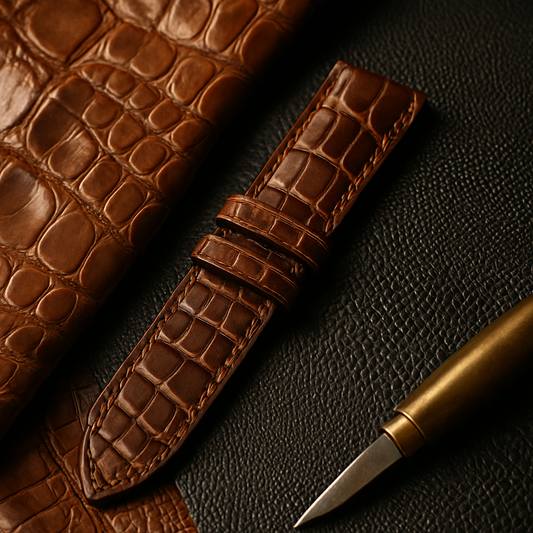
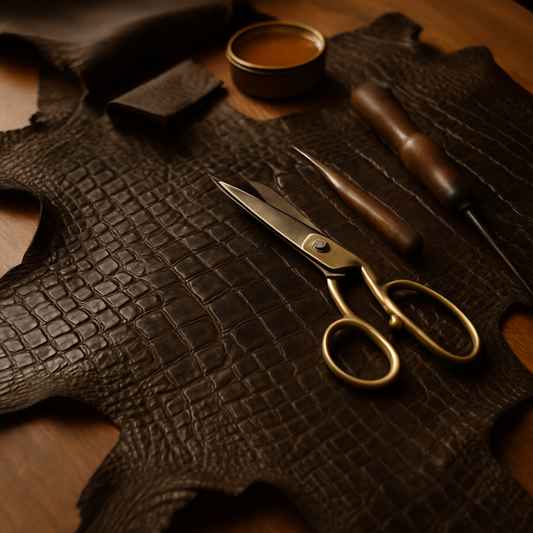
Alligator belly leather is taken from the underside and generally produces the classic regular tile pattern. Broad scales sit through the central area, with smaller scales toward the flanks. The flank or side section has smaller, rounder scales and a less even layout, so two alligator watch bands can look quite different even when both are genuine alligator.
Lizard leather cannot be described with one scale pattern. Some lizard hides create fine, closely arranged scales, while others show stronger direction or more visible variation. The cut also affects the result. Asking which lizard species and which hide section were used is more useful than asking whether “lizard leather” is better in general.
Visible sensory pores should also be interpreted carefully. Crocodile often shows pores in the center of scales, whereas alligator does not use that feature as a defining visual marker. A single sensory trait is not proof of authenticity or species, particularly after finishing, embossing, lighting changes, or low-resolution photography.
Durability and daily wear
Durability depends on more than the animal name. Leather thickness, strap construction, lining, stitching, edge treatment, buckle or clasp hardware, exposure to moisture, and frequency of use all affect service life. Alligator should not be described as automatically more durable than lizard, and lizard should not be dismissed as unsuitable for regular wear.
For a watch worn every day, the practical question is how the finished strap is built and how it will be used. A thin dress strap may be comfortable under a cuff but less suitable for repeated moisture exposure. A thicker strap may provide more structure but feel less flexible on a smaller wrist. The watch case, spring-bar position, and strap taper also influence comfort.
At CrocodileViet, we manufacture our leather goods in-house so the material, strap dimensions, lining, and hardware can be discussed as one finished product rather than as unrelated components. That matters because a visually attractive hide still needs proportions and construction that suit the watch and the wearer’s routine.
Price: what you are actually paying for
There is no reliable price rule saying that every alligator strap costs more than every lizard strap. The cost can change according to:
- the confirmed species and legal source;
- the width of usable belly or other selected hide section;
- scale size, alignment, and the number and position of visible defects;
- strap length, width, taper, and thickness;
- lining material, edge finish, stitching, buckle, deployant clasp, and quick-release hardware;
- custom measurements, unusual colors, and special construction requirements.
Hide grading also requires a supplier-specific explanation. There is no single grading scale that makes labels such as Grade I, Grade II, or Grade III equivalent across all tanneries and suppliers. One system may assess the belly-and-flank midsection by the number and location of defects, while another may use different terminology. Ask what the label means before comparing quotes.
Fit and sizing for an alligator or lizard watch band
Watch strap sizing is based on lug width and wrist circumference, not clothing or shoe sizing. Measure the distance between the watch’s inside lug edges in millimeters, then measure the wrist where the watch will sit. A common strap format is written as 20/16 mm: 20 mm at the watch and 16 mm at the buckle end, but the correct dimensions depend on the case.
EU, US, and UK shoe sizes do not determine watch strap size, and instep measurements are not relevant. For a wide watch case, a wider strap can look proportionate, but the strap should still match the actual lug width. A tapered design may suit a smaller case or a dress watch, while a broader, less tapered strap can support a larger case visually.
For remote measurements, send the watch model or precise lug width, wrist circumference in millimeters, preferred hole position, current strap length, and a photograph showing how the watch sits. A measurement from an existing strap can help, but measure from the buckle to the hole used most often rather than copying the full leather length without context.
Care for reptile leather watch bands
After wearing the strap, wipe it with a dry, soft cloth to remove skin oil and surface dust. Keep it away from prolonged water exposure, sweat buildup, sprays, solvents, and direct heat. If the strap becomes damp, let it dry naturally before placing it in storage; heat from a hair dryer or radiator can affect the leather and finish.
There is no useful fixed care schedule for every wearer. A frequently worn strap in a hot climate needs more regular surface wiping than a dress strap used occasionally. Store the watch band flat or in a position that does not sharply crease the leather, and follow the maker’s instructions before applying any conditioner because products suitable for ordinary cow leather may not suit reptile leather.
Styling an alligator leather watch band vs. lizard leather
Alligator belly works well with watches where a balanced scale layout supports a clean dial and polished case. Black, dark brown, and other restrained shades can coordinate with business clothing, while a lighter or more colorful strap can change the character of a simple watch.
Lizard can suit a smaller dress watch, vintage-inspired case, or outfit where a finer scale pattern provides visual texture without using a broad tile layout. Match the strap’s sheen and color to the case finish and other accessories, but do not treat one material as restricted to formal wear. The watch size, dial design, clothing, and color combination all matter.
Legal sourcing and documentation
Many commercially traded alligator and crocodile species are listed under CITES, and international trade may require permits or identification documents. Requirements depend on the species, source, seller, and destination country. The paperwork rules for a finished strap are not necessarily identical in every transaction.
CITES documentation concerns regulated trade and does not, by itself, prove that a strap is authentic. Ask the seller for the species information and any documentation relevant to the shipment route. This is especially important for international orders or custom work involving a named reptile species.
Which material should you choose?
Choose an alligator leather watch band if you want a more predictable belly pattern, broad central scales, and a strap that can coordinate easily with formal or everyday watches. Choose lizard when the species-specific scale character, finer texture, or less standardized appearance is more important to you.
The most useful decision is not “alligator or lizard” in isolation. Compare the confirmed species, hide section, finished dimensions, construction, price breakdown, care needs, and sourcing information. A well-matched strap with clear material information is a sounder purchase than a strap selected only from a generic grade label or a close-up photograph.
Frequently Asked Questions
Is an alligator leather watch band more durable than a lizard strap?
Not automatically. Durability depends on the species, leather thickness, lining, stitching, edge treatment, hardware, moisture exposure, and frequency of wear. The finished construction and intended use should be compared alongside the hide.
How can I tell alligator belly from lizard leather?
Alligator belly commonly shows broad, squarish scales in a regular, balanced tile pattern, while lizard appearance varies by species and cut. Surface appearance alone is not conclusive, so request the species and sourcing information from the seller.
Does an alligator watch strap always cost more than a lizard strap?
No fixed price order applies to every strap. Species, usable hide area, scale alignment, defects, dimensions, lining, hardware, customization, and supplier grading practices can change the price of either material.
What measurements are needed for a custom alligator watch strap or lizard strap?
Provide the watch’s lug width in millimeters, wrist circumference, preferred strap length, usual hole position, strap taper, and thickness preference. A photograph of the watch and an existing strap can help verify the fit remotely.
Shop Watch Bands
View CrocodileViet’s watch band collection to compare available strap designs and materials. For measurements, material questions, or a custom alligator watch strap request, contact CrocodileViet through WhatsApp.