
Best Alligator Belly Skin for Men: What to Look For

シェア
How to Choose the Best Alligator Belly Skin for Men
The most suitable alligator belly skin for a men’s leather item has a balanced ventral scale pattern, limited visible defects, enough usable width for the intended product, and documentation that identifies its legal source.
What “alligator belly skin” means
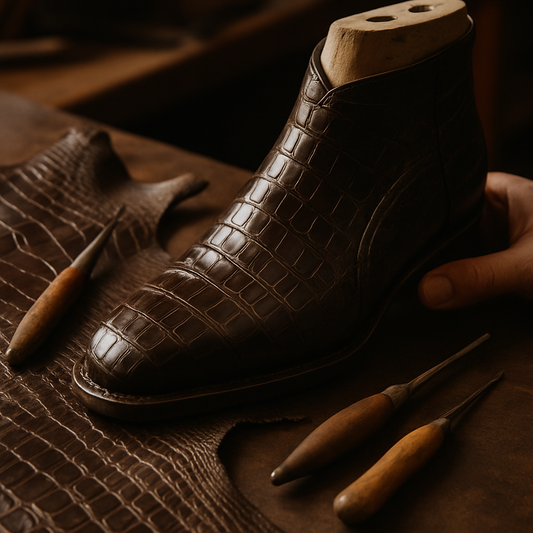
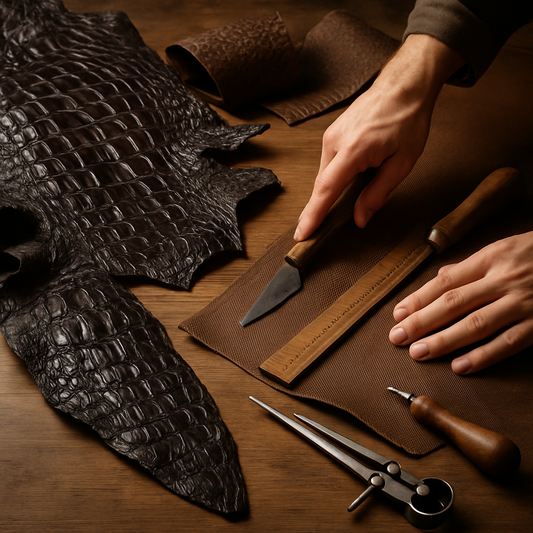
Alligator belly skin is cut from the ventral hide, the smoother underside of the animal. Its scales are generally flatter and more regular than those on the bony back, making the material practical for belts, wallets, watch straps, shoes, briefcases, and other men’s accessories.
The back is a different cut. It contains raised bony deposits and is commonly sold as hornback crocodile leather or hornback alligator leather, depending on the species. A buyer looking for a smooth, regular surface should compare belly cuts rather than treating hornback and belly leather as interchangeable.
For men’s products, the right hide is not simply the one with the largest scales or the highest-sounding grade label. The useful questions are whether the belly area is broad enough, whether the scales suit the product’s proportions, how many defects appear in the working area, and whether the supplier explains the grading system.
How to inspect the belly scale pattern
American alligator belly scales commonly appear comparatively regular and balanced. They are generally less uniform than true crocodile belly scales, but that variation does not automatically indicate a problem. Small changes in scale size and alignment are part of the material’s natural structure.
Crocodile leather can vary more by species and individual hide. Many crocodile belly skins show visible sensory-organ pores, often called integumentary sensory organs or ISOs. Alligator bellies often show an umbilical scar, a feature commonly absent from crocodile belly skins. These clues can support identification, but scale shape or one sensory feature alone should not be treated as proof of species.
Caiman requires additional care during comparison. Bony deposits can create crinkling, a less even surface, and uneven dye appearance. If a product is described broadly as “crocodile,” ask whether it is crocodile, alligator, or caiman before comparing its appearance or price with another hide.
At CrocodileViet, we compare the visible scale layout with the stated species and cut because a similar-looking surface can come from different crocodilian materials. For a buyer, this reduces the risk of comparing unlike hides based only on photographs.
Check the usable width and scale placement
Belly width is commonly measured across the smooth scales between the flank scutes. Suppliers may quote width in centimeters, while other sellers may describe a hide by length or use a different internal sizing convention. Ask which measurement is being used before comparing two pieces.
Width matters differently for each men’s product:
- Belts: The usable strip must accommodate the finished belt width, edge trimming, buckle fold, and any damaged area that will be removed.
- Wallets: A broad central section helps maintain consistent scale placement across the outer panels, but the total hide size also affects how many panels can be cut.
- Watch straps: The scale size should relate to the strap width. Oversized scales can look crowded after tapering toward the buckle.
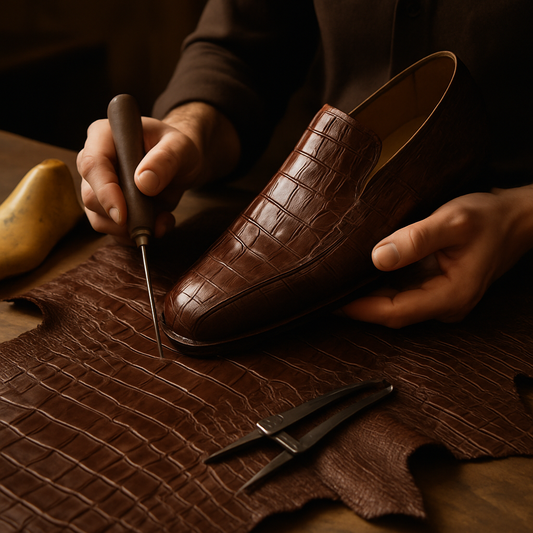
- Shoes: The maker needs enough surface for the vamp and other visible panels, with the grain positioned consistently across the pair.
- Bags and briefcases: Width and length both influence panel layout, seams, and how much of the belly’s regular center can remain visible.
Ask for the usable belly width rather than relying only on the hide’s full edge-to-edge measurement. Flank areas, scutes, scars, and trimming can reduce the portion that is suitable for a clean visible panel.
Understand defects and grading labels
Relevant belly defects can include scars, scratches, shading, scale deformities, and areas where the surface does not dye evenly. Their effect depends on location. A small mark near an edge may be less significant for a wallet panel than a similar mark across the center of a belt or shoe vamp.
Grading labels are not universal across suppliers or tanneries. One documented Louisiana framework uses Grades 1 through 5, with Grade 1 representing a defect-free belly and higher numbers reflecting the number and location of defects. That system evaluates the belly, not automatically the back or tail.
Ask three direct questions about any grade:
- Which supplier or tannery created the grade?
- Does the grade assess the belly only, or the entire hide?
- How do defects affect the price and the usable cutting area?
A low defect count is useful, but “higher grade” should not be read as a universal industry ranking. A supplier’s written grading definition is more informative than a label without a stated standard.
| Factor | What to inspect | Why it matters |
|---|---|---|
| Species | Stated alligator species, with supporting source information | Species affects scale character, texture, appearance, and legal documentation requirements. |
| Scale layout | Balanced center scales and a consistent transition toward the flanks | Good placement makes cutting and panel matching more predictable. |
| Usable width | Measurement across the smooth scales between flank scutes | Affects whether the hide can produce the planned belt, strap, shoe, or bag panels. |
| Defects | Scars, scratches, shading, and deformed scales in the proposed cutting area | Location matters as much as the number of marks. |
| Finish | Color consistency, surface feel, flexibility, and thickness | These influence the appearance and handling of the finished men’s product. |
| Documentation | Species, source, supplier information, and applicable trade papers | Helps establish lawful sourcing and clarifies what material is being purchased. |
Do not confuse visual grade with durability
A visually clean belly may command a higher price because it offers more usable surface and fewer marks, but visual grade is not the same as durability. A hide’s performance also depends on tanning, finishing, thickness, construction, edge treatment, lining, hardware, and how the item is used.
For example, a belt made from a clean-looking panel can still perform poorly if the leather is too thin for its construction or if the buckle fold is not reinforced appropriately. A wallet with a few natural marks may serve well if its panels are cut away from stressed edges and assembled correctly.
At our workshop, we match the available belly area to the product pattern because this limits unnecessary seams and keeps defects away from high-visibility or high-stress zones. That decision concerns the finished construction, not just the appearance of the raw hide.
Price: what you are actually paying for
The price of alligator belly skin depends on several concrete factors rather than one simple quality label:
- Species and lawful source: Alligator, crocodile, and caiman are different materials with different supply chains and documentation.
- Usable dimensions: Greater width and length can support larger panels and reduce the need to join smaller sections.
- Defect distribution: A hide with fewer defects in the center cutting area can be more useful than one with the same defect count concentrated in that area.
- Finish and color: Dye complexity, surface treatment, and color consistency affect processing and appearance.
- Thickness and hand: A pliable belly intended for a wallet is handled differently from leather prepared for a structured belt or shoe.
- Finished-product construction: For a completed item, lining, thread, hardware, edge work, pattern complexity, and labor add to the leather cost.
- Documentation and trade compliance: Regulated crocodilian trade may require applicable permits or re-export certificates.
Ask whether a quoted price covers a raw hide, a finished leather panel, or a completed product. These are different purchases and should not be compared as though they contain the same labor and materials.
Fit and sizing for men’s products
Leather selection and finished-product sizing should be discussed separately. For a belt, provide the measurement from the buckle’s pin to the hole used most often, rather than relying only on trouser size. Also provide the desired finished belt width, because a wide belt requires a wider usable strip and changes the visual scale balance.
For shoes, provide foot length and width, your usual EU, US, and UK size, and whether you need a wide fit. Mention a high instep, low instep, bunion area, or differences between the left and right foot. A standard size conversion does not capture every width or instep variation.
Remote measurements are more useful when they include a foot tracing or measured outline, heel-to-longest-toe length, forefoot width, instep circumference, and photos showing the foot from above and from the side. The maker can then compare those measurements with the available last and leather construction.
For wallets and watch straps, give the dimensions of the contents or watch case rather than selecting by a general “men’s” size. A card-heavy wallet, a large watch, or a tapered strap each needs a different usable panel calculation.
Care for alligator belly leather
Start with a dry, soft cloth to remove surface dust. Use light pressure and keep the cloth moving with the scale direction rather than scrubbing across the grain.
Keep the item away from prolonged moisture, direct heat, and strong sunlight. If it becomes wet, blot it gently and let it dry at room temperature. Avoid household cleaners, alcohol-based products, and untested conditioners because they can change the finish or darken the leather.
There is no useful fixed care schedule for every item. A frequently handled belt or wallet may need inspection sooner than a watch strap stored in a drawer. Follow the finish-specific care advice from the maker, and test any approved product on a hidden area first.
Styling alligator belly skin for men
For business wear, a belt, wallet, or watch strap with a restrained finish can coordinate with shoes and a briefcase without requiring identical textures everywhere. Match the color family and hardware tone rather than trying to duplicate every scale line.
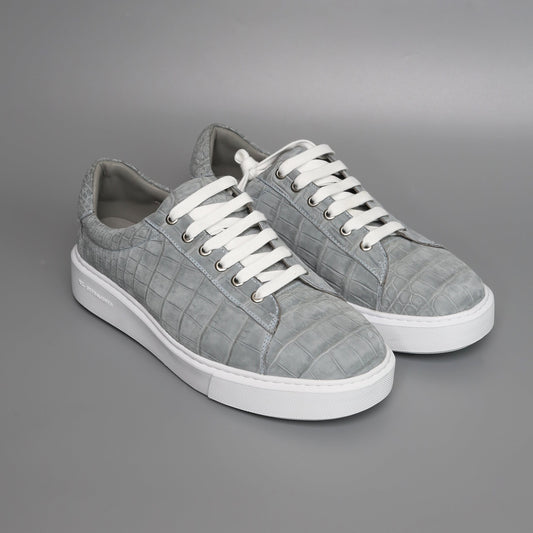
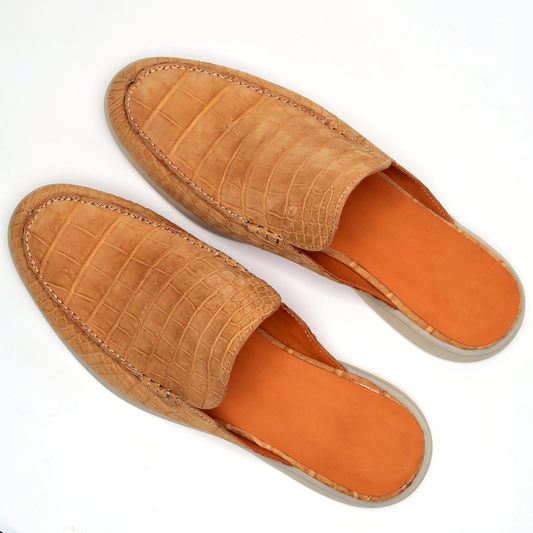
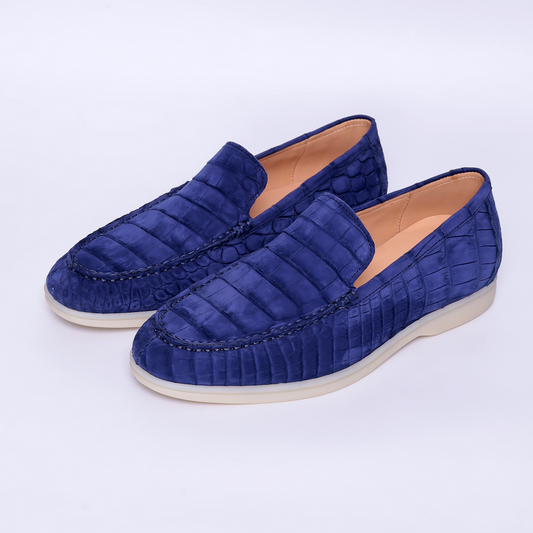
A darker belt with smaller, balanced scales can work with tailored trousers, while a lighter or more visibly varied panel may suit casual footwear or an unstructured jacket. With shoes, keep the alligator surface as the focal texture and use simpler fabrics nearby, such as plain wool trousers or a solid cotton shirt.
For a more detailed comparison of species and surface character, read Alligator Vs Crocodile Leather: Complete Guide for 2026–2027. If the intended use is office footwear or accessories, How to Choose Crocodile Leather Types for Business Wear provides a related material comparison.
Species and legal documentation
Crocodilian skin trade can be regulated under CITES. Depending on the species, source, country, and transaction, applicable permits or re-export certificates may be required. U.S. export requirements for American alligator products can also vary according to the source and whether the material comes from an approved program.
Documentation supports lawful trade, but CITES paperwork by itself does not prove a particular hide’s authenticity or grade. Ask for consistent information about species, source, supplier, and the documents relevant to the shipment. A sensory pore, an umbilical scar, or a scale pattern can assist visual inspection, but no single trait establishes the full identity of a piece.
Frequently Asked Questions
How can I tell alligator belly skin from crocodile belly skin?
Compare the overall scale pattern, inspect for visible sensory-organ pores, and look for an umbilical scar, which alligator often has and crocodile commonly lacks. These clues should be checked alongside supplier information because scale shape or one sensory feature alone does not establish species.
What belly width do I need for a men’s belt?
Measure the finished belt width, then ask for the hide’s usable width across the smooth scales between the flank scutes. Allow extra material for trimming, the buckle fold, and any defects that should stay outside the visible strip.
Does a higher alligator leather grade mean greater durability?
Not by itself. Grading generally describes visible defects under a particular supplier or tannery system. Durability also depends on tanning, thickness, finishing, pattern design, construction, hardware, and use.
What should I ask before buying alligator belly skin online?
Request the stated species, usable length and width, grading definition, photos of the actual piece, finish information, source details, and any applicable trade documents. Also confirm whether the quoted price is for a raw hide, a cut panel, or a finished men’s product.
Choose the material with the finished product in mind
The best alligator belly skin for a man’s belt, wallet, strap, shoe, or bag is the piece whose species, usable dimensions, scale layout, defect position, finish, and documentation suit that specific pattern. A clear material description is more useful than a vague grade label or a photograph taken from too far away.
Browse CrocodileViet’s leather and finished-product information at CrocodileViet. For measurements, material questions, or remote consultation, contact us through WhatsApp.