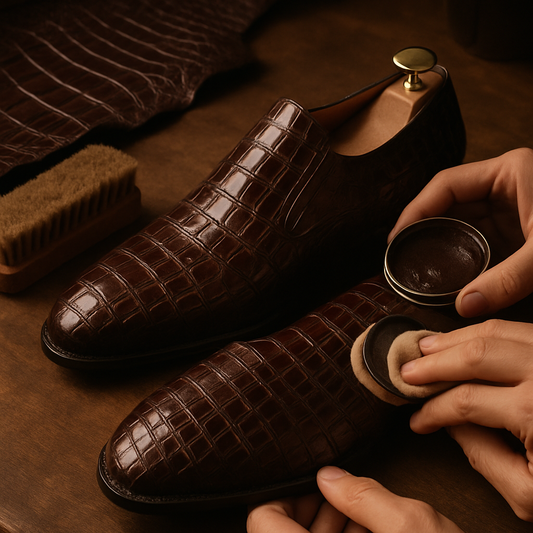

What Makes Luxury Slip On Loafers Men Worth Buying? Quality, Craft and Longevity

Condividi
What Makes Men’s Luxury Slip-On Loafers Worth Buying? Quality, Craft, and Longevity
Men’s luxury slip-on loafers earn their higher cost when the leather, pattern placement, fit, and construction are chosen to suit repeated wear rather than only a showroom appearance.
A well-made slip-on is not defined by a logo or by the word “genuine” on a product label. In leather terminology, “genuine leather” can be a low-end trade term for split or lower-cut leather, so it does not by itself describe the grade, origin, or durability of the material. For luxury slip on loafers men can wear often, the useful questions are more specific: what hide is used, how much usable hide area was available, how the vamp was cut, whether the scales or grain are well placed, and whether the shoe fits the wearer’s foot shape.
Leather Quality Begins With What Is Actually Used
Full-grain leather retains the outer grain surface of the hide. It is not a separate layer above top-grain leather; rather, it is the least-corrected version of the top layer. Because the natural grain remains intact, it commonly has greater resistance to wear than heavily corrected leather, although the finished result still depends on tanning, thickness, construction, and care.
Top-grain or corrected-grain leather has had its surface lightly sanded, buffed, or otherwise mechanically altered to reduce visible marks and create a cleaner-looking finish. That can produce a more regular surface, but it also changes the original grain. Neither description replaces a close inspection of the leather’s finish, firmness, flexibility, and consistency across the shoe.
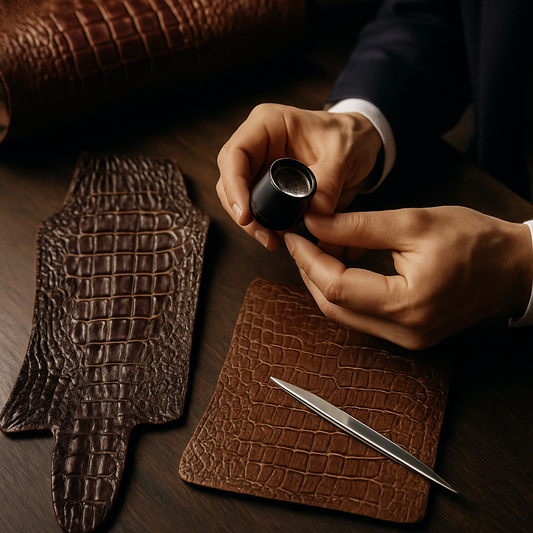
For reptile loafers, species identification matters. Genuine alligator belly leather has a comparatively regular scale pattern, particularly across the central belly area. Crocodile leather can vary substantially by species and often shows visible sensory pores, also called integumentary sensory organs or ISOs, on ventral scales. Alligator belly scales generally do not show these pores, though alligator skin may show an umbilical scar that crocodile lacks.
These characteristics are useful for evaluating material, but one feature alone does not prove authenticity. A reliable assessment combines the scale structure, pore placement, hide markings, seller documentation, and the stated species. CITES paperwork concerns lawful international trade compliance; it is not, by itself, proof that a particular shoe is authentic alligator or crocodile leather.
Why Hide Placement Changes the Look of a Slip-On
The vamp is the most visible section of a mule or loafer, so hide placement has a direct effect on whether the shoe looks intentional. At CrocodileViet, we evaluate central scale areas for prominent vamp panels because flatter, more regular scales help create a controlled appearance across the part of the shoe seen from above. Smaller or more irregular scale areas can still be attractive, but they need to be positioned with the shoe’s pattern in mind rather than treated as interchangeable material.
This is particularly relevant to alligator mules for men. A mule exposes more of the foot opening and places strong emphasis on the front panel, so uneven scale direction or an awkwardly placed scar can draw attention quickly. A paired set should also be assessed side by side: the left and right shoes do not need identical scales, because reptile hides are natural materials, but the visual weight, scale size, and overall direction should work together.
Crocodile leather mules bring a different surface character. Depending on the crocodile species and hide section, their scales and visible pores can create a more varied texture than alligator belly. That variation is part of the material’s identity, not automatically a defect. The important question is whether the maker has placed the hide to work with the shoe’s shape and whether the result suits the wearer’s preference for a calmer or more pronounced pattern.
What Craft Means Beyond the Leather
Good leather cannot compensate for a poorly shaped shoe. Craft in a luxury slip-on includes the relationship between the upper, lining, insole, sole, edge finishing, and last—the foot-shaped form used to shape the shoe. These components determine how the loafer holds its profile, where it bends, and how it feels after more than a few minutes of walking.
A worthwhile pair should have clean transitions where the upper meets the sole, a stable heel area, and an opening that does not cut sharply into the instep. The upper should bend near the ball of the foot rather than collapsing in an arbitrary crease across the vamp. On exotic leather, this matters even more because scales are less forgiving of repeated stress in the wrong place.
Handwork can add value where it improves pattern cutting, scale matching, edge work, or final fitting. It is not valuable merely because it is described as handmade. Ask what part of the work required hand shaping or hand finishing and what practical result that produces in the finished mule or loafer.
| Decision factor | What to inspect | Why it affects value |
|---|---|---|
| Species and material | Stated species, natural scale pattern, grain surface, and supporting documentation | Different hides have different availability, visual character, and usable cutting areas. |
| Hide grade | Scars, scale condition, finish consistency, and how visible marks are positioned | Grade labels differ among suppliers and tanneries, so the actual panel matters more than a label alone. |
| Usable hide area | Whether broad, visually coherent sections were available for the vamp and paired shoe panels | Large, well-matched areas are limited and influence cutting yield. |
| Scale matching | Relative scale size, direction, and visual weight across the left and right shoes | Thoughtful matching produces a more composed pair without pretending that natural hides are identical. |
| Construction and handwork | Upper shaping, lining, sole attachment, edge finishing, and finishing quality | These details affect comfort, flex, repairability, and how the loafer wears over time. |
Why Luxury Slip-On Loafers Vary in Price
The price of a luxury slip-on should reflect identifiable inputs rather than a broad claim of “quality.” Species is one factor, since alligator and crocodile hides have different trade availability and visual structures. Hide grade also affects cost, although grade names are not universal: one tannery’s terminology may not mean the same thing as another’s.
Usable area is especially important in footwear. A hide can be large overall but offer limited sections suitable for a clean vamp, especially where scale size, marks, and directional cutting must be considered. Scale matching across a pair uses additional planning and can reduce cutting flexibility. Construction choices, lining material, sole work, and skilled handwork further affect the final cost.
A lower price is not automatically a poor purchase, and a high price is not automatic evidence of better making. Compare the stated material, the actual panels shown, the construction details provided, fit support, and after-sale care guidance before judging value.
Fit: Length Is Only One Part of the Decision
Slip-ons need secure heel placement without excessive pressure across the instep. A shoe that is correct in length can still feel unsuitable if the vamp is too low for a high instep, if the toe box is too narrow, or if the wearer needs a wide fit. Mules require additional attention because the open-back design changes how the foot is retained during walking.
For in-person fitting, try both shoes while standing and walking on a firm surface. Check toe room, heel movement, pressure over the instep, and whether the forefoot sits naturally without spilling over the sole edge. Wear the type of sock—or no sock—you expect to use with the shoes.
For remote ordering, foot measurements are equally important. Measure both feet from heel to longest toe and use the larger result. Also measure forefoot width and, where possible, the instep circumference around the highest part of the foot. EU, US, and UK sizing systems convert differently between brands, so a numbered size should be checked against the maker’s stated sizing information rather than assumed from a previous pair.
Where Nubuck Alligator Mules Fit In
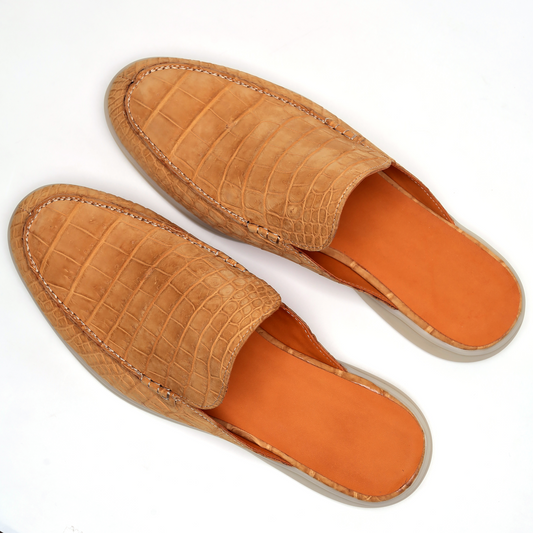
Nubuck alligator mules have a softer, brushed surface appearance than glossy reptile leather. The nap can make the scales appear quieter and less reflective, which suits men who want the material’s structure without a high-shine finish. It also means surface care needs more restraint: aggressive rubbing can disturb the nap or create uneven-looking areas.
Choose nubuck for relaxed tailoring, linen trousers, cotton chinos, or refined resort wear where a matte surface makes sense. A polished alligator or crocodile slip-on may suit evening trousers, dark denim, or a tailored dinner jacket more naturally. These are styling directions rather than fixed rules; color, sole profile, and the rest of the outfit can shift the result.
Care That Supports Long-Term Wear
Use a soft, dry cloth as the default method for removing dust after wear. For nubuck surfaces, use a suitable soft brush with light strokes rather than pressing hard into the leather. If a mark requires more than dry care, use only a lightly damp cloth as a last resort, test it on an inconspicuous area first, and avoid soaking the upper.
Keep slip-ons away from prolonged direct heat, heavy rain, and sealed storage while damp. Let the shoes dry naturally at room temperature if they become wet. Conditioning should be based on how dry the leather appears and how frequently the shoes are worn, not on a fixed calendar schedule. Products that are acceptable for smooth leather may darken, clog, or alter nubuck, so match any treatment to the specific finish.
Use shoe trees or appropriate stuffing to help preserve shape between wears, particularly for closed-back loafers. For mules, store them flat and avoid stacking heavy objects on the vamp, since pressure can affect the shape and surface presentation of reptile scales.
Styling Men’s Luxury Slip-Ons
Business-casual settings
- Dark brown or black slip-ons with wool trousers and an open-collar shirt.
- Matte nubuck alligator mules with tailored chinos and a lightweight overshirt.
- Low-profile loafers with a fine-gauge knit polo and straight-leg trousers.
Evening and social occasions
- Polished reptile loafers with dark denim, a crisp shirt, and an unstructured blazer.
- Black slip-ons with tapered trousers and a dinner jacket where the shoe’s finish complements the formality of the outfit.
- Deep brown crocodile leather mules with monochrome neutral clothing for a textured focal point.
Warm-weather and resort dressing
- Nubuck alligator mules with linen trousers and a camp-collar shirt.
- Natural-toned slip-ons with cotton drawstring trousers and a restrained leather belt.
- Open-back mules with tailored shorts only where the setting is informal and the sole profile is proportionate to bare ankles.
Buying With Better Questions
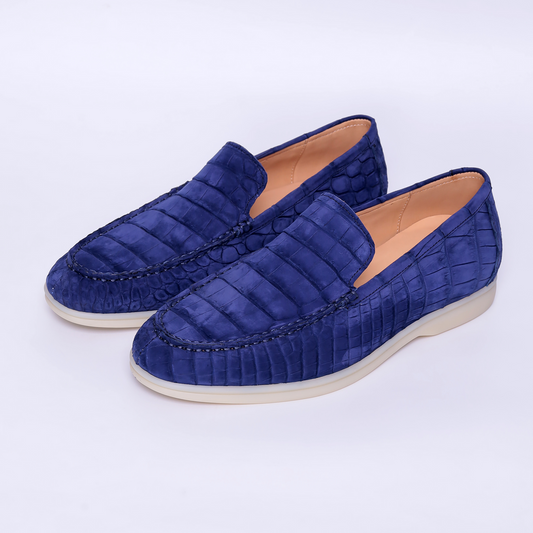
The strongest reason to buy men’s luxury slip-on loafers is not the category name; it is the combination of material clarity, thoughtful hide placement, wearable construction, and fit for your actual foot. Ask for the species where relevant, inspect whether the leather is natural reptile hide or embossed leather, and remember that embossed croc-grain is commonly calfskin or another leather with a pressed pattern rather than genuine crocodile or alligator.
If you prefer an open-back style with a matte reptile finish, view CrocodileViet’s natural tan nubuck alligator mules for men. For sizing or material questions before ordering, contact CrocodileViet via WhatsApp with your foot length, width, and instep measurements.