
How to Choose How To Spot Real Alligator Leather for Business Wear

Condividi
How to Spot Real Alligator Leather for Business Wear
Real American alligator leather for business wear is leather from Alligator mississippiensis, typically showing a non-repeating scale pattern and belly scales without visible sensory-pore dots.
Learning how to spot real alligator leather starts with separating three different questions: whether the surface is genuine reptile leather rather than embossed cowhide, whether it is alligator rather than crocodile, and whether the visible panel has been selected and made well enough for office use. A convincing answer comes from several checks used together—not one texture, label, or document in isolation.
Start with the scale pattern, not the shine
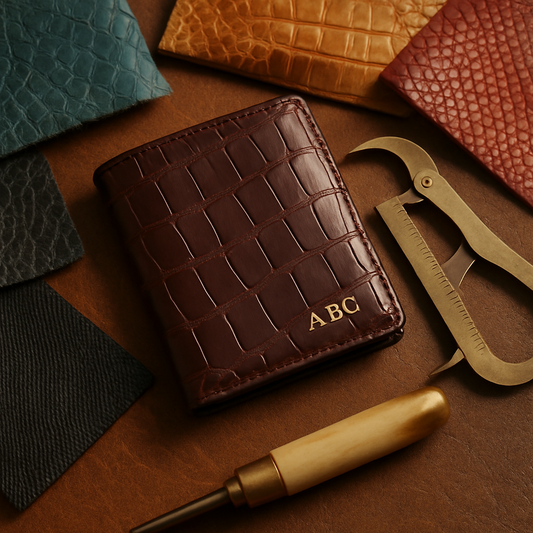
Real alligator leather has a pattern created by individual scales, so its layout changes across the hide. The scales do not repeat in the mechanical sequence commonly seen on embossed “croc” grain cowhide. This does not mean every real hide looks wildly irregular: the alligator belly is valued precisely because its scale field is comparatively regular and balanced. The key is that the pattern still has natural variation in scale size, boundary shape, and transitions from one area of the hide to another.
For business wear, inspect the panel that will be seen most often: the front of a briefcase, the outer face of a portfolio, a belt strap, or the vamp of a shoe. A strong business-facing panel generally has scales arranged in a calm, balanced field rather than a distracting concentration of scars, broken scale edges, or abrupt pattern changes.
At CrocodileViet, we assess the intended display panel rather than judging a hide only from its overall appearance, because the scale flatness and visual balance on the outward-facing area determine how controlled the finished business piece looks in use.
Check for the alligator-versus-crocodile cue
A useful distinction between alligator and crocodile is the sensory pore, often called an ISO. Crocodile belly scales often show a small visible pore dot on each scale; alligator belly scales generally do not show these dots. Under bright indirect light, look closely across several belly scales rather than relying on one mark or one photograph.
This cue helps with how to tell real crocodile leather from real alligator leather, but it should not be treated as a stand-alone authenticity test. Finishing, lighting, camera resolution, wear, and the location of the cut can obscure surface details. Use the pore check alongside the scale layout, the seller’s species description, the cut being offered, and traceable documentation where appropriate.
| Decision factor | What to examine | What it can indicate |
|---|---|---|
| Scale layout | Changes in scale size and shape across the panel; no mechanically repeating grain sequence | A natural hide pattern rather than an embossed imitation |
| Belly-scale pores | Small dots within crocodile belly scales, viewed across multiple scales | A practical species clue: crocodile often shows pores, while alligator generally does not |
| Umbilical scar | A distinctive scar feature that may appear in an alligator belly cut | An additional alligator characteristic; its absence does not settle the question because many cuts do not include it |
| Documentation | Species description, traceable tag or serial information, and cross-border paperwork where relevant | Supports lawful, traceable sourcing and lets a business buyer investigate the claim further |
| Visible panel selection | Scars, scratches, shading, scale deformities, and pattern interruptions on the main display area | Visual grade and suitability for a formal business-facing product |
Understand why belly cuts matter in business pieces
Commercial alligator hides are commonly measured by belly width in centimetres. That convention reflects the value of the belly and prime pattern area, where broad, balanced scales can be placed on visible product panels. A wider usable belly can give the maker more freedom to cut a briefcase front, portfolio cover, belt section, or shoe vamp with a more continuous scale field.
Not every part of a genuine alligator hide is intended to look the same. Flank, tail, and other areas have different scale structures, and a product may use them by design. For conservative business wear, ask which section forms the outward-facing panel. A seller who can identify the hide section gives you a more useful answer than one who simply says “real alligator.”
An umbilical scar can also appear on an alligator belly cut. It is a naturally occurring feature, not damage created during manufacturing. Some buyers like it as a recognisable alligator detail, while others prefer a cleaner central panel for formal work settings. Its presence can support an alligator assessment, but a product without an umbilical scar may simply have been cut from another part of the belly.
Read quality grades carefully
Authenticity and visual grade are separate matters. A real alligator product can have a lower visual grade because of scars, scratches, shading differences, or scale deformities in the visible belly area. Conversely, a clean-looking surface alone does not establish species or lawful sourcing.
A 1-to-5 grading approach is common in commercial alligator trade. Under one widely used convention, Grade 1 refers to a belly area without defects, with lower grades allowing progressively more visible imperfections. The labels and thresholds are not universal: suppliers and tanneries can apply different inspection rules, name grades differently, or assess particular defect types differently.
For that reason, treat crocodile leather quality grades and alligator grading terms as a starting point for questions, not a complete buying decision. Ask where a defect sits. A mark outside the prime belly or pattern area can have much less effect on the finished appearance than a small mark located in the centre of a briefcase front or belt strap.
Documentation supports traceability, not a single-proof claim
Alligator and crocodile leather are generally regulated under CITES Appendix II. For cross-border trade, legitimate shipments typically require traceable tagging and documentation. For American alligator products, a CITES tag or serial number is an important compliance and traceability check, particularly for business buyers purchasing in volume or importing goods.
Documentation does not by itself prove every claim about the finished item’s leather, grade, or construction. It does, however, give the buyer information that can be checked against the stated species, seller records, and transaction details. Missing traceable paperwork is a reason to ask more questions before proceeding with an international or wholesale purchase.
Why real alligator leather costs more than an embossed alternative
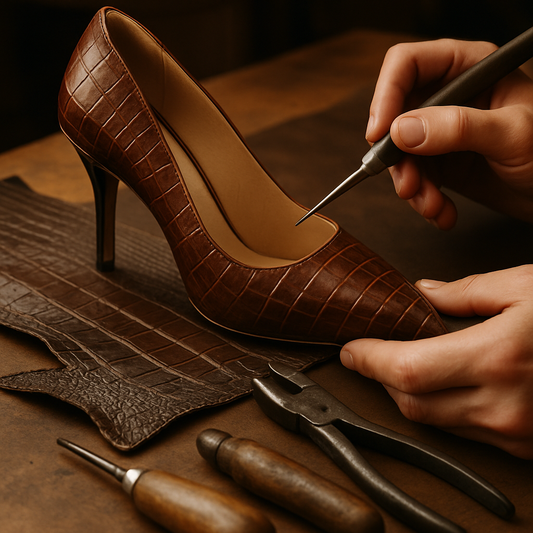
Price should reflect identifiable production and material variables rather than a vague claim of “quality.” For genuine alligator, the main cost drivers include species, hide grade, usable belly area, scale matching across visible panels, construction complexity, and the amount of handwork required for cutting, edge finishing, assembly, and inspection.
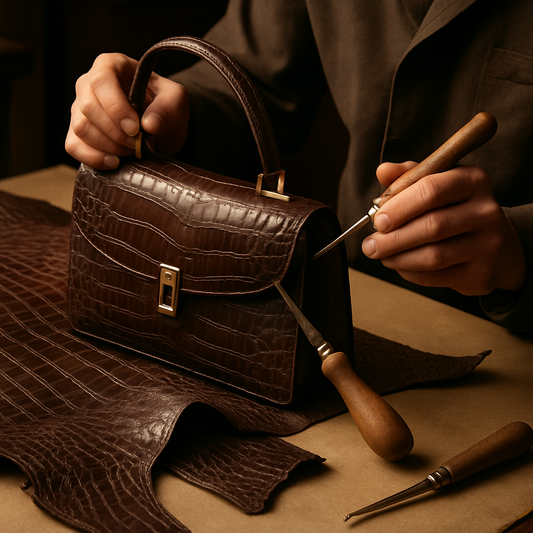
A business bag with a broad, uninterrupted belly panel requires more usable material than a small accessory. Matching the scale direction and scale size between paired or adjacent panels can further reduce usable yield. A lower grade may still be appropriate for areas where the pattern is less exposed, while a cleaner belly section is often reserved for the outward-facing panel. These choices explain why two genuine alligator items can be priced very differently without either being misrepresented.
Choose the right alligator presentation for the workplace
For formal meetings, client presentations, and conservative offices, a dark alligator piece with a balanced belly-scale panel tends to read more restrained than a highly contrasting or heavily glazed finish. Useful options include:
- Black or deep brown portfolios for suits, tailored separates, and formal meeting rooms.
- Dark belts with a controlled scale field for business trousers and leather shoes.
- Briefcases or document holders with cleaner central panels for client-facing work.
For business-casual workplaces, a warmer brown, charcoal, or muted blue-grey alligator accessory can work with chinos, wool trousers, knit polos, and unstructured jackets. The practical aim is not to match every leather item exactly; it is to keep the scale pattern, finish level, and surrounding materials consistent with the formality of the setting.
Care that preserves a business-ready surface
Use a soft, dry cloth for routine dust removal. If a mark requires more than dry wiping, use a lightly damp cloth only as a last resort, test an inconspicuous area first, and avoid soaking the leather or working moisture into seams and edges. Let the item dry naturally away from direct heat.
Conditioning needs depend on climate, use, finish, and how the leather feels, so a fixed calendar schedule is not reliable. Avoid household oils, strong cleaners, abrasive polishing, and products intended for smooth bovine leather unless their suitability for reptile leather is clear. For a structured business bag or footwear, storage that prevents crushing helps protect the visible scale field and the item’s shape.
Questions to ask before you buy genuine alligator leather products
- Is the leather specifically identified as Alligator mississippiensis, rather than described broadly as “croc” or “reptile” leather?
- Which hide section forms the main visible panel: belly, flank, tail, or a combination?
- Are there scars, shading shifts, or scale irregularities on the outward-facing area?
- How was the stated grade defined, and whose grading system was used?
- For international or business-volume purchases, what traceable CITES-related documentation or serial information is available?
- Can the seller provide close photographs in neutral light, including scale boundaries and the product’s central display panel?
Buy with a species-specific checklist
The most reliable way to spot real alligator leather is to combine a natural non-repeating scale layout, alligator-appropriate belly characteristics, an accurate species description, meaningful information about the cut, and traceable sourcing records where trade rules apply. For business wear, add one further question: does the visible panel have the balanced scale arrangement and low-distraction surface appropriate to your workplace?
For more leather-buying information from CrocodileViet, visit our news and leather knowledge section. You can also contact CrocodileViet through WhatsApp to discuss species descriptions, visible hide sections, and documentation questions before ordering.