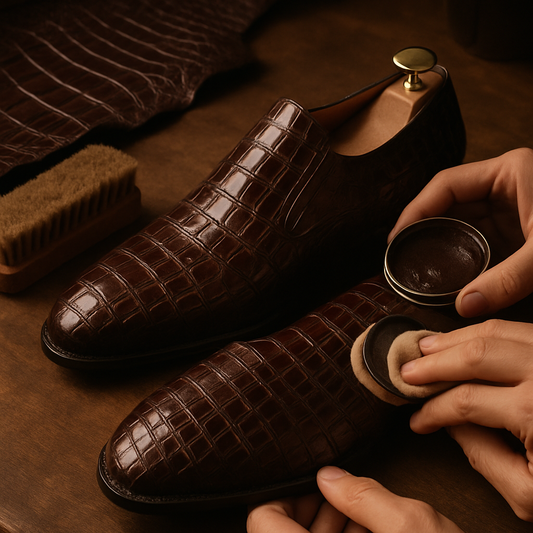

How to Choose How To Spot Real Alligator Leather for Business Wear

Condividi
How to Spot Real Alligator Leather for Business Wear
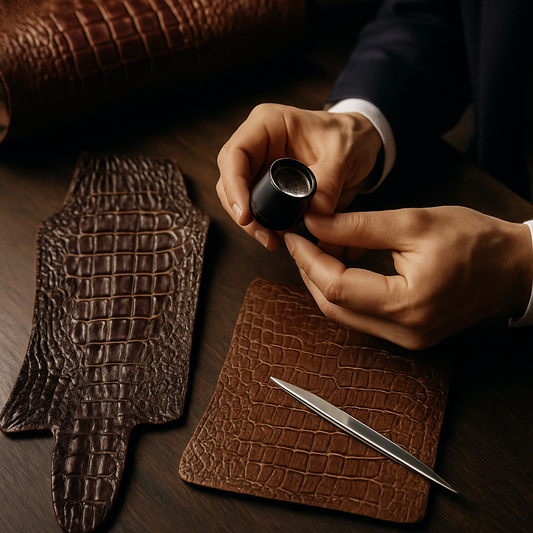
Real alligator leather usually shows non-repeating scales with slight natural variation; on a belly-cut item, those scales are comparatively regular and balanced rather than mechanically repeated.
For business wear, authenticity matters because an alligator belt, briefcase, shoe, or card holder is often selected for the controlled appearance of its belly scales. A convincing embossed leather may look similar from a distance, but it does not carry the individual scale boundaries, natural variation, and hide-specific markings found in genuine alligator leather.
Start with the Scale Pattern, Not a Single “Proof”
The most useful answer to how to spot real alligator leather is to inspect several features together. No single mark settles the question in every item, especially after leather has been dyed, glazed, lined, cut into narrow panels, or finished for formal business use.
On real alligator leather, the scales have naturally varied outlines and dimensions. The variation can be subtle on the belly, where the tiles tend to appear smoother and more regularly arranged, but the pattern should still avoid the repetitive, stamped rhythm often seen on embossed alligator-grain leather.
Embossed material may repeat the same cluster of scales across a broad panel. Its grooves can also appear unusually consistent in depth and spacing. That does not automatically make embossed leather poorly made; it is simply a different material and should be described as embossed, alligator grain, or croc-grain rather than genuine alligator leather.
Check Whether the Product Uses Belly or Hornback Leather
“Belly” and “hornback” identify sections of the hide, not a ranking that applies to every product. For restrained office dressing, belly leather is commonly the relevant section because its flatter scales can create a more orderly surface across a belt strap, shoe vamp, portfolio panel, or wallet exterior.
Alligator belly generally has a regular, balanced scale layout compared with more raised sections of the hide. This helps a maker place panels with visual balance in mind: scales can run cleanly along a belt, sit evenly across a shoe upper, or frame the front of a business case without abrupt ridges.
Hornback comes from the spinal area and has raised ridges. It offers a more textured appearance, which may suit a casual or assertive accessory, but it reads differently from the flatter alligator belly finish usually associated with conservative business wear. A seller should identify the section used rather than implying that hornback or belly alone determines the value or service life of an item.
Use Alligator-versus-Crocodile Clues Carefully
People researching how to tell real crocodile leather often encounter the sensory pore test. Crocodile scales commonly show small visible sensory pore dots, sometimes called ISOs, while alligator scales generally do not show them in the same way. This can be a helpful comparison point, particularly on suitable belly scales under good light.
It should not be treated as stand-alone authentication. Finishing, dye, glare, scale size, cut placement, and wear can obscure small surface details. Instead, combine pore observation with the scale pattern, the section of hide, the seller’s material description, and documentation where relevant.
An alligator may also show an umbilical scar on the belly, a feature crocodile does not have. On a finished business item, however, that scar may have been cut away or placed where it is not visible. Its presence can support identification; its absence does not settle the material question.
| Decision factor | What to examine on an alligator business item | What the finding can and cannot indicate |
|---|---|---|
| Scale repetition | Look across the full visible panel for varied scale outlines and spacing. | Natural variation supports real hide; a strongly repeating motif may indicate embossing. |
| Belly arrangement | Check for flatter, comparatively regular and balanced tiles. | This is consistent with alligator belly leather, but belly placement should be disclosed by the seller. |
| Sensory pores | Inspect suitable scales in indirect light for small pore dots. | Visible pores are more commonly associated with crocodile; surface finishing can limit what is visible. |
| Umbilical scar | Look for a natural belly scar only if the panel is broad enough to include it. | It may support an alligator identification, though many finished pieces will not show one. |
| Material description | Read whether the seller states genuine alligator leather or embossed alligator-grain leather. | Clear terminology helps compare like with like; wording should be backed by a credible seller explanation. |
Read Grade Language in Context
Alligator hides are commonly measured by belly width in centimeters, rather than by total hide length. In commercial grading, the usable belly area is central because it provides the flatter material used for many visible panels. Scars, scratches, shade variation, and scale deformities on that belly can affect the visual grade.
That grading approach has a practical implication for business wear: a broad, clean, well-positioned belly panel may cost more because it gives the maker more usable material for a front-facing surface. A narrow belt can use smaller sections than a briefcase flap or a large shoe vamp, so the required usable area changes with the product design.
Terms used for crocodile leather quality grades and alligator grades vary among tanneries and suppliers. A label such as “grade one” should therefore prompt a useful follow-up question: what visible belly characteristics does that seller mean by the term? It should not be presented as a universal standard.
Visual grade is also different from durability. A hide with fewer visible marks may be more suitable for a clean formal panel, while long-term performance also depends on tanning, thickness selection, lining, edge work, stitching, hardware, use, and care.
Why Genuine Alligator Leather Costs More
There is no responsible fixed price for genuine alligator business wear because the final amount depends on the specific item and material allocation. The main cost factors include the alligator species, hide grade, usable belly area, the need to match scales across visible panels, construction complexity, hardware, lining, and the amount of handwork required.
Scale matching can materially affect a formal piece. A maker may need to reserve larger or more compatible belly sections so the left and right shoe uppers, the face of a belt, or the exterior panels of a case look visually coherent. That reduces the amount of hide available for other cuts.
Ask what section is being used, whether the listed material is genuine alligator rather than embossed leather, and how the visible panels are arranged. These questions are more informative than relying on a general claim that an item is “high grade.”
Fit Checks for Alligator Business Accessories and Footwear
Leather authenticity does not compensate for poor fit. For an alligator belt, provide the measurement from the buckle fold to the hole you use most often on an existing belt, along with the preferred strap width. A formal trouser belt and a belt worn with heavier trousers can require different widths and hole placement.
For alligator footwear, provide actual foot length and width in addition to the stated EU, US, or UK size. Size conversions differ across brands and lasts, so the printed regional size alone is incomplete. Customers with a wide fit or a high instep should state that directly, since the toe shape, vamp volume, and instep allowance affect comfort and the way the leather sits across the foot.
An in-person try-on is useful, and remote measurements are equally important for made-to-order or distance purchases. A clear measurement set gives the maker information that a familiar shoe size may not provide, especially where one foot differs slightly from the other.
Business Styling: Keep the Alligator Surface Proportionate to the Setting
Conservative office and client meetings
- Use a dark alligator belly belt with plain leather shoes and a tailored suit.
- Choose a slim card holder or document case with flatter belly scales rather than a heavily raised hornback panel.
- Keep metal hardware restrained so the scale pattern remains the visible material detail.
Business travel and presentations
- Pair an alligator document holder with plain clothing in navy, charcoal, brown, or black.
- Use one alligator accessory at a time if the setting is formal: for example, a belt or a portfolio rather than several strongly textured pieces together.
- Check that the accessory’s size suits the task, particularly if it must carry documents, a tablet, or business cards.
Business-casual settings
- Combine an alligator belt with chinos, a collared shirt, and leather loafers or derbies.
- A hornback detail can work in less formal environments where texture is appropriate, while belly leather keeps the overall surface quieter.
- Coordinate the general warmth or coolness of the leather with shoes and watch straps rather than trying to match every shade exactly.
Care for Finished Alligator Leather
Use a clean, dry, soft cloth as the default for removing surface dust after use. If a mark requires more than dry wiping, use a barely damp cloth as a last resort and avoid saturating the leather, seams, edges, or lining. Let the item dry gradually away from direct heat.
Conditioning should respond to the leather’s condition, finish, and the maker’s care advice rather than a fixed calendar schedule. Excess product can alter the surface appearance or collect in the boundaries between scales. Before using a conditioner or cleaner, test it on a concealed area where possible and use products suitable for finished exotic leather.
Store belts without sharply creasing them, keep footwear supported with appropriate shoe trees where suitable, and avoid prolonged compression of raised scales. For a business case or portfolio, avoid overfilling it; stress at folds, corners, and closures can affect both the leather and the structure beneath it.
Documentation and Questions Before Purchase
Much of the commercial trade in alligator and other crocodilian leather is regulated under CITES Appendix II. Depending on the species, origin, and destination, cross-border trade may involve permits or species-protection documentation. Such paperwork addresses trade compliance; it does not by itself prove the authenticity of a particular finished item.
Before you buy genuine alligator leather products, ask for a precise material description, the hide section used on visible panels, photographs in neutral light, and information relevant to shipping or cross-border documentation. For a business item, it is also reasonable to ask how scale placement was planned around the front, buckle end, vamp, or flap, because those areas determine how the material reads in use.
Frequently Asked Questions
Can a regular scale pattern still be real alligator leather?
It can. Alligator belly leather often has a comparatively regular, balanced arrangement of scales. The useful distinction is between naturally varied tiles and a mechanically repeating embossed pattern.
Do visible sensory pores mean that a product is definitely crocodile?
Visible pore dots can point toward crocodile, but finishing and viewing conditions matter. Material identification is more reliable when the pores are assessed alongside pattern variation, hide section, seller description, and supporting records.
Does a cleaner-looking alligator hide provide greater durability?
A cleaner belly may carry a higher visual grade because it has fewer visible scars, scratches, shading differences, or scale deformities. Durability also depends on construction and how the finished item is used and maintained.
For more material and buying notes from CrocodileViet, visit our leather journal. You can also contact us through WhatsApp to discuss material descriptions, measurements, and business-wear requirements before ordering.