
How to Choose Alligator Handbag for Business Wear

Condividi
How to Choose an Alligator Handbag for Business Wear
A true alligator handbag typically has smooth-centered belly scales, and the belly is the main visual area to inspect when choosing a bag for business wear.
Business use places different demands on an alligator handbag than occasional evening use. The bag needs a controlled scale layout, a practical interior, hardware that suits a professional setting, and dimensions that carry your daily work items without looking oversized. At CrocodileViet, we assess the belly panel closely because its relatively regular, balanced scales give the front of a handbag a composed appearance and allow more deliberate pattern placement.
Start With the Alligator Belly Panel
The belly is usually the focal point of an alligator handbag. Its scales are flatter and more balanced than the scales found toward the back, flanks, and tail, which helps a structured work bag look visually orderly across its broad front panel.
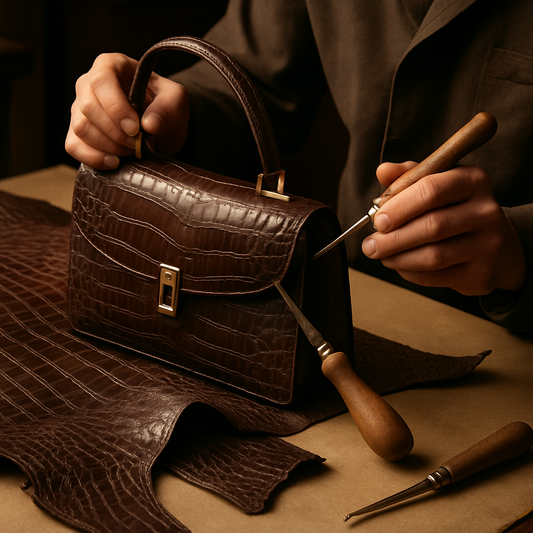
Look at the full front of the bag rather than one attractive scale near the center. A good business-oriented layout generally has scales that transition gradually in size from the middle toward the edges. The panel should look intentional at the handle mounts, flap edge, gussets, and corners, rather than appearing as though the best portion of the hide was reserved for only one small area.
At CrocodileViet, belly cuts are selected for prominent handbag panels because scale flatness and visual balance matter on a bag carried at meetings, in offices, and during client-facing travel. This is not simply a question of rarity: a well-positioned belly panel gives the maker more control over the symmetry and proportion seen from normal carrying distance.
Inspect More Than the Front Panel
A front panel can look clean while the rest of the bag reveals weaker planning. Check the back, side gussets, bottom, handle tabs, and flap or zip surround. Small natural marks may be placed in lower-visibility areas, but they should not interfere with seams, folds, or stress points.
Alligator often has an umbilical scar on the belly, a natural feature that crocodile generally lacks. Its presence can support an assessment of the material, but one trait alone does not establish authenticity. Scale structure, hide characteristics, construction, seller documentation, and the product’s traceable information should be considered together.
Understand Visual Grade Without Confusing It With Durability
In common alligator-hide grading systems, Grade 1 refers to a belly area with no defects, while higher grade numbers indicate more or more noticeable defect clusters. These labels are useful shorthand, particularly for the visible belly portion used on handbags.
Grade terminology is not universal. Suppliers and tanneries can apply their own criteria, so a stated grade should prompt useful questions: Which part of the hide was graded? Are the marks on the main display panel or elsewhere? Is the assessment based on the finished bag or the raw hide?
A higher visual grade does not automatically mean a more durable handbag. Durability also depends on hide thickness and preparation, reinforcement at handles and straps, lining structure, edge finishing, hardware installation, and how the bag is used. A lower visual grade may be suitable for a work bag if its marks are discreetly positioned and the construction is sound.
Choose a Business-Appropriate Shape and Capacity
The right alligator handbag should match the workday items you actually carry. Before choosing a silhouette, place your usual essentials together: phone, wallet, keys, notebook, charging cable, glasses case, cosmetics pouch, and any tablet or document folder. This provides a more reliable capacity target than judging the bag only by exterior appearance.
| Decision factor | What to check | Why it matters for business wear |
|---|---|---|
| Exterior dimensions | Length, height, and base width in centimetres or inches | These measurements determine whether documents, a tablet, or daily organisers fit without distorting the bag. |
| Interior layout | Open compartment, zip section, slip pockets, and closure type | Work essentials are easier to retrieve when smaller items do not collect at the bottom. |
| Handle drop and strap length | Distance from the top of the bag to the inside of the handle or shoulder strap | It affects whether the bag can be carried comfortably over office clothing, including a blazer or coat. |
| Base structure | Flat base, feet, gusset construction, and corner protection | A stable base helps the bag stand upright during meetings and reduces unnecessary abrasion on the bottom. |
| Scale matching | Scale flow across the front, back, flap, and gussets | Balanced matching keeps a structured business bag from looking visually fragmented. |
For a document-heavy role, a structured top-handle bag or work tote may suit better than a compact shoulder style. For commuting, an adjustable shoulder strap can reduce the need to carry the bag in hand throughout the day. An exotic leather shoulder bag can work in a business setting if the strap, closure, and body proportion keep the bag close to the wearer and prevent the contents from shifting.
Remote measurements deserve the same attention as an in-person trial. Compare the listed length, width, height, handle drop, and strap drop against a bag you already use successfully. If you plan to carry a laptop, measure the device with its sleeve rather than relying on the screen size alone.
Select a Colour and Finish for Your Working Wardrobe
For regular office use, select a colour based on the clothes, shoes, and outerwear you wear most often rather than one special outfit. Dark neutral alligator handbags commonly work with navy tailoring, charcoal trousers, black dresses, white shirts, and restrained prints. Brown tones can suit beige, olive, cream, tobacco, and blue business clothing.
- Formal meetings and presentations: choose a structured form, restrained hardware, and a colour that does not compete with your suit or dress.
- Daily office work: choose enough interior room for your organiser and technology, with a closure that keeps contents contained during commuting.
- Business dinners: a smaller top-handle or shoulder bag may be easier to manage than a large document bag while still carrying personal essentials.
- Travel between appointments: prioritise a secure top closure, comfortable carry options, and a base that can be placed down without the bag collapsing.
Colour matching does not require identical leather tones between bag and footwear. A black alligator handbag can sit comfortably with dark brown shoes, for example, when the clothing creates a clear transition between them. The more important consideration is whether the overall outfit has a deliberate level of formality.
What Determines the Price of an Alligator Handbag?
The price of an alligator handbag reflects far more than the word “alligator.” Species, hide grade, usable belly area, and the amount of clean skin available for large panels affect material cost. A handbag requiring broad, closely matched front and back panels uses hide differently from a small pouch or card holder.
Scale matching also affects price. Matching the progression and orientation of scales across a flap, paired gussets, handles, and main body requires more selective cutting, which can reduce usable material. Construction adds further variables: structured reinforcement, lining complexity, hardware, edge work, internal pockets, and the amount of handwork involved in assembling irregular natural material all influence the final figure.
Be cautious with vague material descriptions. “Genuine leather” is a broad leather-industry term and does not indicate top-grade alligator. Likewise, alligator-grained leather is embossed leather designed to resemble alligator skin rather than actual alligator hide.
Check Material Description and Trade Documentation
An alligator handbag should be described clearly as alligator, not loosely presented under a generic exotic-leather label. Crocodile and alligator have different visual characteristics: crocodile leather varies more by species and often shows visible sensory pores, sometimes called ISOs, in many scales. Those pores can be helpful during examination, but they are not by themselves proof of authenticity.
If a listing uses the phrase crocodile leather bag while you specifically want alligator, ask which animal and hide section were used. The same care applies to a crocodile briefcase men may be considering for work: the material name should not be treated as interchangeable with alligator.
CITES documentation relates to legal trade compliance for crocodilian leather goods and cross-border movement; it does not by itself prove that a handbag is authentic. However, a traceable reference number or appropriate trade paperwork can be important evidence of provenance, especially when purchasing across national borders. Missing documentation warrants further questions about sourcing and movement of the item.
Care for a Business Bag Without Over-Treating It
Use a clean, dry, soft cloth for routine dust removal. This is usually sufficient after normal office use. If a mark needs more attention, use a lightly dampened cloth only as a last resort, avoiding saturation around seams, edges, handle attachments, and lining openings.
Keep the handbag away from prolonged direct sunlight, radiators, vehicle heat, and very humid storage. Store it supported with soft, clean filler so the gussets and base retain their intended shape. Do not overfill it with heavy documents or electronics beyond its practical capacity, as excess weight places stress on handles, closures, and structured corners.
Conditioning should respond to the leather’s condition, the climate, and the specific finish rather than a fixed calendar schedule. Test any leather-care product on a concealed area first, and avoid household oils, harsh cleaners, alcohol-based wipes, and products that leave a heavy surface coating.
Questions to Ask Before Buying
Is the visible panel cut from alligator belly?
Ask which hide section forms the front and back panels. Belly leather is particularly relevant on a handbag because it is the area most people see and commonly the area used for visual grading.
Are the listed dimensions internal or external?
Exterior dimensions help assess proportion, while internal dimensions determine whether your notebook, tablet, or document folder will fit. Both measurements are useful for a work bag.
Where are natural marks located?
Natural marks can occur on genuine hide. Ask whether they appear on the main belly panel, under a flap, along a gusset, or near a seam, then decide whether that placement suits your expectations for business use.
What documentation accompanies cross-border delivery?
For international movement, ask what reference information and trade documentation are available for the specific item and destination. Requirements can vary by route and jurisdiction.
Choose for Daily Use, Not Only First Impression
A business-ready alligator handbag is one whose belly scales are visually balanced, whose dimensions suit your actual workday, and whose construction supports the way you carry it. Inspect the whole bag, clarify the material description, compare measurements with your daily essentials, and treat visual grade as one part of the decision rather than the entire answer.
View CrocodileViet’s alligator handbag collection to compare bag shapes and details. For questions about dimensions, carrying needs, or available documentation, contact us via WhatsApp.