
How Crocodile Leather Boots Men Are Made: From Hide Selection to Hand Finishing

Condividi
How Men’s Crocodile Leather Boots Are Made: From Hide Selection to Hand Finishing
Men’s crocodile leather boots are made by cutting the visible boot panels from selected crocodile hide, assembling those panels around a shaped last, and finishing the edges, seams, and surface by hand.
What this process covers
This article focuses on genuine crocodile boots for men, from choosing a suitable hide through cutting, panel matching, boot construction, fitting, and final hand finishing. The visible result depends on more than the animal species: the usable belly area, scale layout, surface defects, boot pattern, construction method, and amount of handwork all affect the finished pair.
1. Selecting a crocodile hide for boot production
The first decision is which part of the crocodile hide will become the outside of the boot. Belly skin is the main cutting area for a smooth-scale crocodile boot because its scales lie flatter than the raised scutes on the back. “Hornback” refers to dorsal skin with raised bony scutes, so it produces a substantially different appearance and construction surface.
For a conventional crocodile boot, the workshop examines the central belly area before looking at the outer sections. This matters because defects in the main cutting zone affect the most visible panels and reduce the amount of usable leather. Common issues include scars, stains, cuts, holes, scale deformities, and bony buttons.
Crocodile belly scales often show small sensory pores, while scale appearance by itself cannot definitively identify a species. Pores, the hide’s documentation, and traceability information need to be considered together rather than treating one visual feature as proof.
What hide grade means
Hide grades generally relate to defects and usable cutting yield within a specified belly or pattern area. Grade names and counting systems vary between suppliers, tanneries, species, regions, and buyers, so a label should not be treated as a universal scale.
A visually high-grade hide may have a clean central pattern but less usable area than a larger hide with minor defects outside the main panels. For boots, the practical question is whether the hide can provide two matched vamp areas, suitable quarters, and enough material for the shaft or other upper sections without forcing distracting flaws into prominent positions.
2. Preparing the leather after tanning
Crocodile hides are commonly chrome-tanned. The pale-blue intermediate material produced early in that process is called wet blue; it is subsequently retanned, dyed, and finished to achieve the required color, handle, and surface appearance.
Before cutting, the leather needs to be assessed for thickness, flexibility, grain direction, color consistency, and surface response. A boot upper cannot be planned from color alone. Leather that looks attractive on a flat table may behave differently over a curved toe or around the instep.
The finish also affects how clearly the scale pattern appears. A more reflective surface emphasizes scale edges and pores, while a softer finish can make the pattern appear quieter. Neither finish automatically indicates better durability. Visual grade and wear performance are separate considerations.
3. Planning the pattern around the scales
Pattern planning is where crocodile work differs from cutting ordinary cow leather. A bootmaker must position each paper pattern so the scales flow in a controlled direction and the most visible areas receive the most suitable part of the hide.
The vamp, which covers the toe and front of the foot, usually receives close attention because it bends during walking and occupies the strongest visual position. The quarters sit around the heel and sides, while the shaft rises above the ankle. Each section has different curvature, stress, and visibility requirements.
At CrocodileViet, the reason for controlling the scale direction is practical: balanced scale progression makes the left and right boots read as a pair, while poor placement can make one boot appear visually heavier even if both pieces are cut from the same hide. Scale matching is therefore a pattern and usability decision, not only a decorative preference.
Some natural variation is expected. Crocodile scales do not form a printed grid, and a handmade pair may show slight differences in spacing or texture. The aim is controlled visual continuity, not a claim that every scale will be identical.
4. Cutting the crocodile panels
Once the pattern positions are established, the leather is cut into the upper components. The cutter has to account for scale edges, softer areas between scales, stretch direction, and any marks that should be kept away from the toe or vamp.
Cutting too close to a defect can leave little room for stitching or lasting. Cutting too conservatively can waste usable area and raise the material cost. This is one reason a larger hide is not automatically the economical choice: its value depends on the amount of suitable leather that can be turned into correctly positioned boot panels.
Pairs are checked together during this stage. The goal is to give the two boots a related scale rhythm, while allowing for the natural differences found in genuine crocodile hide.
5. Building the boot upper
The cut panels are skived or prepared at selected edges so adjoining pieces can be joined without unnecessary bulk. They are then positioned, secured, and stitched according to the boot design. The exact construction varies between models, but the upper must account for the toe shape, heel structure, instep height, shaft opening, and intended sole assembly.
Stitch placement has both structural and visual consequences. A seam crossing an important scale line can change the appearance of the panel, while excessive thickness at a join can create pressure points inside the boot. The maker therefore has to balance scale placement with the requirements of the pattern.
For styles such as crocodile Chelsea boots, the elastic side sections and close ankle opening add another fitting concern. The crocodile panels must sit neatly beside the stretch insert without restricting foot entry or creating a hard edge at the ankle.
6. Lasting and shaping the upper
Lasting means pulling and securing the upper around a three-dimensional foot-shaped form called a last. This gives the boot its toe profile, instep shape, heel position, and overall fit.
Crocodile leather requires controlled handling during shaping. Excessive tension can distort the scale arrangement or stress a seam; insufficient tension can leave wrinkles or a loose-looking vamp. The last must also correspond to the intended size and width, because a narrow last and a wide last distribute pressure differently across the same crocodile panel.
The sole, welt or other joining system, heel, and outsole are then assembled according to the design. These construction choices influence weight, flexibility, repair options, and price. Crocodile leather on the upper does not by itself define the full quality of the boot.
7. Hand finishing the completed boots
Hand finishing brings the assembled boot to its final condition. Depending on the design, this can include cleaning surface residue, refining the edges, checking stitch ends, smoothing transitions around the topline, applying suitable finishing products, and bringing the leather to the intended level of sheen.
At our workshop, the reason for inspecting these areas by hand is that crocodile scales do not respond like a flat synthetic surface. A finishing pass must respect the raised scale boundaries, avoid filling pores with excess product, and keep the left and right boots visually related. The final inspection also checks for loose threads, uneven edge work, surface marks, and fit-related distortion.
Hand finishing does not erase the hide’s natural variation. It should clarify the pattern and prepare the boot for use without presenting a manufactured surface as if every scale were mechanically identical.
Factors that influence the price of men’s crocodile boots
| Factor | Why it affects the price |
|---|---|
| Crocodile species and hide source | Different species and sources can vary in scale structure, available hide area, documentation, and material cost. |
| Hide grade and usable area | A clean, sufficiently large cutting area can reduce the need to place defects in visible panels. |
| Scale matching | Planning two related boots from the same hide takes more usable material and more cutting control than accepting unrelated panel placement. |
| Construction | Sole attachment, welt or edge structure, lining, heel, and reinforcement choices affect labor and material use. |
| Handwork | Detailed cutting, stitching, edge preparation, fitting checks, and final finishing require additional skilled labor. |
There is no responsible single price for every pair of crocodile leather boots men may find online. A quote should be tied to the crocodile species, hide grade, usable area, boot design, size, construction, and requested handwork. Trade paperwork can also depend on the species, country, and transaction. Recognizable crocodilian-skin products entering international trade may require permits or certificates, subject to applicable exemptions, and individually applied tags can include origin, serial, and species information. These documents support trade traceability; they are not a universal consumer-facing label for every pair.
How to choose the right boot size and fit
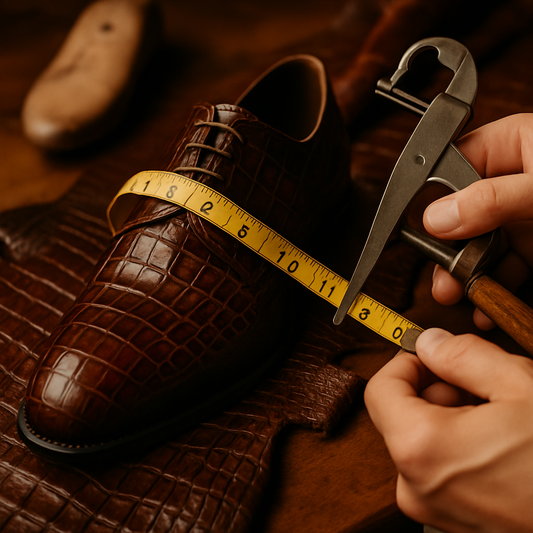
Start with foot length and width rather than relying only on your usual shoe number. A useful measurement set includes both feet, heel-to-longest-toe length, the widest part of the forefoot, instep circumference, and the circumference around the ankle or shaft opening where relevant.
- EU, US, and UK sizing: Treat conversions as a starting point because size charts and lasts differ between makers.
- Wide feet: Ask about the available width and forefoot shape instead of sizing up automatically. A longer boot can still feel tight across the metatarsals.
- High instep: Measure around the instep and explain whether slip-on entry is difficult. This is particularly important for Chelsea-style openings.
- Boot length: Leave practical toe room without allowing the heel to lift excessively during walking.
- Remote orders: Send traced foot outlines, measurements, current shoe details, and photographs of the measuring position. Remote measurement deserves the same attention as trying on in person.
- In-person fitting: Try the boots with the socks you expect to wear and walk long enough to notice pressure at the toe, instep, ankle, and heel.
Crocodile leather may soften with use, but it should not be selected with the expectation that a substantially incorrect width will solve itself. Fit should be addressed through the last and measurements before production or purchase.
Care for crocodile leather boots
After wearing the boots, remove loose dust with a dry, soft cloth. This is the default cleaning method because it avoids adding moisture to the scale surfaces and seams.
If dry wiping is insufficient, use a barely damp cloth only as a last resort, testing an inconspicuous area first and avoiding saturation. Do not scrub across scale edges or apply an untested cream, wax, oil, or solvent. Products intended for smooth cow leather may not suit crocodile finishing.
Allow damp boots to dry naturally away from direct heat. Shoe trees can help support the shape, provided they do not force the vamp or instep outward. Rotate wear where possible and ask the maker which conditioner or finishing product is compatible with the specific surface treatment. Conditioning should respond to the leather’s dryness and finish, not follow a fixed calendar.
How to style men’s crocodile boots
Business settings
- Use dark crocodile boots with navy, charcoal, or medium-grey tailoring when the workplace allows statement leather.
- Pair the belt or watch strap by color family rather than trying to duplicate the crocodile pattern across every accessory.
- Choose a restrained toe shape and lower-shine finish for offices with conservative dress expectations.
Smart-casual settings
- Wear ankle boots with dark denim, wool trousers, or unstructured cotton trousers.
- Keep the rest of the outfit relatively simple so the scale pattern remains the main textured element.
- Use a lighter shirt, knit, or overshirt to create separation from dark crocodile leather.
Formal events
- Black or deep brown crocodile boots can work with a formal suit when the boot profile is clean and the shaft stays covered by the trouser break.
- Coordinate the boot with the general tone of the belt and other leather accessories, while allowing small differences in texture.
- Check the event dress code first; crocodile leather is not suitable for every formal setting.
See the finished boot range
To compare available boot designs and construction details, visit the CrocodileViet boots collection. For fit questions, color requests, or remote measurements, contact us through WhatsApp before ordering.