
How Clean Crocodile Leather Shoes Are Made: From Hide Selection to Hand Finishing

Condividi
How Crocodile Leather Shoes Get a Clean Finish: From Hide Selection to Hand Finishing
Clean crocodile leather shoes begin with a documented crocodile hide selected for usable belly area, scale condition, and defects before tanning, dyeing, cutting, assembly, and finishing take place.
What “clean” means in crocodile leather shoes
In this context, a clean finish refers to a shoe with an orderly scale layout, even color development, controlled edges, and a surface that has been finished without hiding major defects through excessive coating. It does not mean that every scale has the same shape or that the leather is free of all natural variation.
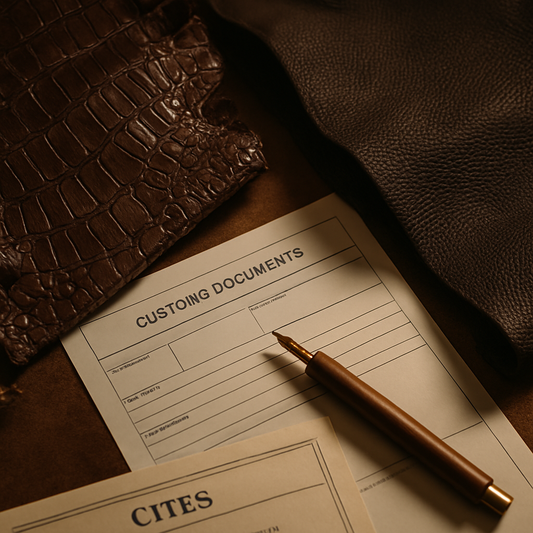
True crocodiles are distinct from alligators and caimans, so a responsible production process starts by matching the species claim to the hide’s documentation. “Crocodile leather” should not be used as a general label for every crocodilian material. Species, source, and trade paperwork matter because appearance alone cannot establish identity.
A belly section is commonly used for footwear because its scales are flatter and more pliable than the raised back scales often called hornback. The belly still has its own variation: scale size can change across the hide, and small scars or irregularities may influence how a pattern is placed on a pair of shoes.
Stage one: selecting the hide and usable belly area
Hide selection determines how much attractive, workable leather is available for the shoe pattern. We first need to confirm that the material is documented as crocodile and then assess the areas intended for the vamp, quarters, tongue, and other visible components. A large hide is not automatically the right hide for a particular shoe, because the scale layout may not suit the pattern or the required panel dimensions.
True crocodile belly scales generally show sensory pores, often called integumentary sensory organs or ISOs. These visible pores can be a useful identification feature, but they are not proof of authenticity by themselves. Scale shape, pores, and color should be assessed alongside documentation rather than treated as a single test.
The center belly may provide a more balanced scale arrangement, while side areas can show changes in scale direction and size. For a pair of shoes, the two sides also need to be planned together. Matching does not mean forcing both shoes to look mechanically identical; it means placing the panels so the pair reads as a coordinated set.
Stage two: grading defects rather than promising a fixed quality label
Hide grading generally relates to defects such as scars, cuts, holes, stains, and scale irregularities. Those marks can affect how much of the hide can be used for visible shoe panels and how much material may be required to complete a pattern.
Grading labels are not standardized across every supplier or tannery. One American alligator system, for example, uses belly grades from 1 to 4, with Grade 1 described as defect-free, while another convention includes grades through 5. That is why a grade number should be interpreted with the supplier’s own grading description instead of assumed to have one universal meaning.
Grade also describes visual and usable condition, not durability on its own. A higher visual grade does not automatically mean that the finished shoe will resist every form of wear better. Construction, leather thickness, pattern placement, use, storage, and care all influence the shoe’s service life.
At CrocodileViet, in-house production allows the hide and the intended pattern to be considered together. The reason is practical: a scale layout that looks strong on a full hide may place an unwanted scar across a visible vamp once the pattern is cut. Reviewing the material against the pattern helps reduce that mismatch before assembly.
Stage three: tanning and dyeing the crocodile leather
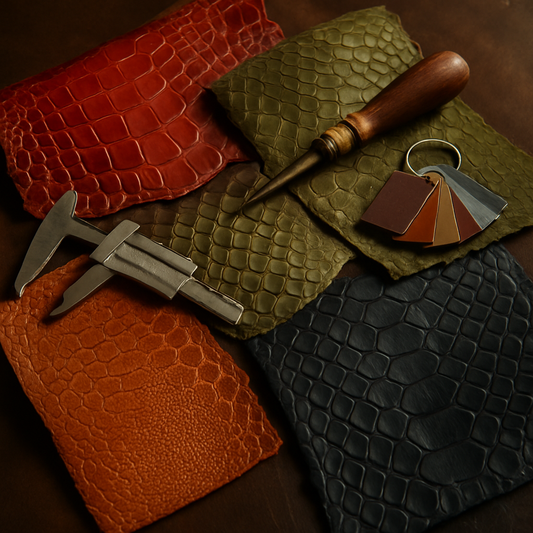
Tanning converts a raw hide into stable leather that can be cut and formed. Dyeing then develops the intended color while retaining the visible character of the crocodile scales. The final appearance depends on the leather itself, the color process, and the finish applied afterward.
Color does not remove the need to inspect the hide. Darker or more heavily finished leather may visually soften small variations, while lighter or more transparent finishes can show scars, pores, and changes in scale tone more clearly. The goal is controlled color development rather than an assumption that every scale will absorb dye in exactly the same way.
Caiman and alligator should not be substituted for crocodile in the description of a product. Alligator bellies often have a comparatively regular or balanced scale pattern and may show an umbilical scar that crocodile commonly lacks. Caiman bellies can contain bony buttons that affect the finish and value. These differences are one reason species documentation should accompany visual assessment.
Stage four: cutting panels for a balanced pair
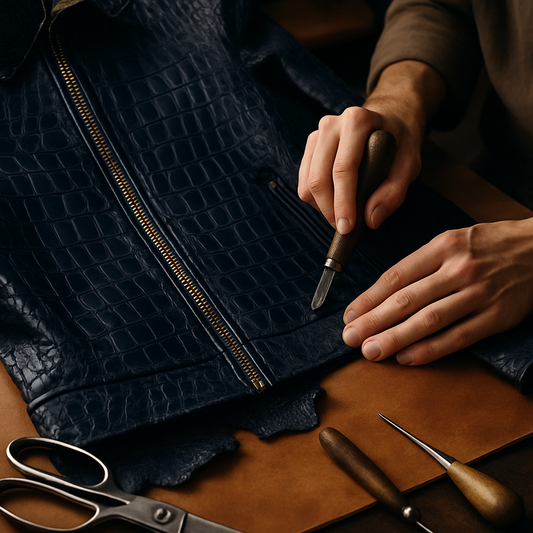
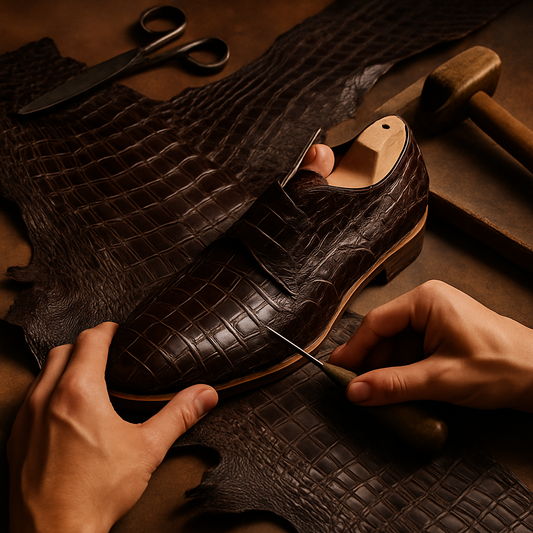
Cutting turns a selected section of leather into the components needed for the shoe. The visible vamp usually receives particular attention because it covers a large front area and carries much of the scale pattern seen from above. Quarters, tongues, counters, and smaller pieces must also be placed so that their grain and scale direction support the shape of the design.
Pattern placement involves trade-offs. Using the largest scales on the vamp may create a strong visual center, while smaller scales can suit narrower panels or help the design transition toward the heel. A scar or hole may require the pattern to move, reduce the usable area, or use another section of the hide.
This stage also explains why two shoes made from the same hide can show natural differences. Crocodile scales are organic features, not printed repeats. A well-planned pair coordinates those differences rather than attempting to erase them.
Stage five: assembly and hand finishing
After cutting, the leather components are assembled with the rest of the shoe structure. The exact shoe-making sequence can vary by design, construction method, and workshop. The general production account includes assembly followed by finishing, but there is no single standard shoe-specific hand-finishing sequence that applies to every crocodile shoe.
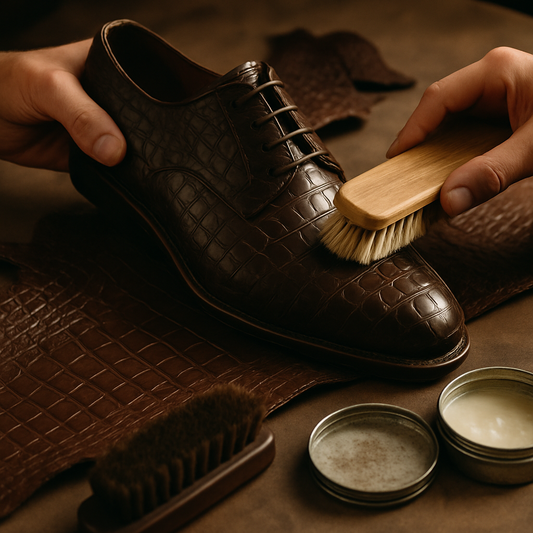
Hand finishing is the stage where the assembled shoe is checked and refined as a complete object. This can involve assessing the appearance of the leather panels, the transitions between components, the edges, and the consistency of the final surface. The aim is to present the crocodile pattern clearly without covering its pores, scale character, or natural variation with an unnecessarily heavy finish.
At our workshop, in-house manufacturing matters because corrections can be evaluated against the actual pair rather than only against separate leather pieces. The reason is straightforward: a color or edge decision that appears suitable on a loose panel can look different after the leather has been shaped around the shoe.
Hand finishing should not be confused with a promise that the shoes will remain free from marks. Crocodile leather can still be scratched, stained, dried, or affected by unsuitable storage. Finishing improves presentation at the time of completion; it does not remove the need for sensible handling.
How to assess a clean finish before buying
- Check the species description: Confirm that the product is described as crocodile rather than using crocodilian terms interchangeably.
- Look at the belly layout: The scales should be arranged in a way that suits the shoe pattern, with no distracting defect placed on a major visible panel.
- Assess the surface: Color should look controlled without an overly thick coating that obscures the scale structure.
- Inspect the pair together: Natural variation is expected, but the two shoes should work as a coordinated pair in scale direction and panel color.
- Ask what the grade means: Request the supplier’s grading explanation instead of relying on a number alone.
- Review documentation: For international trade, CITES-related controls can involve non-reusable identification tags carrying details such as an origin-country code, serial number, and species code. Permit and trade requirements depend on the species, source, and applicable rules. Such documentation supports regulated trade and traceability; it does not by itself prove authenticity.
Price factors for clean crocodile leather shoes
Price reflects several concrete inputs rather than one label. The species and documented source influence the material cost. The usable area of the hide affects yield, particularly when a design requires large, visually consistent vamp panels. Defects, scars, holes, and irregular scales can reduce usable area and increase waste during cutting.
Construction also matters. A shoe requiring more components, more complex pattern placement, or additional hand-finishing time will have different labor costs from a simpler design. Leather thickness, lining and sole materials, hardware, sizing requirements, and the amount of leather needed for a particular size can also change the final price.
A grade number should be included in that conversation, but it should not be treated as a complete price explanation. Since grading systems vary, ask what defects were assessed, which hide area was graded, and how the label relates to the actual shoe panels.
Fit and sizing considerations
Crocodile leather does not remove the need for accurate shoe fitting. Record foot length and width, and note whether the foot is wide, narrow, or high over the instep. EU, US, and UK sizes are not interchangeable by number alone, so use the maker’s conversion guidance rather than selecting a size solely from a familiar label.
For remote measurements, provide both feet because one may be longer or wider than the other. A tracing, heel-to-longest-toe length, forefoot width, instep measurement, and notes about existing fit problems can help the workshop assess the appropriate size. A wide forefoot or high instep may require a different last or a design with more room over the upper.
Length and width should be considered together. A shoe that has enough toe length may still feel tight across the forefoot, while increasing size to gain width can create excess length. The leather may soften with use, but it should not be expected to correct a fundamentally unsuitable fit.
Care after the shoes are finished
For routine surface dust, begin with a clean, dry cloth. Use light pressure and avoid rubbing aggressively across the scales. This basic approach is preferable to applying an unverified cleaner or oil that may change the color, sheen, or finish.
Cleaning and restoration are different tasks. A fresh mark, deep stain, damaged coating, or dried area may need assessment by a specialist familiar with crocodile leather. Do not assume that a product suitable for ordinary smooth leather is suitable for crocodile skin.
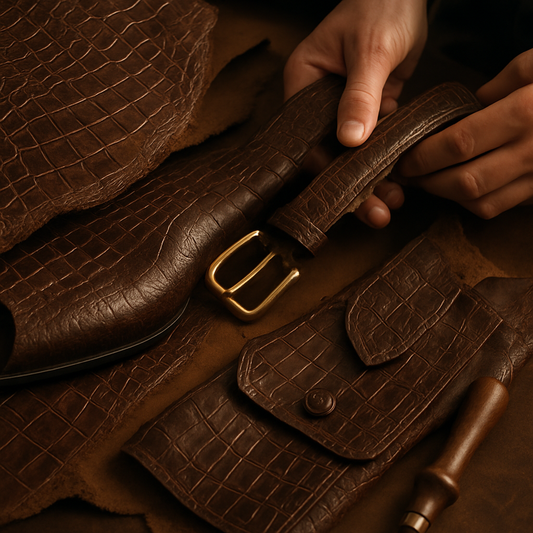
Keep the shoes away from prolonged moisture, intense heat, and cramped storage that presses the scales against another surface. Allow room for the leather to rest between wears, and store the pair so that the uppers are not bent or compressed. If you also store a crocodile leather bag, use the same general principle: protect it from humidity, heat, pressure, and contact with materials that may transfer color.
There is no useful fixed care schedule for every pair. Frequency depends on climate, use, finish, and the condition of the leather. Inspect the surface periodically and seek professional advice when the issue is restoration rather than simple dust removal.
Styling clean crocodile leather shoes
For business wear, a restrained shoe shape and a controlled crocodile pattern can work with a dark suit, tailored trousers, and a plain leather belt. Match the overall formality of the shoe to the setting rather than treating exotic leather as a reason to add more visible accessories.
With smart-casual clothing, crocodile shoes can sit beside wool trousers, dark denim, or a simple blazer when the rest of the outfit uses quieter textures. Let the scales supply visual interest and keep nearby pieces uncomplicated. Color coordination can be based on temperature and depth rather than an exact belt-and-shoe match.
For more specific business-wear decisions, see Crocodile Leather Dress Shoes: How to Choose the Right Pair for Business Wear.
Frequently Asked Questions
What makes crocodile leather shoes look cleanly finished?
A clean finish usually combines a suitable belly-scale layout, controlled color, well-placed panels, neat transitions, and a surface finish that does not obscure the leather’s natural scale character.
Does a higher crocodile leather grade guarantee stronger shoes?
No. Grade generally describes visible defects and usable hide condition, while durability also depends on construction, leather thickness, fit, use, storage, and care. Grading labels vary between suppliers and tanneries.
How can I check whether the material is crocodile rather than alligator?
Ask for species documentation and review the trade information. True crocodiles generally have sensory pores on belly scales, but pores and appearance alone do not prove authenticity. Alligator often has a more regular or balanced belly pattern and may show an umbilical scar.
How should I clean crocodile leather shoes at home?
For ordinary dust, use a clean, dry cloth with light pressure. For stains, damaged finish, or dryness, ask a crocodile-leather specialist before applying a cleaner, oil, or conditioner.
See the CrocodileViet workshop’s current leather goods and related information at CrocodileViet. For sizing, material documentation, or care questions, contact us through WhatsApp before ordering.