
Handmade Alligator Shoes vs Lizard Leather: Which Is Better? — Part 2

Condividi
Handmade Alligator Shoes vs. Lizard Leather: Which Is Better? — Part 2
Alligator leather has broader, more squared belly scales with a relatively regular pattern, while lizard leather has much smaller, finer, beaded scales that create a tighter texture. Neither material is automatically better for every pair of shoes: the stronger choice depends on the visual scale you want, the shoe design, the usable hide area, and the construction budget.
How Alligator and Lizard Leather Look Different on Shoes
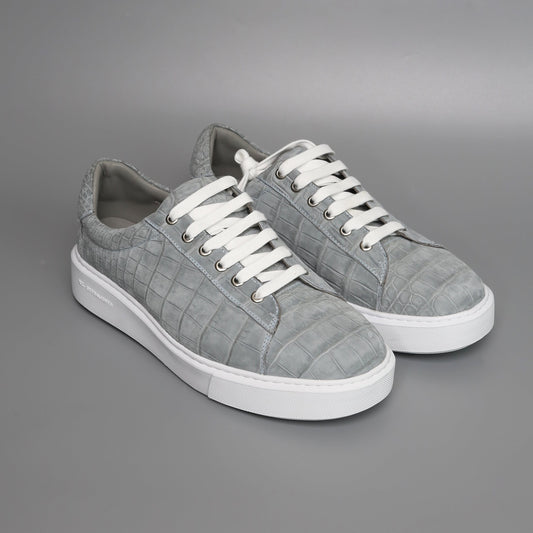
Scale structure is the clearest difference between handmade alligator shoes and lizard shoes. Alligator belly leather gives a shoe a broad tile-like surface. Its scales are comparatively large and balanced, so the pattern remains easy to read across a vamp, quarter, or whole-cut upper.
Lizard leather presents a finer, more closely spaced surface. The small beaded scales can suit narrow shoe panels, detailed uppers, and designs where a less expansive pattern is preferred. Because each scale is smaller, lizard often reads as a tighter texture rather than the broad geometric layout associated with alligator leather.
| Decision factor | Alligator leather shoes | Lizard leather shoes |
|---|---|---|
| Scale appearance | Large, squared belly scales with a regular, balanced layout | Smaller, finer, beaded scales with a tighter surface texture |
| Visual presence | Broader pattern that is readily visible across larger shoe panels | More closely textured appearance that can suit smaller or more detailed panels |
| Pattern planning | Requires careful scale matching across the vamp, quarters, and other visible sections | Requires alignment of the finer scales and control of panel direction |
| Hide measurement | Commonly assessed by belly width across the smooth belly area, measured in centimeters | Usable area depends on the hide and the pattern pieces rather than a generic length-only description |
| Best visual role | A clear reptile-leather pattern for dress shoes, loafers, boots, and larger visible uppers | A finer reptile texture for compact panels, detailed designs, and less expansive scale layouts |
Why Belly Alligator Leather Is Commonly Chosen for Shoes
For a pair of handmade alligator shoes, the belly and midsection are the most important areas in the common grading system. These sections provide the visible scale arrangement used to judge the hide. Back, tail, and flank areas do not determine that belly-focused grade.
At CrocodileViet, selecting a belly-focused section for visible shoe panels makes practical sense because the scales are flatter, more regular, and easier to position across a pair. That helps us plan the vamp and matching sections without allowing a sudden change in scale shape to dominate the design. It is a pattern-control decision, not a claim that every other part of the hide is unusable.
Alligator hide size is also not best described by length alone. Suppliers commonly measure it by the belly width in centimeters across the smooth belly area. That width affects which pattern pieces can be cut from the hide and whether a larger shoe design can use one visually continuous section.
Alligator Grade Does Not Equal Shoe Durability
Alligator hides are commonly described on a Grade 1-to-5 scale. Grade 1 generally indicates a belly with no visible defects, while lower grades reflect more belly defects, such as scars, scratches, shading, or scale deformities.
This grading language mainly describes the appearance and condition of the relevant belly surface. A higher visual grade does not by itself prove that a finished shoe will be more durable. Durability also depends on the leather thickness selected for the design, the usable area, the lining, the sole construction, the flex points, the finishing, and how the shoes are worn.
Grading labels can vary by supplier or tannery, so a seller’s “Grade 1” should not be treated as a universal industry measurement. Ask which area was graded, what defects were included, and whether the label refers to the full hide or only the belly section used for the shoe.
Which Material Works Better for Different Shoe Designs?
Alligator for visible, broad-pattern uppers
Alligator leather suits designs that give the belly scales room to remain visible. A plain-toe dress shoe, whole-cut style, loafer, or clean boot can show the regular scale layout across a larger panel. The material also works well when the design depends on a deliberate centerline and similar scale progression on both shoes.
For genuine alligator shoes for men, the shoe last matters as much as the hide. A rounded or moderately broad toe can display more of the belly pattern, while a sharply tapered toe may require smaller pattern pieces and more planning around scale direction.
Lizard for a finer surface
Lizard can suit a wearer who wants reptile leather without the broad, highly visible scale blocks of alligator. Its finer scales can work on narrow vamps, dressier panels, and designs with more seams or decorative divisions. The smaller pattern may also feel visually lighter on a slim shoe last.
That does not make lizard a substitute for alligator. The two materials create different surfaces, and a lizard shoe should be judged as lizard rather than as a smaller version of an alligator shoe.
Price: What Changes the Cost of Handmade Alligator Shoes?
There is no responsible universal price for either material without reviewing the proposed shoe. For handmade alligator shoes, the main cost factors include:
- Species and material: Alligator and lizard hides differ in scale size, hide dimensions, and how their surfaces fit a shoe pattern.
- Hide grade: A belly with fewer visible scars, scratches, shading changes, or scale deformities may provide more consistent visible panels.
- Usable area: Belly width and the shape of the available hide determine whether the design can use large continuous pieces.
- Scale matching: Matching the left and right shoes, centering a pattern, and controlling scale direction require additional material planning.
- Construction: The upper pattern, lining, insole, outsole, heel, welt or related construction method, and finishing all affect the work involved.
- Handwork: Manual cutting, edge preparation, fitting, stitching, lasting, and finishing can change the labor required for a particular design.
Lizard may require less hide volume for some compact patterns, but that does not establish a fixed price advantage. A complicated lizard upper can require substantial alignment work, while a large alligator design can require more usable belly area. A workshop should price the actual pattern and material rather than attach a blanket rate to the animal name.
Fit and Sizing for Alligator and Lizard Shoes
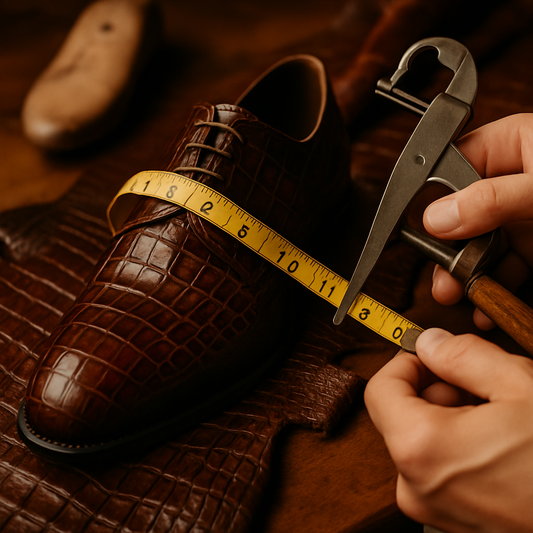
Leather choice cannot correct an inaccurate shoe size. For a made-to-order pair, useful measurements include foot length, ball width, instep circumference, heel width, and the space required by the toes. The instep is particularly important because a rigid or heavily structured upper may feel tight there even when the length appears correct.
- In-person try-on: Useful for checking toe room, heel movement, instep pressure, and the way the upper creases while walking.
- Remote measurement: A practical option when visiting the workshop is not possible. Send measurements for both feet, foot tracings, current shoe sizes, and photos if requested; the left and right feet may not be identical.
- Width: Do not rely only on a standard size number. A wide fit may require a different last shape rather than simply a longer shoe.
- EU, US, and UK sizes: These systems do not convert perfectly across every brand. Give the sizing system, the measured foot length, and the usual fit experience.
- Instep and volume: A high instep needs room over the top of the foot, while a low-volume foot may need additional control around the tongue, quarters, or heel.
For alligator leather shoes, remote measurement should be treated as equally important to in-person fitting when an appointment is not available. A well-planned pattern protects the scale layout, but it must also follow the wearer’s actual foot shape.
Care for Handmade Alligator and Lizard Shoes
Start with a dry, soft cloth after wear. This removes surface dust without introducing unnecessary moisture into the scales, seams, or lining. Store the shoes away from direct heat and strong sunlight, and use suitable shoe trees if the construction allows them; this helps the upper hold its shape while it rests.
If a mark requires more than dry wiping, use a barely damp cloth as a last resort and test an inconspicuous area first. Do not soak the leather or scrub across the scale edges. Water, cleaners, dyes, and conditioners can affect color and surface finish differently, so a product intended for smooth cowhide should not automatically be used on alligator or lizard leather.
There is no fixed conditioning schedule that suits every pair. The right interval depends on the finish, climate, frequency of wear, storage, and whether the leather shows dryness. If the surface begins to look dry or develops a change in feel, ask the maker or a specialist before applying a conditioner.
How to Style Each Material
Alligator shoes for formal settings
- Pair dark brown alligator dress shoes with navy, charcoal, or medium-brown tailoring when the rest of the outfit is restrained.
- Use black alligator with black, charcoal, or deep navy formal clothing where a stronger scale pattern is acceptable for the setting.
- Keep the belt and small leather accessories coordinated by color family rather than trying to duplicate the exact scale pattern.
Alligator shoes for business-casual wear
- Wear brown or oxblood tones with tailored trousers, chinos, a knit jacket, or a plain wool blazer.
- Let the shoes provide the texture while keeping the shirt, trouser, and outer layer in solid or quietly patterned fabrics.
- Choose a loafer or less formal lace-up when the outfit does not call for a traditional dress shoe.
Lizard shoes for a finer texture
- Use lizard loafers with tailored trousers when you want reptile texture without a broad scale field.
- Pair a finely scaled lizard shoe with simple garments so the small surface pattern remains visible without competing with large prints.
- For evening clothing, match the shoe’s color depth to the outfit rather than relying on the material alone to set the formality.
Color, shoe shape, and the setting should work together. There is no single color rule that applies to every alligator or lizard shoe.
Checking Whether an Alligator Shoe Is Genuine
“Alligator leather,” “crocodile leather,” and embossed “alligator grain” are not interchangeable descriptions. Embossed cowhide uses a pressed pattern to imitate reptile scales; it is not genuine alligator hide.
Genuine farmed American alligator leather is commonly associated with CITES Appendix II controls, export documentation, and tagging. CITES addresses regulated international trade and documentation; it does not by itself prove that a shoe is genuine or establish the shoe’s visual grade.
Ask for material information, the relevant tag or reference details, and documentation that can be checked where applicable. A missing tag or an unverifiable reference number is a warning sign, but one sensory feature—such as the feel of the scales, the smell, or the appearance of pores—should not be treated as proof of authenticity by itself.
Which Should You Choose?
Choose alligator if you want larger, squared belly scales, a more open pattern, and a shoe design that gives the hide enough surface to show its layout. It is particularly suitable when scale matching and a centered visual panel are important to the design.
Choose lizard if you prefer a smaller, finer, beaded texture or a shoe with a visually tighter reptile surface. It can work well with narrow panels and detailed designs, but the finished result should be evaluated according to lizard’s own scale structure rather than compared only by price or rarity.
The practical answer for a handmade pair is therefore based on design, fit, usable hide area, grade, construction, and handwork. Material alone does not determine the finished shoe’s comfort or service life.
Frequently Asked Questions
Are handmade alligator shoes more durable than lizard shoes?
Durability cannot be determined from the animal name alone. Leather thickness, finishing, construction, flex-point placement, lining, sole work, fit, and wearing conditions all influence how a pair performs.
Does a higher alligator grade guarantee a better shoe?
No single grade label guarantees the finished result. The common grade focuses on defects in the belly and midsection, while comfort and durability also depend on pattern engineering and construction.
Can a lizard shoe use the same pattern as an alligator shoe?
A pattern may be adapted, but the scale dimensions, usable hide area, panel direction, and visual spacing need to be reviewed for the lizard hide. Copying the pattern without adjustment can produce awkward scale placement.
Is a CITES tag proof that a shoe is genuine alligator?
A CITES tag supports regulated trade documentation and may help trace the material, but it is not a complete authenticity test. The tag, reference number, material description, and seller documentation should be consistent and verifiable.
To discuss a pair of handmade alligator shoes or compare an alligator and lizard design, view the CrocodileViet shoe collection. You can also contact us through WhatsApp with your preferred style, measurements, and material questions.