
American Alligator Leather: How U.S. Conservation and Luxury Demand Shape the Supply

Condividi
American Alligator Leather: How Conservation and Luxury Demand Shape Supply
American alligator leather enters international trade through regulated U.S. harvest and farming systems, with export approval tied to legal and non-detrimental trade findings.
Why conservation affects American alligator leather supply
American alligator leather comes from Alligator mississippiensis. In the United States, the species is not currently federally listed as endangered or threatened, yet it remains on CITES Appendix II because it resembles crocodilian species that do have stricter protection.
That listing affects how hides move across borders. Hides from participating U.S. programs receive CITES tags, and export approval depends on documentation showing that the trade is legal and not detrimental to the species. CITES therefore supports traceability and controlled trade; it does not, by itself, prove that a particular leather item is authentic.
Louisiana illustrates the scale of this management system. The state reports that its alligator population grew from fewer than 100,000 to more than 3 million over roughly 50 years. That recovery has allowed regulated wild harvest and farming to operate alongside conservation controls rather than treating leather production as separate from wildlife management.
How regulated harvest and farming shape supply
American alligator hides can enter the market through two broad channels: regulated wild harvest and farming. These channels influence the quantity, traceability, and consistency available to tanneries and manufacturers.
- Wild harvest: Seasonal and regional management affects how many hides can be legally collected. The supply may reflect permitted harvest levels, local conditions, and documentation requirements.
- Farming: Louisiana alligator farms contribute hides through a managed production route. Farm supply can give buyers another source, although hide size, scale layout, scars, and usable area still vary.
- Traceability: CITES tags and export records connect eligible hides to an approved legal-trade system. Documentation is a supply requirement, not a visual substitute for examining the leather.
- Usable area: A hide’s commercial value depends on how much clean, workable leather remains after natural scars, defects, holes, and irregular sections are assessed.
These controls can limit anonymous or undocumented supply. They also mean that a responsible buyer should ask about the source and paperwork for the specific product rather than assume that every item labeled “alligator” has the same background.
How luxury demand changes what manufacturers seek
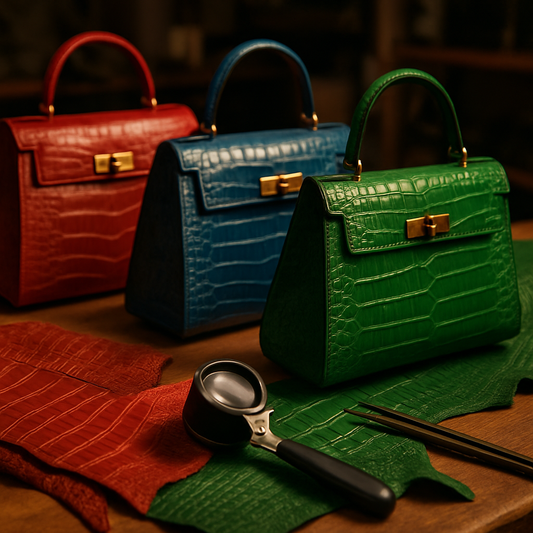
Demand for alligator handbags, alligator leather boots, wallets, belts, and watch straps is concentrated around particular hide characteristics. Buyers often want a broad belly section, balanced scale arrangement, suitable thickness, and enough usable area for the planned pattern pieces.
The belly is the smooth, pliable underside hide commonly used for luxury goods. It differs from flank leather, where scales are smaller and denser. On American alligator belly leather, the scale pattern is comparatively regular and balanced, although it retains natural variation. This layout can be useful for products that place large panels in prominent positions.
Demand also affects sorting. A hide with a large clean belly may suit an alligator handbag, while a smaller or more interrupted area may be better allocated to straps, small leather goods, or narrow boot panels. This does not mean one section is automatically better for every use; the pattern, dimensions, scars, and cutting plan must match the product.
For comparison, crocodile leather can vary more by species and often shows visible sensory pores, known as integumentary sensory organs or ISOs. American alligator belly leather commonly has an umbilical scar, while crocodile belly leather lacks that feature. These details help with material identification, but one visual trait alone should not be treated as proof of authenticity.
What “quality” means in American alligator leather
There is no single grading scale that applies universally across all suppliers and tanneries. Letter labels can differ in meaning, so buyers should ask what a particular supplier’s grade includes.
| Decision factor | Why it affects supply and product selection |
|---|---|
| Usable area | A larger clean section can support wider panels and reduce the need for joins. |
| Scale pattern | Regular, balanced belly scales may suit handbags, belts, and broad boot quarters. |
| Scars and defects | Natural marks reduce the area available for particular pattern pieces, though they may be acceptable in less visible locations. |
| Hide dimensions | Length and width determine whether the hide can cover the intended product components. |
| Tannery or supplier criteria | Published labels should be interpreted according to that supplier’s inspection and sorting method. |
Visual grade is not the same as durability. Construction, leather thickness, tanning, edge finishing, stitching, and daily use also influence how a finished item performs. A higher visual grade may provide a cleaner panel, but it does not remove the need for proper care or sound manufacturing.
Price factors buyers should expect
American alligator leather pricing reflects more than the species name. Important factors include the hide’s length and width, belly coverage, scale arrangement, visible scars, defects, tanning method, finish, usable area, and the amount of leather required for the product.
A large handbag can require substantially more suitable belly area than a card holder. Boots may involve additional costs for matching left and right panels, selecting compatible scale layouts, and cutting around less usable sections. Hardware, lining, soles, stitching, labor, and design complexity also affect the finished price. Since suppliers use different grading criteria, comparing the grade label alone can produce a misleading result.
Fit and sizing for alligator leather goods
For alligator leather boots and belts, check the actual length and width rather than relying only on a general size label. Footwear sizing may be shown in EU, US, or UK measurements, and conversion charts can differ by brand. Width, instep height, toe shape, and sock thickness influence fit as much as numerical length.
People with wide feet or a higher instep should ask for the last width and upper construction before ordering. For remote measurements, provide a traced foot or measured foot length and width according to the maker’s instructions. For belts, measure the usual hole position or the distance from the buckle fold to the preferred hole, rather than submitting only a trouser size.
Care for American alligator leather
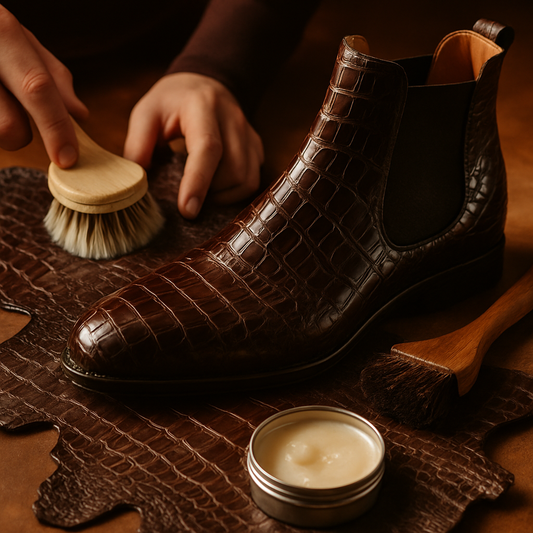
Start with a dry, soft cloth to remove surface dust. Keep the item away from prolonged moisture, strong heat, and direct sunlight, because these conditions can affect the finish and flexibility. If the leather becomes wet, blot it gently and allow it to dry at room temperature without a heater.
Do not apply household creams, alcohol-based cleaners, or an untested conditioner. Finishes vary, so use only a product confirmed as suitable for the specific leather and test it first in an inconspicuous area. Care frequency should follow actual use and the condition of the surface rather than a fixed calendar schedule.
Styling American alligator leather
A structured alligator handbag can work with tailored clothing when its color and scale size are kept consistent with the rest of the outfit. Alligator leather boots can be paired with denim, wool trousers, or understated suiting; a quieter belt and watch strap can prevent several textured accessories from competing.
For business wear, smaller alligator pieces such as a belt, card holder, or watch strap may introduce texture without dominating the outfit. The most practical combination depends on color, scale size, clothing formality, and how visibly the leather is meant to feature.
Frequently Asked Questions
Is American alligator leather considered sustainable exotic leather?
Its sustainability depends on the specific sourcing and management system, not simply on the species label. Regulated U.S. harvest, farming, traceability, legal trade findings, usable-area efficiency, and product lifespan all matter when assessing a particular item.
Does a CITES tag prove that an alligator leather product is genuine?
A CITES tag supports legal and traceable trade documentation for eligible hides, but it is not a standalone authenticity test. Material identification should also consider the item’s construction, supplier records, and visible leather characteristics.
What feature helps distinguish American alligator belly leather from crocodile leather?
American alligator belly leather often has a distinctive umbilical scar, which crocodiles lack. Alligator belly scales are also comparatively regular and balanced, while crocodile patterns can vary more by species and may show visible ISOs.
Why can two American alligator products with similar labels have different prices?
Price can change with usable area, hide dimensions, scale layout, scars, defects, tanning, construction, labor, hardware, and the quantity of leather needed. Supplier grading labels are not universal, so the underlying criteria should be checked.
View CrocodileViet’s American alligator leather collection to compare available product types and finishes. For measurements, sourcing questions, or product details, contact CrocodileViet through WhatsApp.