
Real Crocodile Leather vs Croc-Embossed Leather: What Luxury Buyers Should Know

공유
Real Crocodile Leather vs Croc-Embossed Leather: What Luxury Buyers Should Know
Croc-embossed leather is a mechanically pressed pattern applied to a base material such as cowhide, PU, or PVC, while real crocodile leather comes from a crocodilian hide.
The two can look similar in product photographs, but they differ in material, construction, documentation, price drivers, care requirements, and how the surface develops with use. Understanding those differences helps buyers assess luxury leather bags, wallets, belts, and other accessories without relying on scale appearance alone.
What “croc-embossed” actually means
“Croc-embossed” describes a surface design rather than a species. A manufacturer may press a crocodile-like motif into cowhide or another genuine leather. The same type of pattern may also be applied to PU or PVC, which are synthetic materials rather than leather.
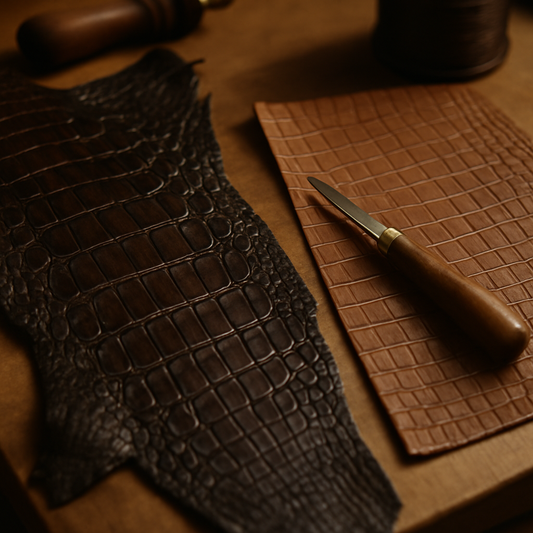
Embossing can repeat a mechanically pressed motif across a panel. Real crocodile skin has a scale structure formed by the animal’s hide, and the pattern changes across different areas of that hide. A repeated appearance can therefore be a reason to ask questions, but it cannot establish the base material by itself.
Product descriptions should state whether the item uses crocodile skin, another leather with a crocodile-style embossing, or a synthetic material. If the description is vague, ask for the species, hide section, and supporting documentation before paying a luxury-leather price.
Real crocodile leather vs embossed leather
| Decision factor | Real crocodile leather | Croc-embossed leather |
|---|---|---|
| Material source | Skin from a crocodilian species, such as crocodile or alligator, identified by the seller | Leather or synthetic material carrying a pressed crocodile-style pattern |
| Scale pattern | Develops from the hide and varies across belly, flank, and other sections | Can repeat a mechanically made motif across a panel |
| Documentation | May require applicable wildlife-trade permits or re-export documents for international trade | Usually documented as the underlying leather or synthetic material, not as crocodilian skin |
| Price drivers | Species, hide section, usable area, scale arrangement, finishing, construction, and documentation | Base material, embossing method, finishing, construction, and brand or workshop costs |
| Buying question | Which crocodilian species and hide section is used? | What material was embossed, and is it genuine leather or synthetic? |
How to assess crocodile skin authenticity
Start with the written description
Terms such as “crocodile embossed leather” and “crocodile pattern” do not confirm crocodilian skin. Look for a clear statement naming the species and identifying the material as crocodile skin. “Genuine exotic leather” is also too broad unless the product description specifies which exotic species is present.
Species labels matter. Crocodile, alligator, and caiman are related but not interchangeable terms. Caiman flank scales, for example, are described as uneven in size and more widely spaced than alligator flank scales. A seller should identify the species instead of using “crocodile” as a general name for every crocodilian material.
Look at the hide, but do not treat appearance as proof
Crocodile belly scales can show more even rows, while patterns vary across the hide and between species. Visible sensory pores, often called integumentary sensory organs or ISOs, may appear on crocodilian skin. These features can support a visual assessment, but one sensory or surface trait does not prove authenticity.
An umbilical scar is another useful identification feature in some belly hides: Louisiana wildlife guidance describes it on alligator skin and absent on crocodile skin. This is a species-identification clue, not a replacement for provenance records. A photograph can also hide finishing effects, lighting differences, or a pressed pattern.
For that reason, inspect the product description, close-up photographs, invoices, and applicable trade documentation together. CITES regulates international trade in crocodilian specimens, with requirements depending on the listed species, destination, route, and circumstances. An applicable permit or CITES document supports legal trade requirements; it does not by itself prove the product’s species, construction, or grade.
What hide section and grading terms tell you
“Full belly,” “squares,” and “grade” are useful terms only when the seller explains the criteria behind them. They are not one universal grading system across suppliers and tanneries.
Belly sections are often discussed because their scale arrangement can suit broad visible panels. Flank sections may have a different scale size and layout, which can affect the appearance and the amount of usable material for a bag or wallet. A higher visual grade does not automatically mean greater durability. Construction, leather thickness, edge work, lining, hardware, and daily use also affect service life.
At CrocodileViet, we manufacture our crocodile leather goods in-house so buyers can ask about the material and the product construction directly. That matters because a workshop explanation can connect the stated hide section with the actual panel layout, rather than leaving “grade” as an unexplained label.
Price: what you are paying for
Price differences between real crocodile leather and an embossed item reflect more than the word “crocodile.” For real crocodile leather, relevant factors include:
- the named species and the documentation needed for the sales route;
- the belly, flank, or other hide section used;
- the size of the usable panel and the amount of scale matching required;
- surface finishing and color treatment;
- pattern placement, lining, stitching, edge finishing, and hardware;
- the workshop’s labor, design, and production standards.
For embossed leather, compare the base material first. Cowhide with embossing has a different material cost and behavior from PU or PVC with the same visual motif. Ask whether the quoted price includes the full item, hardware, lining, shipping, and any documentation required for the destination country. These questions create a more useful comparison than judging a product from its pattern alone.
Fit and sizing for crocodile leather goods
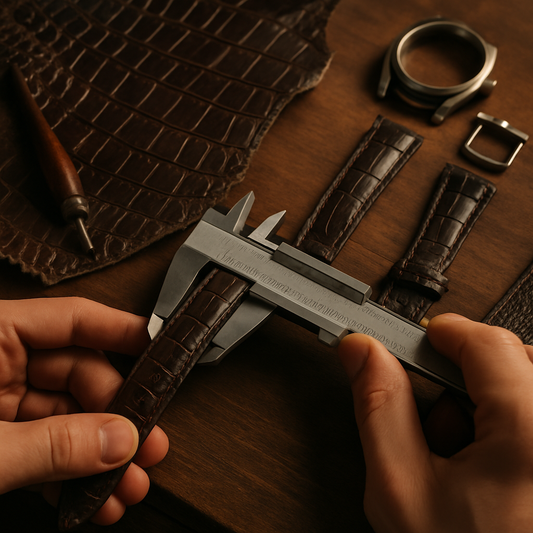
For bags, record length, height, width, handle drop, and strap adjustment range. A bag that looks compact in a photograph may have limited width for a tablet, while a structured gusset can reduce the practical interior space. For belts and watch straps, measure the usable length rather than relying on a nominal size.
Shoes require further checks: compare foot length and width with the maker’s chart, confirm whether the chart uses EU, US, or UK sizing, and ask about wide-fit options. Instep height can affect comfort even when the length is correct. If you are ordering remotely, send measured foot length, the widest point, instep circumference, and a reference size that has fitted you well. The workshop can then assess the requested dimensions instead of guessing from a country label.
Care for real crocodile leather
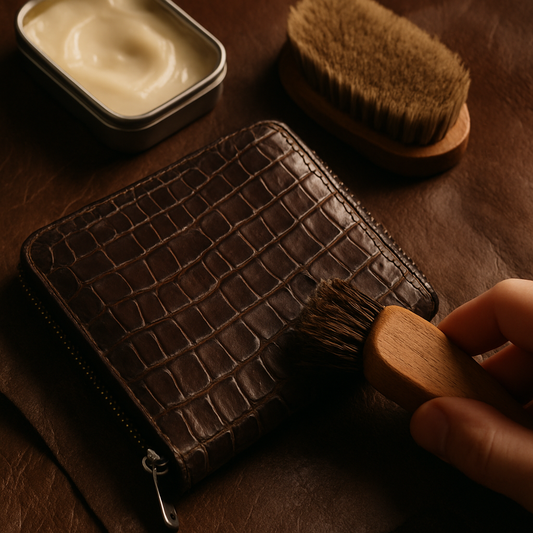
Use a soft, dry cloth as the default for dust and light handling marks. Keep the item away from prolonged moisture, strong heat, and direct sun, since these conditions can affect the finish, shape, and color.
Do not apply household oils, alcohol-based cleaners, or an untested cream. A product made for one leather finish may darken or mark another. If the surface becomes wet, blot it gently and allow it to dry at room temperature rather than using a hair dryer or heater. Store a structured bag with its shape supported and avoid pressing heavy objects against the scales.
There is no useful fixed care schedule for every crocodile item. Frequency depends on handling, climate, finish, and storage. Clean lightly when needed and ask the maker which conditioner, if any, is suitable for that specific finish.
Styling real crocodile leather and embossed leather
Real crocodile leather can work as the main texture of an outfit when the surrounding clothing is relatively quiet: a structured bag with a plain suit, or a crocodile belt with solid-color trousers and a simple knit. For a less prominent effect, pair a small embossed-leather accessory with materials such as canvas, smooth calf leather, denim, or wool.
Match the scale size to the item’s proportions. Larger visible belly scales can read strongly on a broad bag panel, while smaller-scale goods may suit a wallet, card case, or narrow strap. Color, hardware, and finish should also be considered together; a glossy surface with bright hardware creates a different impression from a matte surface with subdued metal.
For another material comparison, see Buy Genuine Alligator Leather Products vs Lizard Leather: Which Is Better?. Buyers checking visual clues may also find How to Choose How To Spot Real Alligator Leather for Business Wear useful, while remembering that visual inspection does not replace documentation.
Frequently Asked Questions
Is crocodile embossed leather real crocodile skin?
Not necessarily. The phrase describes a pressed crocodile-like pattern and may refer to embossed cowhide, another leather, PU, or PVC. The product description must identify the actual base material.
Can scale appearance prove crocodile skin authenticity?
No. Natural crocodilian scale patterns vary across a hide, and embossing can imitate or repeat a motif. Sensory pores, scale rows, and an umbilical-scar clue can support inspection, but species and provenance should be checked through the seller’s description and documentation.
Does a CITES document prove that a luxury bag is genuine crocodile leather?
No. CITES documents relate to regulated crocodilian trade and depend on the species and circumstances. They do not, by themselves, prove the product’s species, material quality, construction, or grade.
What should I ask before buying a crocodile leather bag?
Ask for the named species, hide section, material description, dimensions, finishing information, care instructions, and applicable trade documentation. Also ask how the seller defines terms such as “full belly,” “squares,” or “grade.”
Choose the material with evidence
Real crocodile leather and embossed leather can both be well-made, but they serve different buying purposes. Confirm the material first, then compare hide section, construction, documentation, fit, care needs, and price rather than relying on a crocodile-like pattern.
View CrocodileViet’s crocodile leather collection for workshop-made products and material details. For product questions or remote measurements, contact CrocodileViet through WhatsApp.