
Exotic Leather Dress Belt Care: How to Protect Texture, Shape and Finish

공유
How to Care for an Exotic Leather Dress Belt: Protecting Texture, Shape and Finish
For an exotic leather dress belt, gentle dry-cloth wiping and air-drying away from heat help protect the finish better than frequent or unsuitable conditioning.
Why exotic leather needs controlled care
Alligator and crocodile leather have raised scale structures and finishes that can react differently to moisture, friction, heat, and leather products. A belt also bends repeatedly around the waist, so care needs to protect three separate features:
- Texture: the scale surface should not be flattened, scuffed, or saturated.
- Shape: the strap should not develop sharp bends, twists, or permanent stretching.
- Finish: color, sheen, and surface coating can change if exposed to unsuitable oils, solvents, or excessive moisture.
“Exotic leather” covers several materials, so a care product suitable for one belt may not suit another. Crocodile belly leather and alligator belly leather are both comparatively smooth and pliable, while back and tail sections have more pronounced texture. The finish applied by a tannery or maker also affects how the belt should be treated.
Daily handling for an exotic leather dress belt
After wearing the belt, wipe it lightly with a clean, dry, soft cloth. This removes ordinary dust, skin oils, and surface residue without adding moisture or chemicals. Use light strokes that follow the direction of the scales rather than rubbing across their edges.
Avoid pulling the belt sharply through the buckle. Repeated force at the same point can stress the leather around the buckle fold and holes. Unfasten the belt normally, remove it without twisting the strap, and place it flat for a short period before storage.
Do not use the belt as a support for heavy objects or wear it tighter than needed to hold your trousers in place. Excessive tension can stretch the holes and create a curved section that is difficult to flatten.
What to do after light moisture exposure
If a few drops of water reach the belt, blot them with a dry cloth instead of rubbing. Then leave the belt to air-dry away from direct sun, radiators, hairdryers, heated vents, and other strong heat sources.
Heat can dry the leather unevenly and may affect the finish. Direct sunlight can also influence color over time. Keep the belt loose or flat while it dries, and do not apply conditioner while the leather is still damp.
What to do after a larger spill
For a spill involving coffee, alcohol, oil, cosmetics, or another colored liquid, blot the area promptly with a clean, dry cloth. Avoid household soap, alcohol wipes, detergent, furniture polish, and general-purpose oils. These products may change the surface finish or leave a darkened patch.
Once the excess liquid has been blotted, allow the belt to dry naturally. If a mark remains, contact the maker or a specialist familiar with crocodilian leather before applying a cleaner. A professional recommendation is more reliable than treating the entire strap with an untested product.
Conditioning and cleaning: use less, test first
Conditioner is not automatically required on a fixed calendar. Product instructions differ, and applying too much product can soften the structure, alter the sheen, or interfere with the finish. The right interval depends on the leather, surface treatment, use, and storage conditions.
If the maker recommends a conditioner, choose one formulated for exotic leather. Test it first on a concealed area, such as the underside near the buckle, and wait to see how the color and sheen respond. Apply only a small amount if the test is suitable, keeping product away from heavy accumulation around scale edges and stitching.
For routine dust, a dry cloth is usually the sensible starting point. Cleaning and conditioning should solve a visible or specific care need rather than become a frequent ritual.
Protecting the belt’s shape
Storage has a direct effect on the belt’s shape. A dress belt can be stored flat in a dry drawer or loosely rolled with the leather side facing outward. A tight roll can place concentrated pressure on the same scales and may create a permanent curl.
If the belt hangs, use a broad, smooth hanger or a belt hanger that supports the strap without pinching it. Avoid narrow hooks that create a sharp fold. Keep the buckle from pressing into the leather surface during storage.
Store the belt away from damp bathrooms, sealed plastic bags, and direct sunlight. A breathable fabric pouch can reduce dust while allowing some air movement. Do not place heavy items on top of the belt.
Texture differences: crocodile and alligator belts
The scale pattern can help identify what you are looking at, but it is not a stand-alone guarantee of species or authenticity. Alligator belly leather generally has a more regular, balanced scale pattern. It often transitions more abruptly from larger belly scales to smaller flank scales.
Crocodile leather varies more by species and may show visible sensory pores, often called integumentary sensory organs or ISOs. Alligator belly scales do not typically show the same visible pores. Alligator leather often has an elongated, web-patterned umbilical scar on the belly, while true crocodile leather lacks that feature.
These details are useful clues rather than proof by themselves. A photograph, a single pore, or one scale characteristic cannot establish authenticity on its own. For buyers comparing a crocodile leather belt with an alligator leather belt for men, the seller’s documentation and material description should be considered alongside the visible hide structure.
Trade descriptions also matter. “Belly-cut” or “belly leather” refers to material cut from the smoother, more pliable underside. The back and tail are separate hide areas with more textured surfaces. A belt made from belly-cut leather may feel and look different from one using back or tail sections, even when the species is the same.
Price factors that affect an exotic leather belt
The price of a genuine crocodile belt or alligator belt depends on more than a label such as “Grade 1.” In some trade systems, grading refers to belly defects, with Grade 1 indicating fewer visible defects and higher grade numbers indicating more. Grading labels and rules vary by supplier or tannery, so the label should not be treated as a universal scale.
Specific price factors may include:
- Species and source material: alligator and crocodile hides are traded under different descriptions and may carry different material costs.
- Belly width: hide size is commonly stated by belly width in centimeters. A wider usable section can support broader belt dimensions or allow more flexibility in cutting.
- Usable area and visible defects: scars, marks, holes, and scale irregularities affect how much material can be used for a finished strap.
- Cut and texture: belly-cut material generally has a smoother surface than back or tail sections, while textured sections create a different visual and tactile result.
- Buckle and construction: buckle material, replaceable-buckle design, edge treatment, lining, stitching, and finishing work can all affect the final price.
- Size: a longer or wider belt uses more material and may require a larger usable hide section.
Visual grade is not the same as durability. A strap with fewer visible marks may cost more because of appearance and usable cutting area, but that label alone does not predict how the belt will perform under poor storage or excessive tension.
Fit and sizing: measure the right way
Belt sizing can be confusing because brands may measure from the buckle fold to the center hole, from the buckle to the end, or by total strap length. Check the maker’s stated method before ordering.
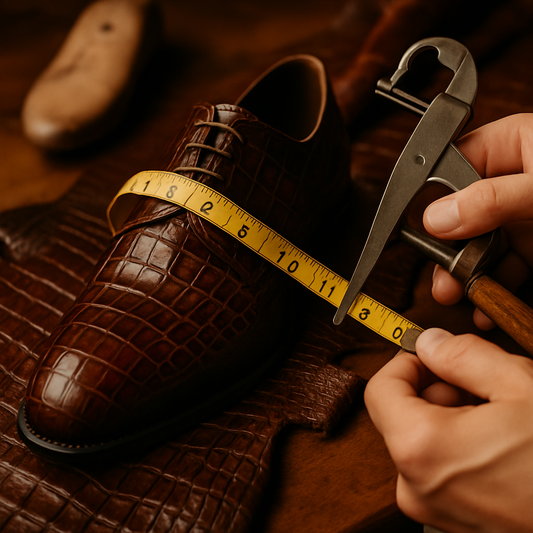
For a remote measurement, lay a belt that fits well on a flat surface. Measure from the point where the buckle prong meets the leather to the hole you use most often. Compare that measurement with the new belt’s center-hole measurement when the maker provides it. Also record the strap width, because a wider belt may not pass through your trouser loops or suit the intended dress trousers.
Check the sizing system used by the seller. EU, US, and UK trouser sizes do not automatically convert to an identical belt size across brands. A waist measurement taken over a shirt may also differ from a body measurement or trouser-tag size.
For a wide fit, measure both the waist and the belt loops. For a higher instep or fuller midsection, leave enough length for the belt to sit without excessive tension. If your measurements fall between two options, ask for the buckle-to-hole dimensions and strap width rather than relying only on a size label.
These measurements are especially useful when ordering an alligator leather belt for men as a gift, because the recipient’s trouser size alone may not reveal the preferred hole position or width.
Styling an exotic leather dress belt
Match the belt’s width to the trousers and the setting. A narrower strap generally works with formal trousers, while a wider strap may suit denim or less formal tailoring. Coordinate the buckle’s visible metal with other hardware, such as a watch case or shoe details, without requiring an exact match.
Scale size also influences the outfit. Smaller, regular belly scales tend to read quietly with a suit, while larger or more textured scales can draw more visual attention with plain trousers. For business wear, a restrained belt color and a buckle with limited ornamentation can keep the leather as the main texture.
Use the same level of formality across the outfit. A heavily textured back-cut belt may work better with casual tailoring than with a minimal formal suit, while a smooth belly-cut crocodile leather belt can suit dress trousers when its width and buckle are proportionate.
For further outfit-specific sizing and styling considerations, read How to Choose Alligator Leather Belt Men for Business Wear.
Buying and transport considerations
Ask what part of the hide the belt uses, how the stated size is measured, and whether the surface is finished, glazed, matte, or lightly textured. Ask for close photographs of the scales, edges, buckle area, and holes when buying remotely. These views can reveal whether the material description matches the visible strap.
International transport may involve CITES requirements because CITES regulates trade in listed crocodilian specimens. Permits or certificates may be required depending on species, destination, and circumstances, with specific exemptions sometimes applying to personal effects. Belts are recognized among small manufactured crocodilian-leather products, but that classification does not by itself mean every shipment is permit-free. Confirm the requirements for the actual destination and shipment before ordering.
For a purchasing checklist, see 7 Things to Check Before You Buy Crocodile Leather Belt Online.
Frequently Asked Questions
How should I clean an exotic leather dress belt?
Start with a clean, dry, soft cloth and wipe gently in the direction of the scales. If the belt becomes wet, blot rather than rub and let it air-dry away from heat and direct sun. Use only a cleaner or conditioner formulated for exotic leather, and test it on a concealed area first.
Can I condition a crocodile or alligator belt every few months?
A fixed schedule does not suit every belt. Conditioning guidance varies with the leather and finish, and excess product can change the surface. Follow the maker’s instructions, use an exotic-leather product, and apply it only when the belt’s condition and the product guidance support doing so.
How do I store an exotic leather dress belt?
Store it flat or loosely rolled with the leather side outward, or hang it from a broad support that does not pinch the strap. Keep it away from damp areas, direct sunlight, strong heat, and heavy objects that could create a sharp bend.
Does a regular scale pattern prove that a belt is alligator?
No. Alligator belly leather often has a regular, balanced pattern, an abrupt change from belly to flank scales, and may show an umbilical scar. Crocodile varies more by species and may show sensory pores. These are identification clues, not stand-alone proof of authenticity.
Browse CrocodileViet’s exotic leather belt collection to compare available belt designs and dimensions. For sizing or material questions, contact CrocodileViet via WhatsApp before ordering.