
How to Choose Genuine Crocodile Shoes For Men for Business Wear — Part 2

シェア
How to Choose Genuine Crocodile Shoes for Men for Business Wear: Part 2
Genuine crocodile shoes for men should be assessed through the leather’s species clues, belly-section quality, construction, fit, and trade documentation rather than appearance alone.
For business wear, the most useful starting point is the visible leather. Smooth belly leather usually presents a more regular scale arrangement, while hornback leather comes from the bony-backed section and has a raised central structure. These are different cuts with different visual effects, so the seller should identify the cut clearly instead of using “crocodile” as a complete description.
This second part focuses on practical checks for buying crocodile leather shoes that can work with suits, tailored trousers, and formal office settings. It does not treat a grade number, a single sensory feature, or a photograph as conclusive proof of origin.
Check whether the leather is identified as crocodile
“Crocodile” and “alligator” are not interchangeable species labels. Crocodile belly scales often show small visible sensory pores, commonly called integumentary sensory organs or ISOs. Alligator belly scales generally lack these pores and tend to have a more balanced scale pattern. An alligator hide may also show an umbilical scar, a feature that crocodile leather typically lacks.
These clues can support an identification, but they do not establish authenticity by themselves. Scale shape, pore visibility, color, or a glossy finish can be affected by the species, cut, tanning, finishing, lighting, and photography. Ask the seller to state the species and hide section in writing.
A product described only as “exotic leather” leaves too many questions unanswered. For business shoes, ask:
- Is the upper crocodile, alligator, caiman, or another reptile leather?
- Is the leather from the smooth belly, flank, tail, or hornback section?
- Is the leather used across the visible vamp, or only as a small decorative panel?
- Are the photographs of the actual pair or representative images?
If you are comparing crocodile with another reptile material, Handmade Crocodile Shoes vs Lizard Leather: Which Is Better? explains why the leather’s scale structure and surface behavior matter to the final shoe.
Read the belly pattern and the usable cutting area
The central belly is often the most closely examined area because its scales can create a balanced appearance across the vamp. A regular pattern is not the same as a guarantee of quality, however. Grade commonly relates to defects and usable yield in the prime belly or pattern area, but grading areas and labels vary between tanneries, suppliers, and markets.
Inspect the section that will be most visible while standing. Look for scars, cuts, holes, stains, deep wrinkles, insect marks, and abrupt changes in scale shape. Small natural marks are part of an animal hide, while concentrated defects across the vamp can affect the appearance and the amount of usable leather.
Higher grades typically indicate fewer blemishes in the central cutting area and a greater proportion of usable leather. A grade number should still be treated as supplier-specific information rather than a universal scale. Ask what the stated grade means and which part of the hide it covers.
Width is another point that is often misunderstood. Belly width describes a measurement of the hide; it is not a quality grade. Published measurement methods differ, so compare width figures only when the seller explains where and how the measurement was taken.
| Decision factor | What to inspect | Why it matters for business shoes |
|---|---|---|
| Species | Written identification and consistent product description | Different crocodilian species have different scale and pore characteristics |
| Hide section | Smooth belly, flank, tail, or hornback construction | The cut controls the scale layout and the formality of the upper |
| Pattern area | Regularity, scale transitions, scars, holes, and stains on the vamp | The vamp is highly visible during meetings and walking |
| Grade description | The supplier’s grading definition and inspected area | Grade labels do not have one universal meaning |
| Documentation | Species information, invoices, permits, and tags where applicable | International trade requirements can depend on the species and shipment route |
Understand what “genuine” can and cannot mean
A genuine crocodile upper contains crocodile leather in the stated area. It does not necessarily mean that every part of the shoe is crocodile. Soles, linings, counters, insoles, heel components, and reinforcement materials may be made from other materials. A seller should describe which components use crocodile leather.
Genuine leather also does not automatically mean flawless leather. Natural scars and changes in scale size can remain visible, especially on a pair made from a hide with character. The more useful question is whether the visible marks are acceptable for the price, the stated grade, and the intended office setting.
At CrocodileViet, we manufacture our crocodile leather goods in-house. For a shoe order, clarifying the visible leather area matters because it lets us discuss the pattern placement and the customer’s preferred level of surface variation before the pair is confirmed. It also avoids treating every crocodile hide as if it had the same scale layout or cutting yield.
Check provenance and CITES paperwork
CITES controls international trade in many crocodilian species and products. Depending on the species, country, and shipment route, export, re-export, or import documentation may be required. A buyer should ask what documents accompany the product when cross-border delivery is involved.
CITES guidance also calls for non-reusable identification tags on crocodilian skins entering international trade, with tag information reflected in relevant permits or certificates. A tag or certificate supports legal trade documentation, but it does not by itself prove that a particular pair is genuine. Match the species, product description, seller information, and shipment details as far as the paperwork allows.
Domestic purchases may follow different documentation requirements from international orders. If the shoes will be shipped across borders, confirm the paperwork before payment rather than assuming that the buyer or seller can resolve it later.
Compare price by concrete factors
The price of crocodile dress shoes reflects more than the word “crocodile.” Compare the following factors:
- Leather coverage: a full crocodile vamp uses more visible crocodile leather than a small toe, quarter, or side panel.
- Hide section: smooth belly leather and hornback leather require different pattern planning and produce different appearances.
- Usable yield: fewer defects in the cutting area can mean less waste when matching left and right uppers.
- Pattern matching: a pair with closely coordinated scales may require more selective cutting than shoes using unrelated panels.
- Construction: the sole, lining, footbed, heel, finishing, and repairability all affect the finished cost.
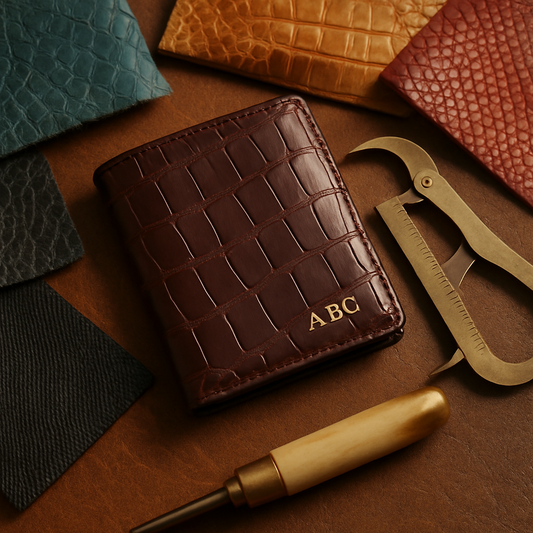
- Customization: unusual colors, widths, lasts, or monogram placement can change the amount of work required.
- Documentation and shipping: international compliance checks and transport arrangements can affect the final amount.
Do not use a low price as proof that leather is imitation, and do not use a high price as proof that the leather is genuine. Ask for a material breakdown and compare like with like: the same species, visible coverage, construction, and documentation.
Get the fit measured for business use
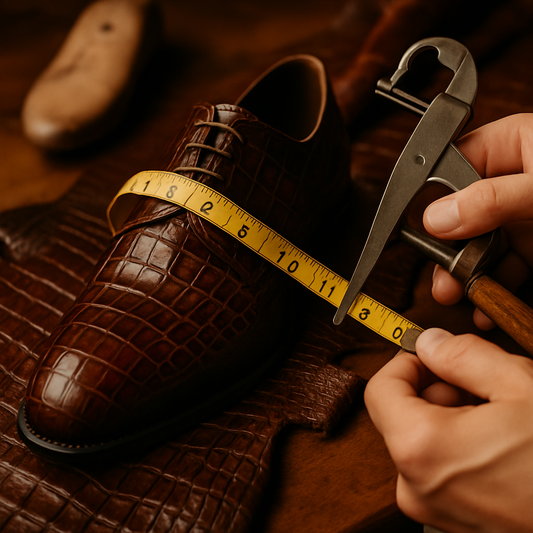
Good crocodile leather shoes should fit the foot rather than simply match its measured length. Request the shoe’s internal length and width where available, then compare those figures with a pair that already fits well.
- Length: allow practical room in front of the longest toe without letting the heel lift excessively.
- Width: check the ball-of-foot width, not only the outsole width. A broad foot may need a wide-fit last.
- Instep: high-instep feet can feel pressure over the vamp even when the toe length is correct.
- Heel: modest movement can occur during break-in, but persistent slipping can create rubbing and affect walking stability.
- Size systems: EU, US, and UK numbers are not interchangeable. Confirm the maker’s conversion chart and the last shape.
For remote measurements, measure both feet at the end of the day while wearing the socks intended for the shoes. Record foot length, ball girth, instep girth, and the widest point of each foot. Send photographs of the outline only if requested, since camera angle can distort proportions. A workshop can then recommend a likely size or ask for additional measurements; remote advice cannot replicate a fitting in person.
Choose a business-appropriate design
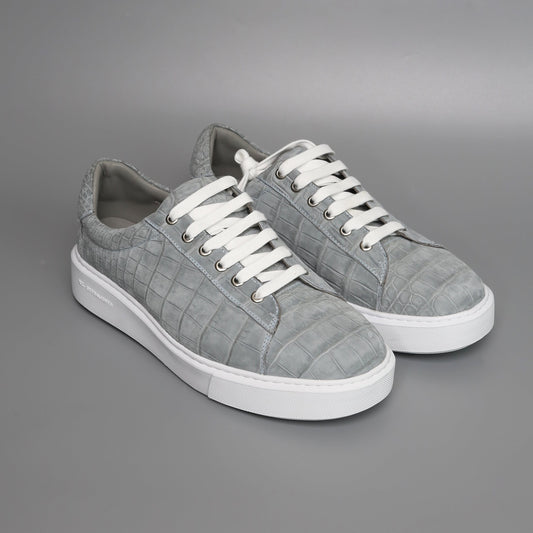
A smooth belly upper with a restrained toe shape usually coordinates easily with navy, charcoal, and mid-grey tailoring. Black crocodile leather suits the most formal office combinations, while dark brown can work with navy, grey, and medium-brown trousers. A deep burgundy or another subdued shade can be used with neutral tailoring when the workplace permits more color.
Cap-toe, wholecut, and plain-toe patterns generally keep attention on the leather without adding several competing design lines. A visible hornback ridge, large contrast stitching, or a strong surface finish creates a more noticeable shoe and may suit creative offices better than conservative boardroom dress.
Match the belt or briefcase by color family rather than trying to duplicate every scale pattern. The shoes can carry the texture while the rest of the outfit stays controlled: a solid shirt, a quiet tie, and trousers with a clean break help keep the overall combination suitable for business.
Care for crocodile leather shoes
After wearing the shoes, remove surface dust with a soft, dry cloth. This is the default care step because grit and perspiration residue can dull the finish without requiring additional products.
Use shoe trees that fit without forcing the vamp or spreading the scales. Let the pair air away from direct heat, radiators, and strong sunlight. If the leather becomes wet, blot it gently and allow it to dry gradually; heat can cause uneven drying and surface stress.
Do not apply ordinary smooth-leather polish automatically. Crocodile leather may need a conditioner or finish-compatible product, and an unsuitable formula can darken the surface, leave residue between scales, or change the sheen. Test any product on a concealed area first, or ask the workshop for product-specific advice.
There is no useful fixed care schedule for every wearer. Frequency depends on climate, perspiration, rotation, storage, and the finish applied to the leather. Inspect the vamp and edges periodically, and arrange professional care when the surface appears dry or the finish becomes uneven.
Frequently Asked Questions
How can I tell whether men’s business shoes are genuine crocodile?
Ask for the stated species, hide section, visible crocodile coverage, and supporting purchase documentation. Crocodile belly leather often shows sensory pores, but pores, scale shape, color, or sheen alone do not prove authenticity.
Does a higher crocodile leather grade mean the shoes will last longer?
Not necessarily. Grade generally concerns defects and usable yield in a stated cutting area, while durability also depends on the leather preparation, shoe construction, fit, wear pattern, and care. Grading labels vary by supplier and tannery.
Is belly width the same as crocodile leather quality?
No. Belly width is a measurement of the hide, not a quality grade. Measurement methods differ, so ask how the width was taken before comparing figures from different sellers.
What documents should I ask for when ordering crocodile shoes internationally?
Ask which species is stated, whether export or import documentation applies, and whether relevant permits, certificates, or non-reusable skin identification information accompany the shipment. Requirements depend on the species and trade route.
View CrocodileViet Shoes
Browse the CrocodileViet crocodile shoe collection to compare business-ready designs and leather coverage. For species, sizing, remote measurements, or documentation questions, contact CrocodileViet through WhatsApp.