
How to Choose Genuine Alligator Shoes For Men for Business Wear — Part 3

シェア
How to Choose Genuine Alligator Shoes for Men for Business Wear: Part 3
A genuine alligator business shoe should be identified by its species—American alligator (Alligator mississippiensis)—rather than by a crocodile-like scale print.
For business wear, choosing alligator leather shoes requires more than checking whether the surface looks expensive. You need to verify the animal species, understand the hide section used, assess the scale layout, inspect construction, confirm the fit, and match the shoe to your wardrobe. “Genuine” describes the material claim, but it does not by itself prove lawful sourcing, a particular grade, or a specific level of durability.
Start with the species, not the pattern
American alligator and crocodile are different animals. A product described as alligator should identify the species accurately, especially when the shoe is sold as a high-value item. A crocodile print on cow leather, or crocodile leather marketed as alligator, does not meet that description.
Product information should ideally state “American alligator” or Alligator mississippiensis, rather than using only broad language such as “exotic leather.” If the shoes are intended for international trade, ask about traceable documentation and the required identification tag. CITES regulates international trade in American alligator products, while crocodilian skins require tamper-resistant tags recording species and harvest details; untagged skins cannot be exported from the United States.
These documents support legal traceability. They do not mean that a CITES reference alone proves the material is genuine, so the species description, supplier information, and product construction should make sense together.
Read the belly pattern correctly
For business shoes, the visible vamp and quarters are often cut from the belly portion of the hide because its scales are comparatively regular and suitable for a controlled dress-shoe appearance. American alligator belly scales are generally smooth and squarish to rounded, with a gradual shift toward smaller scales as the leather moves toward the sides.
Crocodile belly scales can vary more by species and often show visible sensory pores, sometimes called integumentary sensory organs or ISOs. A pore-like mark can help raise a question about the material, but pattern alone is not a definitive species test. Alligator often has an umbilical scar, while crocodile lacks that feature, although the scar may be less visible depending on the cut and finishing.
Look for a balanced scale arrangement rather than demanding identical rows. Natural hides contain variation, and the scale sizes may change gradually across a panel. A regular pattern supports the appearance expected from alligator belly leather, but it does not replace species documentation.
Belly and hornback describe the cut, not the species
“Belly” describes the cut or presentation of the hide. “Hornback” retains the raised back scutes along the spine. Neither word identifies the animal species or proves a particular quality level.
For conservative business wear, belly-cut alligator is usually easier to coordinate with tailored clothing because the surface is flatter and the scale rhythm is less pronounced. Hornback can be appropriate for a more distinctive pair, but the raised scutes create a stronger visual effect and may sit less discreetly under trouser hems.
Ask which hide section is used on the toe, vamp, quarters, and heel counter. A shoe may combine different sections, and the answer affects both appearance and the way the leather flexes. A clear description is more useful than a broad label such as “full alligator” without a panel breakdown.
Check the grade without assuming one universal scale
Alligator grading labels vary by supplier and tannery. One published system assesses the midsection by the number and location of defects, while another uses quadrant-based grades. For that reason, a seller should explain the grading scheme instead of presenting “Grade 1” as a universal industry measurement.
In one commonly used system, Grade 1 means the belly has no defects, while higher numbers indicate more defects or defects located closer to the center. The head and tail may be excluded from the grade. This matters because the grade may refer to a specific section of the hide rather than the completed shoe.
Inspect the panels for healed marks, holes, deep scars, uneven pigmentation, and abrupt scale changes. Small natural variations do not automatically indicate a problem. More important questions are whether a defect sits in a prominent toe area, whether the two shoes are visually compatible, and whether the finish disguises an issue that may become clearer with use.
Do not confuse visual grade with durability. A clean-looking belly can improve appearance and cutting efficiency, but it does not by itself guarantee stronger leather, better stitching, or a longer service life. Construction and maintenance influence how the finished shoes perform.
Examine construction for business use
Alligator leather is the visible material, but a business shoe also depends on its last, lining, insole, sole, heel, and fastening system. Check that the toe keeps a clean shape without looking excessively rigid. The vamp should flex without sharp creasing or signs that the finish is cracking at the fold.
Look closely at the junction between the upper and sole. Stitching should follow a controlled line, with no loose threads, skipped sections, or uneven spacing that affects the appearance. The heel should sit squarely, and the outsole should be appropriate for the environments where you will wear the shoes. Leather soles can suit formal offices and dry conditions, while a rubber insert or rubber sole may offer more traction for wet commutes.
For handmade alligator shoes, ask what is actually handmade or hand-finished. The phrase can refer to cutting, skiving, closing, lasting, sole attachment, finishing, or only selected stages. A precise answer is more valuable than the label alone.
Panel matching is another practical point. On a pair intended for business clothing, the left and right shoes should have compatible scale size, color depth, and orientation. They do not need to look mechanically identical, because the hide is natural, but major differences can make the pair appear assembled from unrelated sections.
Use price as a breakdown of costs
The price of genuine alligator shoes reflects several concrete factors:
- Species and documentation: American alligator identification and traceable trade records support the material claim and legal movement of the product.
- Hide section: Belly leather with a regular scale layout is generally more suitable for formal uppers than less even areas, so the usable cutting area affects cost.
- Grade and yield: Fewer visible defects can improve the number of clean panels obtained from a hide, while complex patterns may increase material waste.
- Pattern matching: Aligning scale direction and visual weight across both shoes requires additional planning and can reduce cutting efficiency.
- Construction: Lasting method, stitching, sole attachment, lining, heel work, and finishing all contribute to labor and materials.
- Customization: Special sizing, unusual colors, monograms, or a made-to-measure last can add work beyond a standard model.
A higher price should therefore be explained through the hide, construction, and service included. A lower price is not automatically evidence of poor leather, but vague species descriptions and missing documentation deserve further questions.
Confirm fit by length, width, and instep
Alligator shoes should fit correctly before you judge their appearance. Start with foot length, then check the ball width, heel width, and instep height. A pointed or narrow last may feel restrictive even when the length is correct, while a wide foot may need a wider fitting rather than simply a longer size.
Compare the maker’s chart across EU, US, and UK sizing systems. These conversions can vary by brand and last, so use the stated foot-length measurement as the primary reference. If you usually wear different sizes in leather loafers, sneakers, and lace-up dress shoes, tell the workshop which models fit well and where they differ.
High insteps require particular care with loafers and closed lace facings. A shoe that is difficult to put on may create excessive pressure across the vamp. For remote orders, provide a traced outline of each foot, heel-to-toe length, ball width, instep measurement, and photographs of your usual footwear. Measure both feet because modest differences are common.
Do not expect the leather to solve a poor last selection. Alligator can soften with use, but excessive stretching may distort the scale layout and finish. Ask about the available width and whether the pattern can be adjusted before ordering.
Match the shoes to business clothing
Black alligator dress shoes work naturally with charcoal, navy, and black tailoring, particularly in formal offices. Dark brown can pair with navy, medium gray, and brown suits, while burgundy or oxblood works best when the rest of the outfit stays restrained.
For a conservative workplace, choose a lower-shine finish, a balanced belly pattern, and a plain toe or restrained cap toe. A high-gloss finish, prominent scale contrast, or hornback panel can suit evening events or less formal business settings but may draw more attention than expected in a traditional office.
Coordinate the belt, watch strap, and briefcase by color family rather than trying to make every texture identical. A dark brown alligator shoe can work with a smooth brown belt if the tones are close. Keep the suit fabric, shirt, and tie quieter when the footwear has strong scale definition.
Care for alligator leather shoes
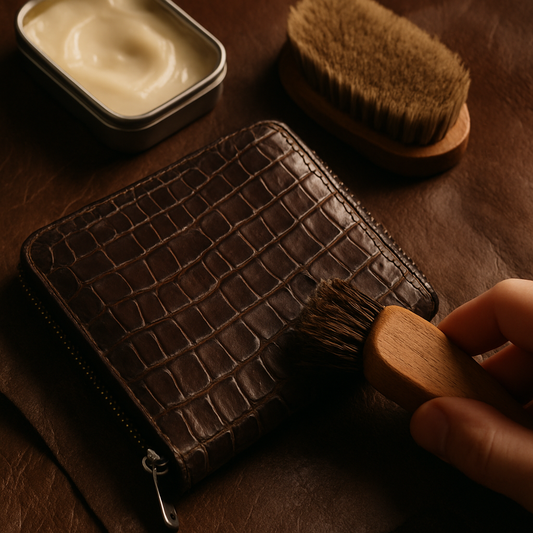
After wearing the shoes, remove surface dust with a dry, soft cloth. This is the safest default for routine care because it avoids adding moisture or product unnecessarily. Use shoe trees that support the shape without stretching the vamp, and allow the shoes to air away from direct heat.
Keep the pair away from radiators, hair dryers, and prolonged sunlight. Heat can dry the leather and affect the finish. If the shoes become wet, blot them gently, let them dry gradually, and avoid forcing them back into shape while damp.
There is no useful fixed care schedule for every wearer. Climate, frequency of use, perspiration, rain exposure, and the type of finish all affect the maintenance interval. Before applying conditioner or polish, confirm that it is suitable for alligator leather and test it on a concealed area. Heavy product buildup can reduce the clarity of the scale surface and change the color.
For additional styling and maintenance ideas, see Navy Alligator Skin Shoes: Styling, Care and Buying Tips. For a broader discussion of construction and service life, read What Makes Luxury Alligator Dress Shoes Worth Buying? Quality, Craft and Longevity.
Frequently Asked Questions
How can I tell whether men’s shoes are genuine alligator?
Check that the description identifies American alligator or Alligator mississippiensis, then examine the belly pattern, possible umbilical scar, construction, and traceable documentation. A crocodile-like pattern or one sensory feature alone does not prove authenticity.
Is belly alligator better for business shoes than hornback?
Belly and hornback describe hide presentation rather than species or universal quality. Belly usually offers a flatter, more regular surface that suits conservative business shoes, while hornback retains raised back scutes and creates a stronger visual effect.
Does Grade 1 alligator guarantee a more durable shoe?
No single grading label guarantees durability. In one grading system, Grade 1 indicates no defects in the belly, but grading systems differ and may exclude the head and tail. Durability also depends on tanning, thickness, construction, fit, and care.
What measurements should I send when ordering alligator shoes remotely?
Send both foot lengths, ball widths, instep measurements, heel widths, traced outlines, and your usual EU, US, and UK sizes. Also describe whether you need a wide fit or have a high instep, and include the name and size of a shoe that already fits well.
Browse CrocodileViet’s alligator and crocodile shoe collection to compare available business styles and construction details. For sizing questions, contact CrocodileViet through WhatsApp with your measurements and the shoe style you are considering.