
How Crocodile Leather Mules Are Made: From Hide Selection to Hand Finishing

シェア
How Crocodile Leather Mules Are Made: From Hide Selection to Hand Finishing
A typical pair of crocodile leather mules begins with a belly-cut crocodile skin, followed by panel cutting, backless shoe assembly, edge finishing, and fit checks.
What “crocodile leather” means
Crocodile leather should refer to leather from a crocodile species, rather than cowhide embossed with a crocodile-like pattern. Embossed leather is an imitation material with a different structure, surface, and sourcing history.
This distinction matters during hide selection. Crocodile and alligator skins both have belly scales, but their patterns should not be treated as interchangeable. Crocodile skin often shows visible sensory pores, known as integumentary sensory organs or ISOs, while alligator skin commonly has a more regular, balanced belly-scale arrangement. These features can help with identification under magnification, although visual appearance by itself is not sufficient proof of species.
1. Selecting the hide and the cutting area
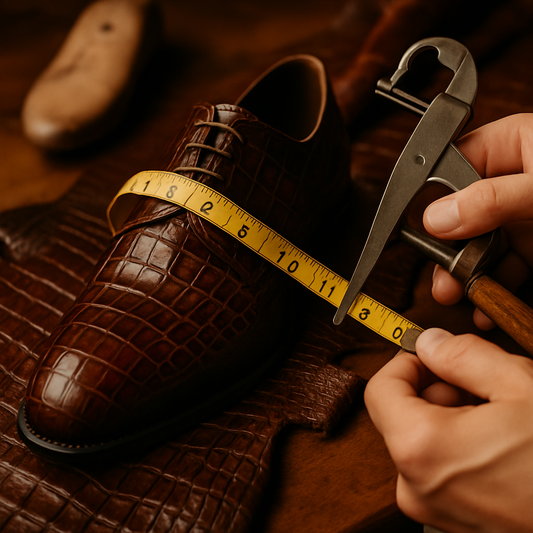
The first manufacturing decision is not simply choosing the largest skin. The workshop assesses the usable cutting area, scale arrangement, surface defects, and the placement of the finished shoe’s main panels.
| Decision factor | Why it matters for mules |
|---|---|
| Belly or back section | Belly leather has broader, smoother scales; back or hornback leather retains more prominent bony scutes and a more textured surface. |
| Central scale area | The vamp is highly visible, so regular scale spacing and a clean central area affect the shoe’s finished appearance. |
| Defects | Cuts, holes, stains, buttons, and visible collagen marks can reduce the usable cutting area or change panel placement. |
| Grading system | Grades vary between suppliers and tanneries. A stated grade has meaning only when its grading method is also identified. |
In one supplier’s belly-skin system, higher grades contain largely blemish-free central belly scales and approximately 70–90% blemish-free cutting area. That percentage belongs to that particular system; it should not be presented as a universal crocodile-leather standard.
At CrocodileViet, panel placement is planned around the scale direction because the scales need to follow the shoe’s shape rather than appear randomly rotated across the upper. This reduces visual interruption at the vamp and helps the two shoes read as a pair.
2. Preparing and cutting the leather
After the usable section is identified, patterns are positioned on the hide. A mule has a backless construction, so the upper must hold the foot without a closed heel counter. The main vamp is therefore especially important: it crosses the instep and receives much of the visual and physical contact during walking.
Cutting requires a balance between scale size and shoe size. A small shoe may not accommodate the same scale layout as a larger shoe, while a wide upper can require more leather across the foot. The objective is not to force an entire hide into one design, but to place the strongest and most visually consistent sections where they will be seen and flexed most often.
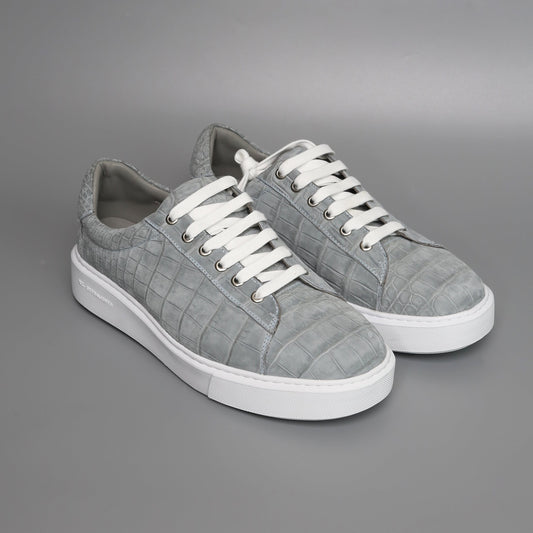
Crocodile leather is not the same as nubuck alligator leather. Nubuck alligator has a buffed surface that creates a softer, velvety feel, while crocodile belly leather normally retains a more defined scale surface. The terms can appear together in online searches, but they describe different species or surface treatments.
3. Building the backless shoe
A mule is a backless shoe. “Crocodile leather mule” describes the material and shoe style, not a special construction method.
The cut upper is shaped over the last, the form used to establish the shoe’s length, width, toe shape, and instep volume. The upper is then joined with the lining and sole components according to the design. Because a mule lacks a rear section, the front opening and vamp need to sit securely over the foot without creating excess pressure across the instep.
For men searching for alligator mules for men or luxury slip on loafers men, the same fit issue applies: a slip-on cannot be judged by length alone. Instep height, forefoot width, and the opening’s position influence whether the shoe stays on while walking.
4. Hand finishing the upper
Hand finishing is where the leather edges, surface, and final proportions are checked together. Edges may be cleaned, shaped, and finished so the upper meets the sole with a controlled transition. The scales are inspected for marks introduced during cutting or assembly, and the pair is checked side by side for alignment and proportion.
Hand finishing does not turn every hide into an identical product. Crocodile is a natural material, so small differences in scale size, pore visibility, and surface character can occur between panels. The purpose of finishing is to present those characteristics clearly while correcting avoidable construction irregularities.
Species, sourcing, and trade documents
CITES regulates international trade in covered crocodilian species and specimens. Crocodilian skins entering international trade are subject to identification and tagging requirements, with permits or certificates required where applicable.
CITES recognizes shoes among manufactured crocodilian-leather goods, but a finished shoe is not automatically free from documentation requirements. The applicable paperwork depends on the species, origin, destination, and trade rules involved. CITES documentation can support lawful trade; it does not, by itself, prove that a particular shoe is authentic.
Price factors for crocodile leather mules
The price of crocodile leather mules reflects several concrete factors:
- Usable hide area: A skin with a larger clean cutting area may yield more coordinated panels with less waste.
- Scale placement: Central belly scales with consistent spacing can require more selective cutting.
- Leather treatment: Finishing, color development, surface protection, and the desired hand feel affect labor and materials.
- Construction: The sole, lining, insole, edge treatment, and amount of hand finishing all influence the final cost.
- Documentation and sourcing: Species, legal origin, tagging, and applicable trade paperwork can affect the supply chain.
- Pattern waste: Small sizes, wide fits, and designs requiring matched panels may leave different amounts of unused leather.
A supplier’s grade should be read alongside its definitions. “Grade A” or a similar label does not carry one universal meaning across every tannery or workshop, and visual grade should not be confused with durability.
Fit and sizing
Start with foot length and forefoot width, then check the instep. Compare your measurements with the maker’s chart in the stated system, whether EU, US, or UK sizing. A conversion table is useful, but it cannot account for every last shape.
Customers with wide feet should ask for the actual internal width or the maker’s wide-fit recommendation rather than simply sizing up. Adding length may leave too much space in front while failing to provide enough room across the forefoot. A high instep can also need a different opening depth.
For remote measurements, measure both feet while standing, wearing the socks normally used with the mules. Record heel-to-longest-toe length, the broadest forefoot circumference, and the instep circumference. Send both sets of measurements and mention whether your current slip-ons slip at the heel or press across the vamp.
Care after wearing
Use a dry, soft cloth as the default cleaning method. Wipe away dust without pressing grit across the scales. Allow the shoes to air away from direct heat after use, and avoid soaking the leather or applying an untested cream, wax, or solvent.
There is no useful fixed care schedule for every wearer. Climate, perspiration, frequency of use, and the finish on the leather all change the maintenance requirement. If the surface becomes dull, marked, or unusually dry, ask the maker which product suits that specific finish before applying anything.
Styling crocodile leather mules
A dark crocodile mule works with tailored trousers, knit polos, and a clean overshirt because the textured leather supplies visual interest without requiring patterned clothing. A lighter brown or tan pair can coordinate with denim, linen trousers, or unstructured tailoring.
Keep the trousers’ break in proportion to the backless shape. A shorter or lightly tapered trouser can show the vamp, while a wider trouser usually works better when its hem does not bunch heavily over the shoe. For a business-casual setting, combine the mules with solid colors and restrained accessories; for relaxed wear, denim and a plain shirt allow the scale pattern to carry more of the outfit.
Frequently Asked Questions
Are crocodile leather mules made from the same material as alligator mules?
No. Crocodile and alligator are different species groups, and their scale structures can differ. A product described as alligator should not be relabeled crocodile simply because both have belly scales.
Is belly-cut crocodile leather better than hornback leather?
They serve different visual purposes. Belly-cut leather has broader, smoother scales, while back or hornback leather retains more prominent bony scutes and a textured appearance. The suitable option depends on the design and the desired surface.
How can I choose the correct mule size when buying remotely?
Measure both feet while standing and send length, forefoot width or circumference, and instep circumference. Check the maker’s EU, US, or UK chart and ask about internal width, especially if you have a wide forefoot or high instep.
Does CITES documentation prove that a mule is genuine crocodile leather?
No. CITES addresses regulated international trade and related documentation. Species identification and material verification require appropriate product and supply-chain evidence; one document or one sensory feature should not be treated as conclusive proof by itself.
For an alligator-specific slip-on option, see the natural tan nubuck alligator mules. For measurements or material questions, contact CrocodileViet through WhatsApp.