
Custom Alligator Watch Strap Care: How to Protect Texture, Shape and Finish

シェア
How to Care for a Custom Alligator Watch Strap and Protect Its Texture, Shape, and Finish
The safest routine for a custom alligator watch strap is simple: wipe it with a dry, soft cloth after wear and keep it away from water, perfume, creams, and heat.
Alligator leather responds well to controlled handling, but a watch strap is exposed to sweat, wrist movement, changing temperatures, and pressure from the buckle every day. Care therefore needs to protect three separate features: the raised scale texture, the strap’s curved shape, and its surface finish.
What makes an alligator watch strap sensitive?
An alligator strap is made from a skin with natural scale structure rather than a flat, featureless sheet. Belly leather generally has a regular, balanced scale pattern, which is why it is commonly selected for watch straps that need a consistent visual rhythm across the wrist. The scale pattern itself is not a durability rating. A more regular pattern does not automatically mean the leather will resist every type of wear better.
At our workshop, the hide area matters because the scale structure affects how a strap looks after it is cut to narrow watch-strap dimensions. Belly, flank, and hornback are different hide areas or cuts. Belly leather is cut with the back split, while hornback displays the bony back scutes. Confusing these areas can lead to the wrong expectation about texture, flexibility, and appearance.
Alligator belly may also show an umbilical scar. This is a distinctive alligator-hide indicator, but it should not be treated as a defect automatically or as a complete proof of authenticity by itself. Crocodile leather is more variable by species and often shows visible sensory pores, sometimes called ISOs. Neither a pore nor a scar should be used as the sole test of whether a strap is genuine.
Daily care for a custom alligator watch strap
Use a dry cloth first
After removing the watch, wipe the strap gently with a clean, dry cloth. This removes surface moisture, skin oils, and dust before they settle around the scales or edge of the leather. A soft cotton or microfiber cloth is suitable if it has no abrasive debris trapped in its fibers.
Use light passes instead of vigorous rubbing. Strong friction can flatten the visual relief of the scales or create uneven shine on a finished surface. Pay attention to the underside, the holes around the buckle, and the edges, since these areas receive repeated contact with the wrist and hardware.
Keep liquids away from the leather
Keep the strap away from soaking, running water, perfume, creams, and other liquids. A small splash should be treated promptly rather than ignored, especially near the folded keeper loops or the strap holes where moisture may remain longer.
If the strap becomes wet, gently blot it with a dry cloth. Do not twist it, press it under a heavy object, or rub the scales to speed up drying. Let it dry fully at room temperature away from direct sunlight, radiators, hairdryers, and other heaters. Heat can draw moisture out unevenly and may affect the strap’s shape or finish.
There is no useful fixed cleaning schedule for every wearer. A person who wears the strap in a warm climate or during long working days may need to wipe it more often than someone who wears it occasionally indoors. The condition of the surface should determine the frequency.
How to preserve the strap’s shape
Shape is affected by bending, moisture, storage pressure, and the way the strap is fastened. After wearing the watch, release the buckle without sharply folding the leather backward. A gentle curve is preferable to a tight crease, particularly at the point where the strap passes around the wrist.
Do not store the watch with the strap compressed under books, clothing, or another watch. Keep it in a dry place with enough room for the leather to sit in a relaxed curve. If the strap has become damp, allow it to dry completely before closing it tightly around a watch cushion or placing it in a confined case.
Repeatedly using a hole that pulls the strap into an awkward angle can also affect its shape. For a custom strap, the correct length helps reduce this stress because the buckle can sit in a comfortable position without forcing the leather into an excessive bend.
Protecting the finish and scale texture
The finish is the surface treatment and visual character you see on the leather. It can be glossy, muted, smooth, or textured, depending on the material and finishing approach. Cleaning should not be used to change that character.
Avoid household leather cleaners, oils, waxes, alcohol-based products, and unapproved conditioners. Products intended for another leather type may darken alligator leather, leave residue between scales, or alter the level of shine. Creams and perfume can also transfer from the wrist to the strap and create uneven surface marks.
If the strap has accumulated dust in the scale channels, use the dry cloth gently rather than a sharp tool or stiff brush. Scraping between scales can mark the finish and may lift material at an edge. For a persistent mark, ask the workshop or seller about the specific finish before applying any product.
Fit and sizing for a custom strap
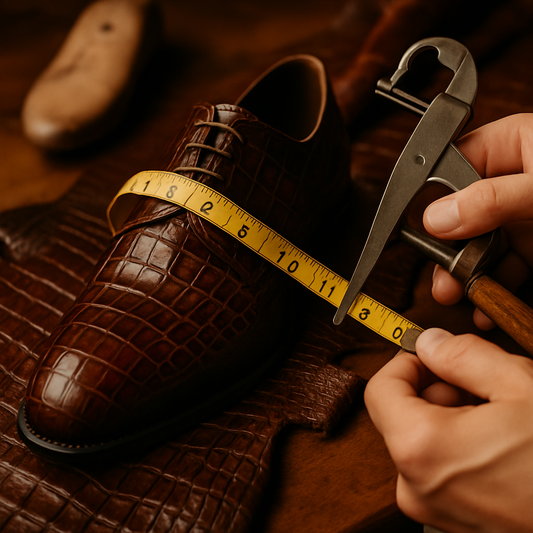
A well-fitted custom strap supports care because it reduces unnecessary pulling and creasing. The key measurements are the lug width, buckle width, long-side length, short-side length, and wrist circumference. Strap dimensions are commonly discussed in millimeters, while alligator hides themselves are often sized by the width across the belly in centimeters. These are different measurements and should not be confused.
For remote measurements, provide the watch reference or measure the distance between the inside faces of the lugs with suitable precision. Measure the wrist where the watch will sit, without pulling the tape tight. Also state whether you prefer a close fit or additional room, and provide the current strap’s long and short lengths if it fits well.
Wide-fit requirements deserve a direct note. A wearer with a broad wrist may need additional length, while a high instep is not relevant to a wrist strap; the comparable wrist consideration is a fuller wrist profile or a pronounced wrist bone. Mention that profile when requesting a custom size, because circumference alone may not explain where the strap feels tight.
EU, US, and UK sizing systems are common for shoes and clothing, but watch straps are normally specified by millimeter dimensions rather than those regional size labels. If a seller uses EU, US, or UK size language, ask for the corresponding length and width before approving the order.
Price factors for a custom alligator watch strap
A quote should be assessed by its actual specifications rather than by the word “alligator” alone. Relevant factors include:
- the hide area used, such as belly, flank, or hornback;
- the strap width, long-side and short-side lengths, and unusual sizing;
- the scale layout required across the visible sections;
- the surface finish and color treatment;
- the lining material, edge treatment, buckle, and other hardware;
- the requested personalization and the supplier’s production method;
- the grading system used for the hide and what its labels actually mean.
Alligator grading is not standardized across every supplier or tannery. One supplier may use a numbered belly-defect scale, while another may use quadrant-based fractions. Ask which grading system is being used, what area it covers, and whether the stated grade applies to the complete hide or only the portion selected for the strap. A visual grade describes appearance and defects; it should not be presented as a direct durability guarantee.
How to wear an alligator watch strap with different outfits
A dark, low-shine alligator watch band can work with a business suit when the strap width matches the watch case and the buckle does not draw attention away from the dial. With business-casual clothing, a less formal finish and a coordinated leather tone can sit comfortably alongside a blazer, knitwear, or an open-collar shirt.
For casual clothing, the strap can be paired with denim, cotton trousers, or a plain overshirt when the color contrast is intentional. A lighter or more visibly textured strap generally attracts more attention, so keep the rest of the accessories restrained if the watch is already the main focal point.
A crocodile watch band should not be treated as identical to an alligator strap. Crocodile scale patterns vary more by species and often show sensory pores, while alligator belly leather is commonly recognized for a regular, balanced arrangement. Choose according to the hide area, surface character, and watch design rather than using the species name alone as a quality label.
Documentation and responsible buying
International wildlife-trade rules can apply to alligator and crocodile products. CITES-regulated shipments may require export permits or re-export certificates, and national regulations may add further requirements. Buyers and sellers should verify the documentation for the species and shipment instead of assuming that a watch strap is exempt.
Documentation supports lawful trade, but CITES paperwork does not by itself prove every detail of a strap’s material, grade, or construction. Ask for clear product information and keep shipment documents where applicable.
Frequently Asked Questions
How should I clean a custom alligator watch strap?
Start with a clean, dry, soft cloth and wipe the surface lightly, including the underside and edges. Avoid soaking, perfume, creams, household cleaners, and unapproved conditioners. For a persistent mark, contact the seller or workshop before applying a product.
What should I do if my alligator strap gets wet?
Gently blot it with a dry cloth and let it dry fully at room temperature away from sunlight, heaters, and hairdryers. Do not twist, rub forcefully, or apply heat to accelerate drying.
How do I order the right custom strap size remotely?
Provide the lug width, buckle width, wrist circumference, long-side and short-side lengths, and your preferred wearing room. A photo or measurement of a well-fitting current strap can also help, but confirm all dimensions in millimeters before production.
Does a regular alligator scale pattern prove the strap is authentic?
No. Alligator belly commonly has a regular, balanced pattern, and an umbilical scar may be visible. These features are useful observations but should not be treated as sole proof of authenticity. Supplier information and applicable documentation also matter.
Choose a custom alligator strap with clear specifications
View the CrocodileViet watch band collection for available strap styles and material details. For custom sizing, finish questions, or remote measurements, contact CrocodileViet through WhatsApp with your watch and wrist dimensions.