
Best Handmade Alligator Shoes for Men: What to Look For — Part 2

シェア
Best Handmade Alligator Shoes for Men: What to Look For, Part 2
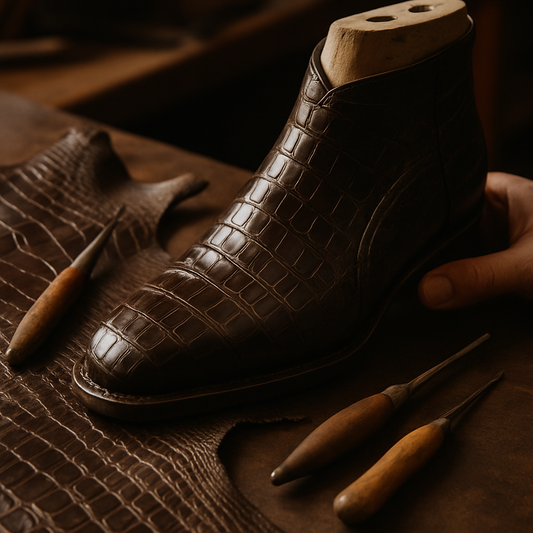
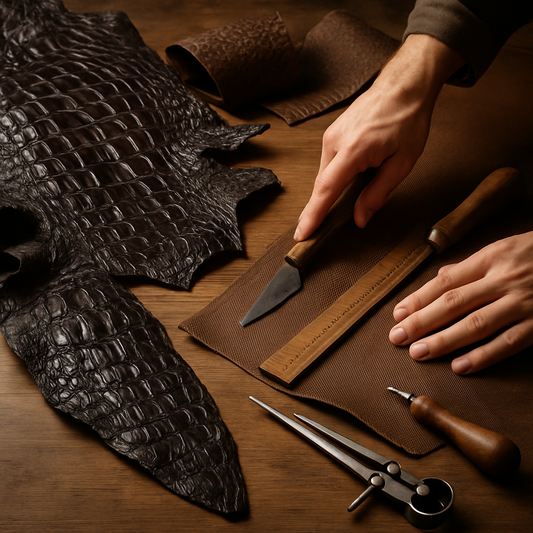
The belly cut is the smoother central underside of an alligator skin, and its regular, balanced scale layout is one of the first details to inspect when choosing handmade alligator shoes for men.
That detail matters because shoes place large, visible leather panels across the vamp, quarters, and counter. The scale arrangement, surface condition, pattern placement, and fit all affect how the finished pair looks and wears. A high price alone does not confirm that the most useful part of the skin was selected for the visible shoe panels.
Start with the alligator belly cut
In crocodilian leather terminology, the central underside is called the belly or ventral cut. It is usually smoother than the flank and tail sections, with a comparatively regular scale pattern. Those balanced scales are commonly preferred for dress shoes because they create a controlled visual rhythm across the vamp.
Ask which part of the skin is used for each visible panel. “Alligator leather” does not automatically mean that the entire shoe is made from belly leather. Flank and tail sections have different scale shapes and may be used in areas where a less regular pattern is suitable.
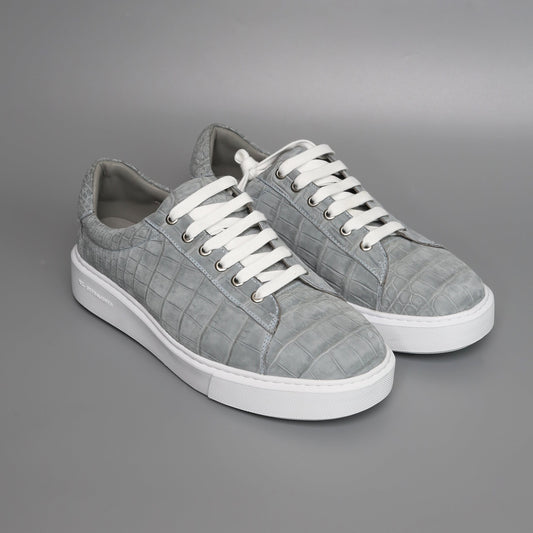
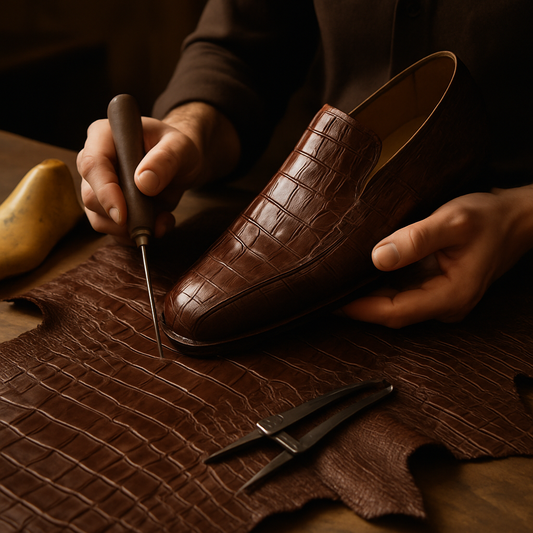
Look at the scale alignment from the toe toward the lacing area. The scales should follow the shape of the shoe rather than appearing abruptly rotated or crowded at a seam. On a pair with a prominent centerline, check whether the pattern is balanced from one shoe to the other. Natural skins are not machine-identical, so the goal is visual harmony rather than cloned markings.
Inspect surface condition where the shoe is actually cut
Small marks on a raw skin do not carry the same importance in every location. A cut, hole, stain, or scar in an area intended for the vamp can affect the visible result more than a similar mark on a hidden section. Ask to see photographs of the completed shoes from the top, side, heel, and close range around the toe and vamp.
This is also why a skin grade should not be confused with shoe-making quality. Grading labels vary between suppliers, tanneries, buyers, and markets. There is no single universal Grade A, B, or C system that tells you exactly how a pair will look. A grade generally describes the condition of the skin, while the finished shoe also depends on pattern layout, construction, finishing, and fit.
For genuine alligator shoes for men, ask what documentation accompanies the product and where the skin originated. American alligator skins exported from the United States require CITES tags and a legal-acquisition finding. A CITES tag supports regulated trade documentation, but it does not by itself prove every destination’s import requirement has been satisfied or establish authenticity through one label alone. Requirements can depend on the product, shipment, and destination rules.
Assess the visible pattern, not just the word “alligator”
A seller’s description should identify the species and the cut as clearly as possible. If the product is described only as “alligator leather,” ask whether the upper uses belly, flank, tail, or a combination of sections.
- Scale regularity: belly scales usually create a balanced pattern across the central upper.
- Scale size: smaller scales can suit a narrower or more understated shoe, while larger scales create a stronger visual effect.
- Pattern direction: the scales should support the shoe’s toe shape and panel lines.
- Surface marks: inspect visible areas for scars, stains, holes, or cuts rather than judging only the grade label.
- Pair consistency: compare both shoes side by side for a coherent relationship between scale size, color, and layout.
One visual trait should not be treated as proof of authenticity. Texture, scale shape, color, a tag, or a seller’s wording needs to be considered alongside species identification, supplier information, documentation, and the seller’s ability to answer specific questions.
Understand what affects the price
The price of handmade alligator shoes reflects several separate cost factors, not simply a general claim about quality. Useful questions include:
| Price factor | What to check |
|---|---|
| Amount of alligator leather | Ask whether the upper uses belly leather, smaller panels, or a mixture of skin sections. |
| Visible skin condition | Check whether marks or defects fall on the vamp, toe, quarters, or other exposed pieces. |
| Pattern layout | More selective matching across a pair can require additional usable skin and cutting judgment. |
| Shoe design | Plain wholecut-style uppers, cap toes, brogues, loafers, and multi-panel designs use leather differently. |
| Construction and finishing | Ask what construction method, sole materials, hardware, lining, and finishing work are included. |
| Size and customization | Large sizes, wide fittings, unusual insteps, and special measurements can change material use and labor. |
| Shipping and paperwork | International delivery, duties, and wildlife-trade documentation may affect the final landed cost. |
Comparing two pairs by price alone can hide important differences. Request the same information for each pair: species, cut, upper construction, sole, lining, available measurements, paperwork, and what happens if the fit needs adjustment.
Check length, width, and instep before ordering
A well-selected upper cannot compensate for an incorrect last. Measure both feet because foot length and width can differ. Record heel-to-toe length, the widest part of the forefoot, and the circumference over the instep. Take measurements at the end of the day, when feet may be slightly larger than in the morning.
Convert your measurements to the seller’s sizing system rather than assuming that an EU size equals one fixed US or UK size. EU, US, and UK sizes vary by brand and last shape. Ask for the actual insole length or the recommended foot measurements for the specific model.
Width deserves separate attention. A standard-width shoe may feel restrictive even if the length is correct. If you need a wide fit, provide forefoot width and ball circumference, then ask whether the last can accommodate that shape. A high instep can create pressure beneath the lacing area, while a low instep may allow the heel to lift.
For remote orders, send measurements according to the workshop’s instructions and include photos only if requested. A useful measurement set normally includes both feet, standing weight-bearing measurements, and notes about existing fit problems. Also mention bunions, uneven toes, orthotics, or a preference for thicker socks. These details help a maker assess whether the standard last is appropriate or whether another option should be discussed.
Do not rely on breaking-in time to solve sharp pressure, toe contact, or heel slippage. Leather can soften, but it does not convert an unsuitable length into a suitable one.
Choose a design that works with the leather pattern
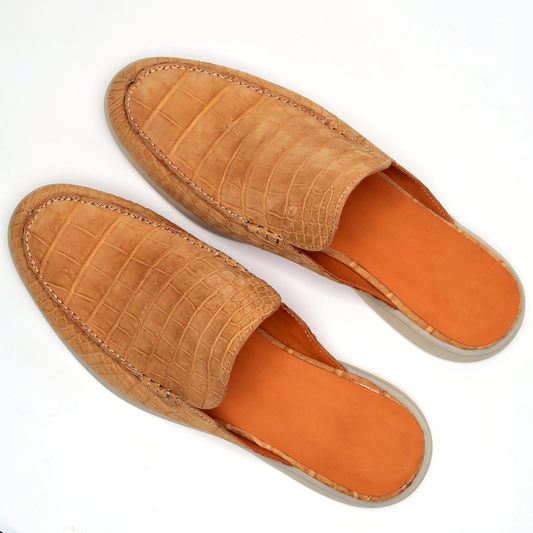
Plain-toe derbies, wholecut-inspired designs, loafers, monk straps, and cap-toe oxfords present alligator leather differently. A broad uninterrupted vamp shows more of the belly pattern, while a cap toe divides the surface with a seam. Broguing and multiple panels add visual structure but also interrupt the scale layout.
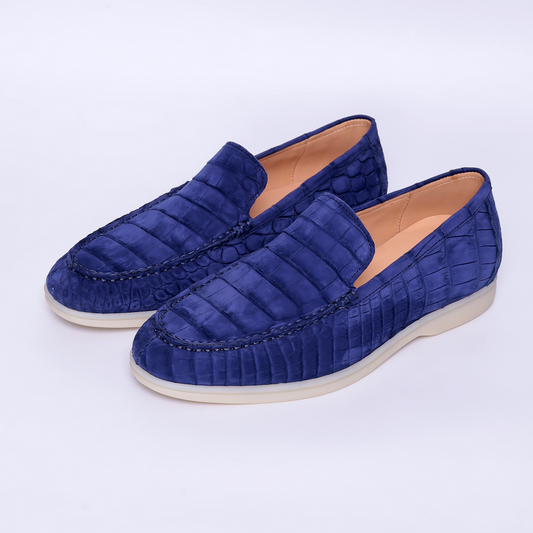
For business clothing, dark brown or black alligator leather shoes can work with navy, charcoal, and medium-grey tailoring when the design is restrained. A lighter brown pair can support tan, olive, cream, and textured jackets. Navy alligator skin shoes call for attention to color temperature: they can work with grey trousers, dark denim in suitable settings, and navy tailoring when the shades are clearly separated.
Match the formality of the shoe to the setting. A sleek lace-up with limited decoration generally reads more formally than a heavily perforated shoe or a casual loafer. Trousers should cover enough of the upper to avoid an awkward break, while the scale pattern should still be visible when standing.
For more color-specific suggestions, see Navy Alligator Skin Shoes: Styling, Care and Buying Tips.
Care for alligator leather shoes at home
Begin with a dry, soft cloth to remove dust after wear. This is the safest default because alligator leather can react poorly to excess moisture, unsuitable solvents, and heavy product application. If the surface is wet, blot it gently and let the shoes dry naturally away from direct heat.
Use shoe trees that support the shape without stretching the upper aggressively. Rotate pairs rather than wearing the same shoes continuously, giving perspiration and moisture time to dissipate. Keep them in a breathable shoe bag or box away from strong sunlight and humid storage conditions.
Do not apply ordinary shoe polish, alcohol-based cleaners, or household oils without confirming that the product is suitable for alligator leather. Different finishes need different treatment, and an incompatible conditioner can darken, dull, or stiffen the surface. A specialist should assess serious staining, cracking, or finish damage.
There is no useful fixed care schedule for every wearer. Climate, frequency of use, perspiration, storage, and the leather’s finish all matter. Inspect the shoes regularly and respond to visible dryness, dirt, or loss of shape instead of applying products simply because a calendar date has arrived.
Questions to ask a workshop
A reliable conversation should produce specific answers rather than broad labels. Ask:
- Which alligator species and skin section are used on the upper?
- Are the visible vamp panels cut from belly leather?
- Where are natural marks located, and are they visible when worn?
- Which EU, US, or UK size and width should match my measurements?
- What documentation accompanies an international shipment?
- What care products are suitable for this particular finish?
For a broader discussion of materials, construction, and ownership factors, read What Makes Luxury Alligator Dress Shoes Worth Buying? Quality, Craft and Longevity.
Frequently Asked Questions
What part of an alligator skin is best for handmade men’s shoes?
The belly or ventral cut is commonly preferred for visible shoe panels because it has a smoother surface and a comparatively regular, balanced scale pattern. Flank and tail sections can also be used, but their scale shapes differ and should be identified clearly.
Does Grade A prove that alligator shoes are well made?
No. Grading labels vary by supplier and tannery, and a grade generally describes skin condition rather than the quality of shoe construction. Check where defects fall, how the upper is constructed, the fit, the sole, and the finishing.
How should I check the fit when ordering alligator shoes remotely?
Provide both foot lengths, forefoot widths, ball circumferences, and instep measurements while standing. Ask for the maker’s actual EU, US, or UK size recommendation and explain whether you need a wide fit, extra instep room, orthotics, or a particular sock thickness.
Does a CITES tag prove that a pair is authentic?
A CITES tag is part of regulated trade documentation for applicable shipments, including American alligator skins exported from the United States. It does not by itself prove authenticity or confirm that every destination’s import requirement has been met.
See handmade alligator shoes for men
Browse the CrocodileViet handmade alligator shoes collection to compare available designs and leather layouts. For sizing, customization, documentation, or care questions, contact CrocodileViet through WhatsApp.