
Best Alligator Leather Watch Band for Men: What to Look For

シェア
How to Choose the Best Alligator Leather Watch Band for Men
The most useful alligator leather watch band for men usually comes from the belly section of the hide, where the scales are comparatively regular and the surface is easier to control across the strap.
A well-chosen band should suit three things at the same time: the watch case, the wearer’s wrist, and the amount of visual pattern he wants to show. Leather origin matters, but so do the cutting area, grade, scale matching, strap dimensions, lining, stitching, and buckle placement. These details affect how the band looks on the wrist and how naturally it works with a particular watch.
Start with genuine alligator leather
“Croc” or “croco pattern” can describe embossed calfskin rather than the skin of an alligator or crocodile. If genuine alligator is important to you, ask what material is used for the outer surface and request appropriate sourcing information rather than relying only on the pattern.
Alligator belly leather is known for a regular, balanced rectangular scale arrangement. The pattern generally appears more consistent than the larger, more irregular scale arrangement often associated with crocodile leather. This does not make one material automatically better; it creates a different visual result.
Trade documentation is also relevant. Genuine leather from regulated species may require CITES-related compliance when it is sourced or transported across borders. CITES concerns legal trade and species protection documentation; it is not, by itself, proof that a particular strap is genuine or well made.
Choose the right hide section
For a conventional dress or everyday alligator watch strap, the belly cut is usually the most practical starting point. The belly has a flatter surface and a more controlled scale layout, so the strap face can present a measured pattern instead of abrupt changes in scale shape.
At CrocodileViet, a belly cut is useful when the goal is visual balance across the two strap pieces. The scales near the center can be arranged so that the long side and short side do not look unrelated when the watch is fastened. This also gives the strap maker more control over where larger or smaller scales appear near the lugs, keeper loops, and buckle.
A hornback alligator strap is different. It retains the raised dorsal ridge texture from the back of the hide, producing a more pronounced surface. A flat or belly strap has a smoother profile and usually suits watches where the dial, case, or formal clothing should remain the main visual focus. Neither style is automatically the best; they serve different design preferences.
Understand grade without confusing it with durability
Alligator grading is generally assessed from the belly or cutting area rather than treating the entire hide as one consistent grade. The head and tail have different shapes and textures, so a grade assigned to belly leather should not be read as a universal rating for every part of the hide.
| Decision factor | What to check | Why it matters on a watch band |
|---|---|---|
| Species and material | Genuine alligator leather rather than embossed imitation grain | The scale structure, sourcing requirements, and surface character are different. |
| Belly grade | Visible scars, irregular scales, holes, or other marks in the cutting area | The outer face is exposed, so defects are difficult to hide on a narrow strap. |
| Usable area | Whether enough suitable leather is available for both strap pieces | A matched pair can look more coherent than two pieces cut from unrelated areas. |
| Scale matching | Scale direction, size, and spacing at the lugs and along the length | The pattern should not change abruptly where the band meets the watch case. |
| Construction | Layer structure, edge finishing, lining, stitching, and buckle attachment | These features affect comfort, flexibility, and how the band fits the watch. |
| Handwork | Even stitch spacing, clean corners, and controlled edge work | Small construction errors are easy to see on a short, highly visible strap. |
Suppliers and tanneries do not use grading labels in exactly the same way. Some commonly describe the cleanest belly material as Grade I or Grade 1, while other systems use different names or scales. Ask what the label means in that supplier’s system and request photographs of the actual cutting area when possible.
A cleaner visual grade does not automatically mean greater resistance to bending, moisture, or abrasion. Durability depends on the leather structure, thickness, lining, finishing, construction, and daily use. A lower visual grade may be appropriate for a distressed design, but visible marks on the strap face should be an intentional choice rather than an unexpected defect.
Look for controlled scale placement
Scale size should relate to the watch case. A large case can carry a broader scale pattern, while a smaller or thinner watch may look crowded if the scales are too large near the lugs. The most important area is often the first section beside the case because it is seen whenever the watch is worn.
On a two-piece alligator watch strap, the long piece and short piece should be reviewed as a pair. The central scales do not need to form a mathematically identical image, but their direction, spacing, and visual weight should feel related. A strap can use genuine, high-grade leather and still look poorly planned if one side has noticeably different scale proportions.
Ask whether the strap is cut for the watch’s lug width and whether the chosen leather area can support the requested dimensions. A custom alligator watch strap is useful when the watch has unusual lug spacing, an integrated case design, a curved lug profile, or a preferred taper that is not available in standard sizes.
Check length, width, and wrist fit
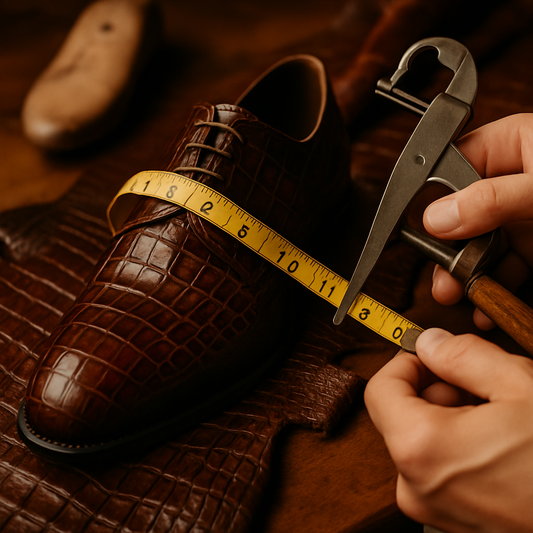
Measure the watch strap in millimetres, including the lug width and buckle width. Common formats include widths such as 20/16 mm or 22/18 mm, where the first number refers to the end that attaches to the watch and the second refers to the buckle end. The correct dimensions must match the watch hardware, not just the wearer’s wrist.
For length, measure your wrist circumference with a flexible tape or a strip of paper held where the watch normally sits. Record the measurement in centimetres or inches; watch bands are not normally sized through EU, US, or UK clothing and footwear systems. Also note whether you prefer the buckle centred, whether you wear the watch loosely, and whether the watch has a thick case.
A wide wrist may require a longer band, but length alone does not determine comfort. The strap should leave enough adjustment holes for seasonal changes and daily movement without forcing the watch head to sit off-centre. A wide lug width can also make a narrow strap look visually weak, while an overly wide band can restrict movement at the wrist.
In-person fitting lets you check the bend around the wrist, the position of the buckle, and contact with the case. Remote measurement can be equally useful when you provide accurate wrist circumference, lug width, buckle width, current strap length, watch-case thickness, and photographs of the watch on the wrist. For a remote custom order, photographs with a ruler can clarify proportions that a single wrist measurement cannot.
Evaluate construction, not just the leather face
The leather visible on top is only one part of a watch band. Check the lining material, padding profile, edge treatment, stitch spacing, keeper loops, spring-bar clearance, and buckle attachment. A very thick padded strap may look substantial but feel restrictive under a fitted shirt cuff. A thin strap may sit comfortably but need a stronger construction for a heavy watch head.
Stitching should follow the strap edge without drifting toward the scales or corners. The holes should be cleanly cut and spaced for practical adjustment. The buckle should sit securely without pulling the strap end sideways. On a custom alligator watch strap, these measurements should be confirmed before cutting because a small error becomes conspicuous once the strap is attached to an expensive case.
Use price as a list of factors, not a grade by itself
The price of an alligator leather watch band can vary because of several separate inputs:
- alligator species and legally compliant sourcing;
- the amount of usable belly area available;
- the visual grade and number of visible marks;
- scale size, direction, and matching between strap pieces;
- strap length, width, taper, padding, and curved construction;
- lining, edge finishing, stitching, and buckle hardware;
- the amount of handwork required for a standard or custom shape.
A higher price may reflect a cleaner cutting area or more involved construction, but it should be explained through these concrete details. Price alone does not establish authenticity, durability, or the suitability of the band for your watch.
Care for the band according to its surface
After wearing the strap, wipe it with a soft, dry cloth to remove skin oil and surface dust. Store the watch in a dry, ventilated place rather than pressed against a damp case or sealed immediately after wear.
If a small amount of moisture reaches the leather, blot it gently and let it dry naturally away from direct heat. Use a barely damp cloth only as a last resort for a specific mark, and test an inconspicuous area first. Do not soak the strap or use household cleaners, alcohol, solvents, or abrasive cloths.
There is no useful fixed conditioning schedule for every wearer. Conditioning depends on climate, perspiration, frequency of use, the lining, and the maker’s finishing system. If the surface begins to feel unusually dry or shows changes in sheen, ask the maker whether a compatible product is suitable before applying anything.
Style the band by watch and setting
- Business or formal wear: Choose a flat belly strap in a restrained black, brown, or deep burgundy tone, with moderate padding and a buckle that follows the case metal.
- Daily office use: A medium-brown or dark navy band can bring warmth to steel watches and work with grey, navy, tan, and charcoal clothing.
- Weekend wear: A hornback texture, contrast stitching, or a less formal colour can suit denim, knitwear, overshirts, and casual jackets.
- Dress watches: A slimmer tapered profile usually keeps attention on the thin case and dial, especially when worn with a fitted cuff.
- Large sports watches: A broader strap, stronger padding, or hornback texture can relate better to a substantial case, provided the lug width and wrist circumference are correct.
Colour coordination does not need to be exact. Match the band’s overall depth and temperature to the watch and clothing: dark brown can sit comfortably with navy or olive, while black may work with grey, black, white, and formal tailoring. The case finish, dial colour, shoes, and belt can guide the decision without requiring identical shades.
Questions to ask before ordering
Is an alligator watch strap suitable for every watch?
It can suit many watches, but the case shape, lug width, spring-bar position, thickness, and intended use should be checked first. A highly padded strap may not work with a slim case, and a dress-style band may not suit frequent water exposure or strenuous activity.
Does a higher grade guarantee a longer-lasting strap?
No single grade label can establish that. Grade usually describes the visual condition of the relevant belly cutting area. Construction, lining, moisture exposure, fit, and wear habits also influence service life.
Should I choose a flat belly or hornback style?
Choose a flat belly style for a more controlled scale pattern and lower-profile appearance. Choose hornback when you specifically want raised dorsal texture and a stronger surface presence. The watch case and your clothing will determine which proportion looks more natural.
What should I send for a remote custom order?
Provide wrist circumference, lug width, buckle width, preferred strap length, current strap measurements, case thickness, and clear photographs of the watch. Mention whether you wear the band tight or loose and where you want the buckle to sit.
To view CrocodileViet’s watch band options or discuss a custom alligator watch strap, visit the watch band collection. You can also contact CrocodileViet through WhatsApp with your watch measurements and wrist details.