
Genuine Crocodile Belt vs Lizard Leather: Which Is Better? — Part 2

Condividi
Genuine Crocodile Belt vs. Lizard Leather: Which Is Better? — Part 2
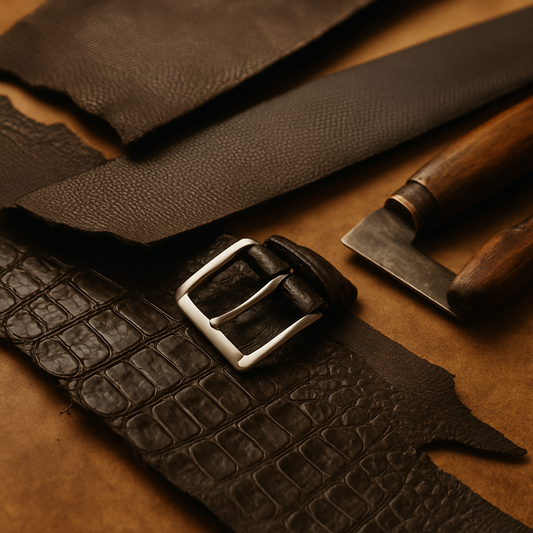
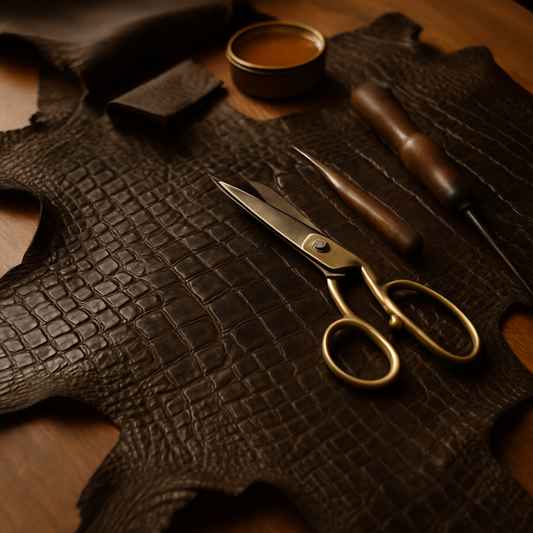
A crocodile belly typically has larger, more structured scales than lizard leather, whose scales are generally smaller and finer.
That visible difference affects the character, price, fit, and styling of an exotic leather belt. A genuine crocodile belt may suit someone who wants a broad, clearly structured scale pattern, while lizard leather can work well for a finer-grained and often lighter visual effect. Neither material wins in every situation: the better choice depends on your wardrobe, belt size, budget, and tolerance for variation between hides.
What “genuine crocodile” means
“Crocodile” and “alligator” describe different animal and leather categories. The phrase “genuine crocodile” should therefore refer to leather from a crocodile species, rather than serving as a general label for all exotic leather.
At the same time, the word “genuine” by itself does not prove the species, source, or quality of a belt. Finished leather can have treatments, embossing, cuts, and surface variation that make visual identification difficult. A scale pattern alone is not sufficient proof of authenticity.
For international trade, crocodilian products can fall under CITES rules. The applicable paperwork depends on the species, source, and transaction. CITES regulates trade and documentation; it should not be presented as a universal authenticity certificate for every belt.
Crocodile leather belt vs. lizard leather at a glance
| Decision factor | Genuine crocodile belt | Lizard leather belt |
|---|---|---|
| Scale appearance | Usually larger, more structured belly scales with a stronger panel effect | Generally smaller, finer scales that create a more closely patterned surface |
| Visual presence | More immediately visible at belt width, especially across the central belly cut | More restrained from a distance, with texture becoming clearer up close |
| Hide-area planning | The usable central area and scale layout affect how well the belt panel reads | The smaller scales can create a denser pattern, but the cut still influences the result |
| Price factors | Species, usable cutting area, grade, belt width, construction, buckle, and finishing affect the price | Species, hide size, usable area, belt width, construction, buckle, and finishing affect the price |
| Best visual setting | Works well with tailored clothing when you want the belt to be a visible accessory | Works well when you prefer a finer texture that does not dominate the outfit |
Scale pattern: the most noticeable difference
Crocodile belly leather generally shows larger, more structured scales than lizard leather. The effect is especially clear on a belt made from a central belly section, where the scale arrangement can run in a balanced layout along the strap.
Species and cut still matter. Not every crocodile hide presents the same scale proportions, and a belt made from a different section of the hide may look less regular than a central belly cut. Finished surface treatment can also change how clearly the scales appear.
Alligator is a separate category from crocodile. Alligator belly leather is often recognized by a comparatively regular and balanced scale pattern. Many alligator hides also show an umbilical scar in the belly area, while crocodile leather lacks that feature. Crocodile leather can show visible sensory pores, often called integumentary sensory organs or ISOs. These details may support a material assessment, but one sensory trait does not prove authenticity on its own.
Which belt has better durability?
Neither the animal name nor the size of the scales gives a complete durability answer. A belt’s working life depends on the leather thickness, the usable hide area, the backing or lining, edge finishing, buckle attachment, stitching, bending, moisture exposure, and how often the belt is worn.
A larger crocodile scale does not automatically mean a stronger belt, and a fine lizard pattern does not automatically mean a fragile one. The belt must be assessed as a finished product. Inspect the flexibility of the strap, the condition of the edges, the firmness of the buckle connection, and whether the surface shows weak or heavily creased areas.
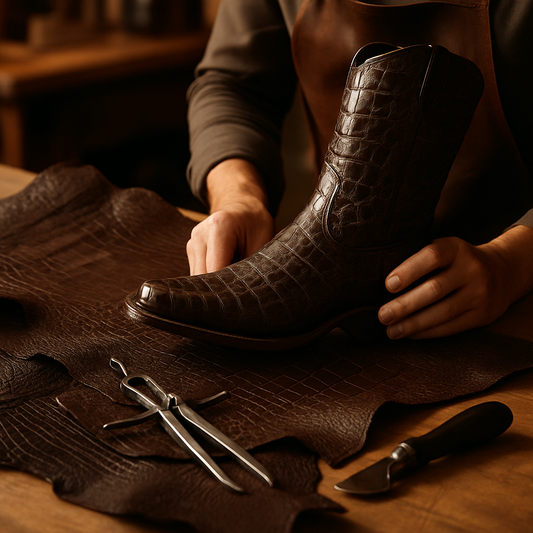
At CrocodileViet, we manufacture our leather goods in-house so the hide selection and finished belt can be checked within the same workshop process. The reason this matters is practical: a belt needs a usable cutting area and construction suited to repeated bending, not only an attractive scale pattern on the surface.
How grading affects a genuine crocodile belt
Hide grades usually describe the usable, relatively defect-free cutting area. They do not identify the animal species, and they do not provide a universal ranking of durability or luxury.
For a crocodile belt, a higher grade may offer a cleaner central belly area with fewer visible blemishes. A lower grade may contain more marks or irregularities in that cutting area. However, grading labels and criteria vary by supplier, tannery, species, and buyer. One supplier’s grade label should not be assumed to match another supplier’s label.
Natural marks can include scars, small holes, color variation, and changes in scale shape. Their presence is not automatically a defect if the belt is sold according to a clearly stated grade. Ask what the seller’s grade means, which hide section was used, and whether the stated grade concerns appearance, usable area, or another internal standard.
Price: what you are actually paying for
The price of an exotic leather dress belt is shaped by several concrete factors:
- Species and hide type: Crocodile and lizard are separate material categories, and species within each category can differ in hide size and supply.
- Usable cutting area: A clean, well-proportioned central section can reduce waste and produce a more consistent belt panel.
- Grade: Fewer visible blemishes in the cutting area may increase the material cost, but grade labels are not standardized across every supplier.
- Belt width and length: A long or wide strap requires more usable leather than a short, narrow belt.
- Construction: Lining, reinforcement, edge treatment, stitching, and buckle attachment all add labor and materials.
- Buckle and hardware: Metal type, finish, shape, and replaceability affect the finished price.
- Color and finishing: Dyeing and surface finishing can require additional work, while strong finishing can also change how scale texture appears.
For a closer buying checklist, read 7 Things to Check Before You Buy Crocodile Leather Belt Online.
Fit and sizing for a crocodile belt
Measure the waist position where the belt will sit, rather than relying only on your trouser label. Trouser sizes can differ between brands, and the belt’s stated length may refer to the strap overall, the buckle end, or the distance to the middle hole.
For remote measurement, send the measurement from the point where the buckle folds around the waist to the hole you use most often. Also provide your preferred belt width and the approximate distance from the trouser waistband to the top of your shoe. These details help the workshop assess whether the belt will sit correctly with your clothing.
EU, US, and UK clothing sizes do not convert perfectly into belt lengths. A person who wears the same nominal size in two countries may still need a different belt measurement. If you have a wide fit, a fuller waist, or a high instep that changes how trousers sit, mention it before ordering. A wide strap may also need suitable belt loops; narrow loops can twist or press against the leather.
For business wear, the belt should normally sit securely without forcing the strap into a sharp bend. If the measurement falls between two available sizes, ask whether the belt can be shortened from the buckle end and whether that adjustment affects the scale layout.
For more workplace-specific advice, see How to Choose Alligator Leather Belt Men for Business Wear. Alligator is not crocodile, but the article’s sizing and business-wear considerations can still help with belt planning.
Care for crocodile and lizard leather belts
After wearing the belt, wipe it with a clean, dry cloth to remove surface dust and skin oils. Store it flat or loosely rolled with the leather facing outward; a tight roll can encourage creasing along the same scales.
Keep the belt away from prolonged rain, standing water, direct heat, and strong sunlight. If it becomes wet, blot it gently with a dry cloth and let it dry at room temperature. A hair dryer, radiator, or other concentrated heat source can dry the leather unevenly.
Do not apply household oils, alcohol-based cleaners, or an untested conditioner. Crocodile and lizard finishes differ, so use a product only when it is identified as suitable for that specific leather and test it first in a hidden area. There is no useful fixed care schedule for every wearer; inspect the surface and edges, then clean lightly when needed.
Styling a genuine crocodile belt
A crocodile leather belt pairs naturally with structured tailoring because the larger scale pattern has a clear visual rhythm. A dark belt with a restrained buckle can work with a navy, charcoal, or brown suit, while a lighter brown belt can connect with tan shoes, a watch strap, or other warm accessories.
Lizard leather suits outfits where you want texture without a large scale pattern. It can work with fine wool trousers, chinos, or a simple shirt-and-jacket combination. Match the belt’s color family to the shoes rather than trying to make every leather item identical.
For an alligator leather belt men may wear in an office, choose a width that fits the trouser loops and a buckle that does not compete with the scale layout. With any exotic leather dress belt, keep the rest of the accessories controlled if the belt has high contrast or a pronounced pattern.
Frequently Asked Questions
Is a genuine crocodile belt better than lizard leather?
It depends on your priorities. Crocodile usually offers larger, more structured scales and a more visible belt panel, while lizard generally provides smaller, finer scales. Price, fit, construction, and intended clothing should influence the decision as much as the animal category.
Can scale pattern prove that a belt is genuine crocodile?
No single scale feature proves authenticity. Species, hide section, finishing, and surface treatments can affect appearance. Ask for clear material information and relevant trade documentation where required; CITES paperwork relates to regulated trade and does not by itself prove every finished belt’s identity.
Does a higher crocodile grade mean the belt will last longer?
Not necessarily. Grades commonly describe the usable, relatively defect-free cutting area, and grading systems vary. Longevity also depends on leather thickness, backing, edge work, buckle attachment, bending, moisture, and regular use.
What measurements should I send when ordering remotely?
Send the waist measurement at the place you will wear the belt, your preferred hole position, trouser-loop width, belt width, and any wide-fit or high-instep information. If possible, measure from the buckle fold to the hole you use most often.
View the CrocodileViet belt collection at crocodileviet.com/collections/belts to compare available belt designs and materials. For sizing or material questions, contact CrocodileViet through WhatsApp.