
How to Choose Genuine Crocodile Shoes For Men for Business Wear — Part 2

Share
Choosing Genuine Crocodile Shoes for Men for Business Wear: Part 2
The most practical starting point for business wear is a genuine crocodile belly-cut upper, because belly hide is smooth, pliable, and suited to clean dress-shoe patterns.
For an office wardrobe, the aim is not simply to find a shoe with large scales or a high price. You need to assess the hide section, scale layout, construction, fit, grading information, and how the finished shape works with business clothing. A discreet crocodile leather shoe can suit formal offices, client meetings, dinners, and occasions where a standard calfskin shoe feels too familiar.
Start with the Correct Crocodile Hide Section
“Belly” or “belly-cut” describes the smoother ventral part of the hide. Its scales are generally flatter and more workable than the raised bony scales along the back. By contrast, a hornback cut preserves those pronounced back scales and creates a more rugged surface.
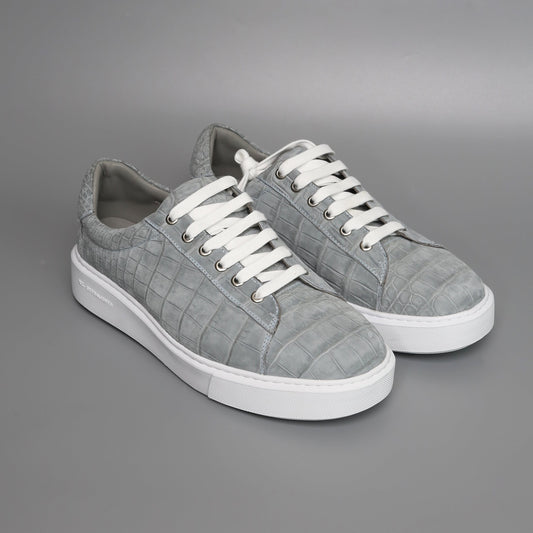
For business wear, belly-cut crocodile is usually easier to use in a restrained Oxford, Derby, loafer, or monk-strap design. The surface can show the species clearly without making the shoe look overly casual. Hornback can work in a distinctive wardrobe, but the raised structure is harder to combine with conservative tailoring and may attract more visual attention than intended.
At CrocodileViet, we assess the hide section before planning the shoe pattern because the scale direction, width, and natural marks affect where each component can be placed. This matters particularly on vamp pieces, where the central scale arrangement remains visible while walking or sitting.
Inspect the Scale Pattern Without Treating It as Proof
Crocodile belly scales can vary by species and by location on the hide. Some areas show relatively regular rows, while others have more variation in scale size and spacing. A natural pattern normally includes small differences rather than a mechanically repeated grid.
Visible sensory pores, often called integumentary sensory organs or ISOs, may appear as small points in crocodile scales. They can support a material assessment, but one sensory feature should not be treated as conclusive proof of authenticity. Surface finishing, photography, lighting, and scale location can affect what you see.
Alligator and crocodile are different animals. Alligator belly leather is known for a comparatively regular or balanced scale pattern and often has an umbilical scar. Crocodile commonly varies more by species and often retains visible sensory pores, while crocodile generally lacks the alligator’s umbilical scar. These features can help separate materials, but scale shape by itself is not a reliable identifier.
Caiman is another crocodilian and should not be used interchangeably with crocodile or alligator. Caiman flank scales can be uneven in size and more widely spaced. If a seller uses “crocodile” as a broad label for every crocodilian leather, ask for the exact species and supporting product information.
Ask What “Genuine” Means in the Product Description
A credible description should identify the species or at least state clearly that the upper uses crocodile leather. It should also distinguish crocodile from alligator, caiman, embossed cowhide, and other textured leather. A crocodile-like print is not the same material as a crocodile hide.
Close photographs of the vamp, quarters, heel, and edges are useful because they show whether the pattern continues naturally across the shoe. They may also reveal how the shoemaker worked around small marks or changes in scale. Photographs are evidence to review, not a substitute for transparent material information.
Paperwork can depend on the species, country, and type of transaction. International trade in recognizable crocodilian-skin products may require applicable permits or a re-export certificate, while exceptions can apply to qualifying personal effects. CITES documentation concerns regulated trade and does not, by itself, prove that a shoe is genuine. Ask what documents apply to your purchase and destination instead of assuming every pair has identical requirements.
Understand Grade Before You Compare Shoes
Hide grading generally describes defects and their position in the important cutting area. Grade I commonly indicates that the prime area is comparatively free of defects, while lower grades may allow more blemishes, cuts, holes, or bony “buttons.” The exact labels and pattern-area definitions can differ between suppliers, markets, and tanneries.
Grade is not a universal measurement of species, authenticity, durability, or the finished shoe’s appearance. A higher grade can give the maker more freedom when positioning visible pieces, but the final result still depends on the pattern, cutting plan, leather thickness, lining, sole, and finishing. A lower grade may produce a clean-looking shoe if the maker places natural marks outside the main visual areas.
When evaluating handmade crocodile shoes, ask which parts use the stated grade and whether the quoted description refers to the entire hide or only the prime cutting zone. This question is more useful than treating a grade label as a complete verdict.
Use Business-Wear Design as a Decision Filter
| Decision factor | What to look for | Why it suits business wear |
|---|---|---|
| Toe shape | Moderately rounded or gently almond-shaped toe | Works with tailored trousers without appearing overly casual or theatrical |
| Pattern placement | Balanced central scales on the vamp and controlled side pieces | Keeps the crocodile texture visible but visually organized |
| Color | Black, dark brown, deep burgundy, or another shade that fits your wardrobe | Pairs more easily with navy, charcoal, brown, and neutral tailoring |
| Closure | Oxford lacing for formal settings; Derby, loafer, or monk straps for more flexibility | Lets you match the shoe’s formality to the office and occasion |
| Sole profile | Moderate thickness with a neat edge | Maintains a dress-shoe proportion instead of a heavy outdoor appearance |
Color should be selected with the rest of the wardrobe in mind. Black crocodile dress shoes can support formal charcoal or navy tailoring. Dark brown gives more room with medium-brown, navy, and beige trousers. Burgundy or another deep color can work with restrained suits when the rest of the outfit stays quiet.
There is no need to match a crocodile belt and shoe by identical scale pattern. Coordinating color depth and surface finish is usually enough. A smooth leather briefcase, watch strap, or belt can connect the outfit without creating a repeated crocodile texture from head to toe.
Check Sizing Beyond Your Usual Number
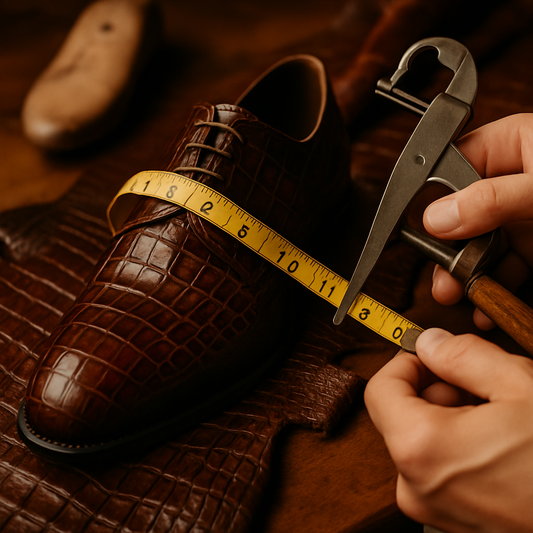
Crocodile leather shoes should be assessed by length, width, instep height, heel hold, and toe-room rather than by size number alone. EU, US, and UK sizing systems do not use the same numerical scale, and lasts can differ between makers.
- Length: Measure from heel to the longest toe while standing. Allow useful toe room without letting the foot slide forward.
- Width: Record the broadest part of the foot. A standard width can feel restrictive if you have a broad forefoot.
- Instep: Measure around the highest part of the foot, particularly for loafers and monk straps where the upper must hold the foot securely.
- Heel: Some initial movement is normal, but excessive lifting can cause rubbing and unstable walking.
- Foot differences: Measure both feet and use the larger measurement when discussing a made-to-order pair.
For remote fitting, send foot length, forefoot width, instep circumference, and clear measurements of both feet. A tracing can add useful information, especially when accompanied by photographs of the foot from above and the side. State the sizing system you normally wear, the socks you expect to use, and whether your current shoes feel tight at the toes, across the ball, or over the instep.
Do not assume that a larger size will solve a width problem. Increasing length may leave excess space in front while the forefoot remains tight. A different last or width specification may be more appropriate.
Compare Price by Concrete Factors
The price of genuine crocodile shoes reflects several separate inputs:
- Hide area and belly width: Crocodile skins are commonly priced by belly width, although American alligator is an important exception and is sold at auction by length. This means a single sizing convention should not be applied to every crocodilian hide.
- Species and sourcing: Different species, legal supply chains, and documentation requirements affect material cost.
- Usable cutting area: A hide with fewer defects in the key pattern area can reduce waste, but the grade label must be understood according to the supplier’s system.
- Pattern complexity: Larger panels, matched scales, apron work, and carefully positioned sections require more planning and can increase cutting loss.
- Construction: Lining, insole, outsole, heel, welt or edge treatment, and finishing all contribute to the completed price.
- Fit service: Remote measurements, special widths, and adjustments can add work beyond a standard-size pair.
A low price may reflect a smaller usable area, a different crocodilian species, simpler construction, or less demanding pattern placement. A high price does not automatically prove authenticity or guarantee that the shoe will suit your feet. Ask for a clear breakdown of material, construction, sizing, and applicable documentation.
Care for Crocodile Leather Shoes
After wearing the shoes, wipe surface dust with a dry, soft cloth. This is the safest default for routine care because dirt left in the scale texture can dull the finish and collect around the edges.
Keep the shoes away from radiators, direct high heat, and prolonged moisture. If they become wet, remove excess water gently, let them dry at room temperature, and use shoe trees that support the shape without forcing the vamp. Do not apply an unfamiliar cream or oil over the entire shoe before testing it on a concealed area; products made for smooth calfskin may alter crocodile’s finish or darken the scales.
There is no fixed care schedule that suits every pair. Frequency depends on wear, climate, finish, and exposure to rain or dust. Rotate business shoes where possible, store them in a breathable shoe bag, and have a specialist assess the leather if the surface becomes dry, cracked, sticky, or heavily marked.
Coordinate the Shoes with Business Clothing
Keep the rest of the outfit controlled when the shoe has a visible scale pattern. A navy or charcoal suit with a dark crocodile Oxford creates a formal combination. A brown Derby can work with navy tailoring, while a loafer is more suitable for business-casual settings than for the most conservative office environments.
Trousers should fall cleanly over the shoe without hiding the vamp completely. Avoid combining a highly patterned suit, a loud shirt, a textured tie, and strongly contrasting crocodile shoes in the same outfit. The shoe can be the most distinctive texture while the other pieces provide visual space.
For client meetings, choose a closed-lacing style and a dark color if you are uncertain about the dress code. For dinners or less formal offices, a monk strap or loafer can show more of the crocodile surface while keeping the overall outfit composed.
Frequently Asked Questions
Is a belly-cut crocodile shoe suitable for formal business wear?
Yes, a belly-cut upper is often suitable because its smoother, pliable surface works well with Oxford and other dress-shoe patterns. The final formality also depends on color, toe shape, sole profile, and closure.
Can visible pores prove that a shoe is genuine crocodile?
No. Sensory pores can support a material assessment, but one visual feature is not conclusive proof. Confirm the stated species, hide description, supplier information, and any documentation that applies to the transaction.
Does a higher crocodile grade guarantee a better-looking shoe?
No. Grade usually describes defects in an important cutting area, and grading labels vary by supplier or tannery. Pattern placement, cutting skill, construction, and finishing also affect the finished appearance.
What measurements should I send for remote crocodile shoe sizing?
Send both-foot length, forefoot width, instep circumference, and heel-to-ball information if requested. Include your usual EU, US, or UK size, the socks you wear, and where your current shoes feel tight or loose.
View the current CrocodileViet shoe collection at genuine crocodile shoes for men. For material questions, measurements, or business-wear recommendations, contact CrocodileViet through WhatsApp.