
Luxury Alligator Dress Shoes Care: How to Protect Texture, Shape and Finish

シェア
How to Care for Luxury Alligator Dress Shoes: Protecting Texture, Shape, and Finish
Luxury alligator dress shoes stay in better condition when they are wiped with a soft dry cloth after wear, supported with correctly sized shoe trees, and kept away from alcohol, solvents, heat, and heavy leather oils.
Alligator leather has a distinct surface structure that needs different treatment from ordinary smooth cowhide. The belly section used in dress shoes is valued for its comparatively regular, balanced scale layout and relatively flat scales. That surface can be damaged by over-cleaning just as readily as by neglect: excess product may collect along scale edges, while harsh cleaners can dull or disrupt the finish.
For alligator leather shoes, care has three separate jobs: remove surface dust without abrading the scales, preserve the shoe’s shape between wears, and protect the finish from moisture, chemicals, and friction. Treating all three areas separately helps avoid the common mistake of applying a general shoe-care routine to an exotic hide.
Understand the Surface You Are Caring For
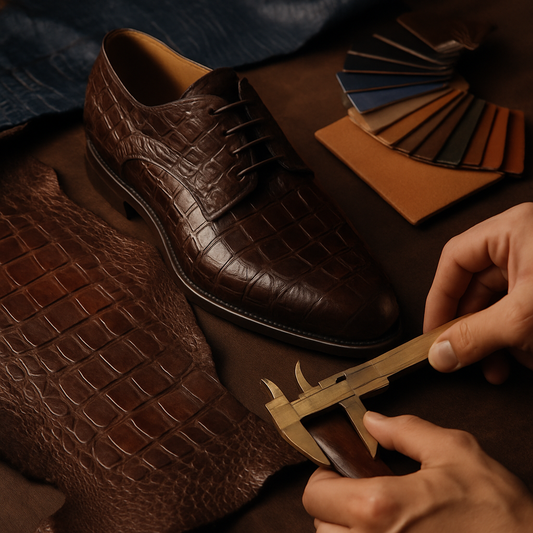
Most luxury alligator dress shoes use belly leather because this area offers a broad, comparatively regular scale pattern that can be arranged across the vamp and toe with visual control. Hide selection matters at this stage: a maker needs enough usable belly area to cut matched shoe components and position the scales in a way that looks balanced across both shoes.
The visible pattern is not merely decorative. Individual scales can react differently at their edges when exposed to repeated flexing, water, aggressive brushing, or heavy polish. A thick coating of wax may obscure the scale definition that distinguishes alligator leather in the first place. For that reason, products intended to build a high-gloss surface on conventional calfskin are not automatically suitable for alligator.
Authenticity should not be judged from one visual feature alone. Alligator belly leather is generally recognized by its regular scale arrangement and typically lacks the visible sensory pore dots often associated with crocodile leather, but finish, dye, cutting, and age can change what is easy to see. Documentation matters for legally traded alligator goods because alligator leather is a CITES-controlled wildlife material; trade compliance, however, is not a standalone test of authenticity.
Daily Care After Wearing Alligator Dress Shoes
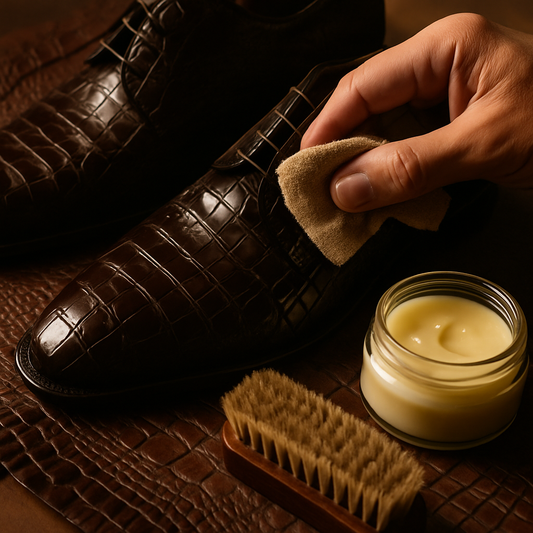
A brief dry-care routine is usually safer than frequent conditioning. After taking off the shoes, remove dust with a clean, soft, dry cloth. Use light pressure and work across the surface rather than pressing repeatedly into the joins between scales. This removes grit that could scratch the finish during storage or the next wear.
- Wipe the vamp, toe, quarters, and heel counter with a dry microfiber or other lint-free soft cloth.
- Check scale edges around flex points, especially across the instep and toe bend, for trapped dust or dried residue.
- Allow shoes to air out at normal room temperature before putting them away.
- Insert shoe trees that support the toe box and heel without stretching the upper.
- Store each shoe away from direct sunlight, radiators, enclosed humid spaces, and plastic bags that can hold moisture.
Shoe trees are primarily shape-management tools. They help the vamp recover after walking, reduce deep creasing caused by the shoe collapsing inward, and keep the heel area supported. They should fit the shoe’s actual length and width; an oversized tree can place unnecessary tension on the upper, while an undersized one offers limited support.
Rotation also reduces stress. Giving a pair time to air between wears helps moisture from normal use dissipate before the shoes are stored. This is particularly useful for genuine alligator shoes for men worn for long business days, formal events, or warm-weather occasions.
What to Do If the Shoes Get Wet
Water should be addressed promptly, but a wet alligator shoe should not be force-dried. Blot moisture with a soft dry cloth, insert shoe trees, and let the shoes dry gradually indoors at room temperature. Direct sun, hair dryers, radiators, and other concentrated heat sources can dry the surface unevenly and may affect both the leather and the shoe’s construction.
If a mark remains after the shoes have dried, start with the least invasive method. A slightly damp cloth may be used only as a last resort for localized surface residue, and it should be followed by gentle drying with a separate soft cloth. Do not soak the leather, scrub the scales, or allow water to pool near seams and welts.
Salt, street grime, drink spills, and unknown stains deserve extra caution. Rubbing harder is likely to spread a stain or disturb the finish. For a valuable pair, professional assessment is preferable to testing household stain removers on a visible panel.
Conditioning Alligator Leather Without Overloading It
Alligator leather may occasionally need conditioning, but it should be treated as a response to the leather’s condition rather than a calendar task. Signs worth assessing include a surface that feels unusually dry, reduced suppleness at flex points, or a finish that appears dull after ordinary dry cleaning. These signs can also result from finish wear, so more conditioner is not automatically the answer.
Use a conditioner formulated for exotic leather, apply a very small amount to a soft cloth rather than directly onto the shoe, and test it first in a discreet area. Work gently in a thin layer, avoiding repeated product build-up around scale edges. Let the shoe rest and inspect the result before applying anything further.
General cowhide conditioners, heavy oils, saddle grease, harsh cleaners, alcohol-based products, solvents, and aggressive polishing compounds can create problems on fashion-finished alligator. Depending on the product and finish, they may leave an uneven sheen, darken sections, soften surface coatings, attract dust, or dull the leather.
How to Protect the Finish During Polishing
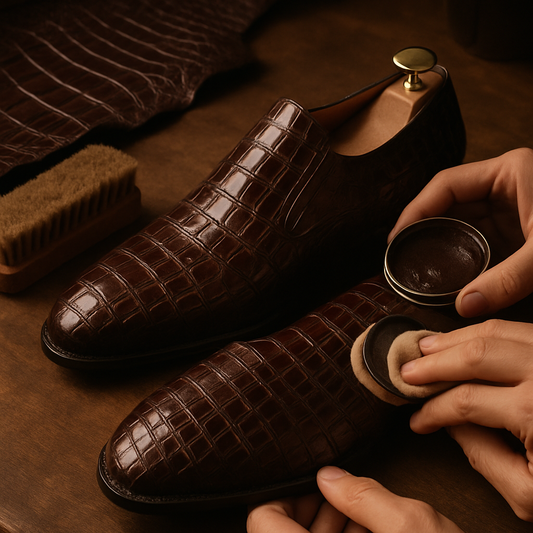
Polishing should preserve the appearance of alligator dress shoes, not turn the upper into a thick waxed layer. If the shoes need a finish refresh, choose a product specifically compatible with exotic leather and use it sparingly. The goal is a clean, restrained sheen that leaves the scale pattern visible.
A soft cloth is generally preferable to vigorous brushing on the alligator upper. Brushing can be useful on some parts of a shoe, but repeated force over finished scales may create unnecessary abrasion. The sole edge, heel, and any non-alligator trim may require different products and methods, so avoid assuming that one polish belongs on every component.
Before any product is used, check whether the shoe has a matte, semi-gloss, or higher-shine finish. A product that suits one finish can alter another. This is one reason a small test area matters: it reveals changes in color, sheen, and surface feel before the visible toe or vamp is treated.
Protecting Shape at the Instep, Toe, and Heel
Shape loss usually begins where the shoe flexes or receives pressure. The instep is especially important because it bends with each step and is affected by fit. Shoes that are too tight across the instep can place concentrated stress on the alligator upper; shoes that are too loose may crease excessively as the foot slides forward.
Fit should be evaluated in both length and width. A stated EU, US, or UK size is a starting point rather than a complete answer, since conversions vary between makers and lasts. Customers with a wide fit, a high instep, or a noticeable difference between their feet should assess width and instep volume as carefully as toe length.
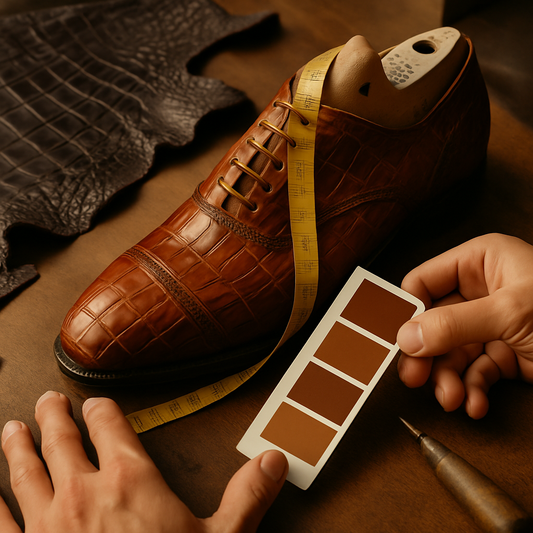
For remote ordering, measure both feet while standing and compare the longer foot’s length with the seller’s sizing information. If possible, also record the widest part of the forefoot and describe any high-instep or wide-fit requirement. These measurements are as important as trying on in person because they help identify whether the shoe’s last is likely to accommodate the foot without excessive pressure on the vamp.
Use a shoehorn when putting on dress shoes. It reduces crushing at the heel counter and helps the foot enter without pulling the rear upper out of shape. Untying or loosening closures before removal also places less stress on the heel and instep than forcing the foot out of the shoe.
Why the Price of Alligator Shoes Varies
The price of handmade alligator shoes is influenced by more than the visible scale pattern. Relevant costs include the alligator species, hide grade, usable belly area, the amount of scale matching required between left and right shoes, construction method, lining and sole materials, and the level of handwork required to cut and assemble the upper.
For dress shoes, usable belly area is particularly important because the maker needs sufficiently clean, well-positioned panels for the toe and vamp. A hide may be large in total length while offering less usable material in the specific belly zone needed for matched shoe parts. More demanding scale placement can increase material waste and cutting time.
Visual grading should also be separated from durability. In alligator hide trade, grades are commonly associated with the number and placement of visible defects on the belly area, but grade labels and definitions vary by tannery and supplier. A high visual grade may support a cleaner pattern for a formal shoe, yet it does not independently determine how long the finished shoe will wear. Fit, construction, use, storage, and care all matter.
Situations That Call for Professional Help
Professional leather care is worth considering when there is peeling or clouding of the finish, a deep scratch crossing several scales, substantial water exposure, dye transfer, loose stitching, sole separation, or a structural crease that does not ease with normal shoe-tree use. A repairer should understand exotic leather before treating the upper; techniques intended for heavily waxed calfskin may not suit finished alligator.
Take photographs before treatment if the shoes have been stained or damaged. This creates a useful reference for a repair specialist and helps prevent unnecessary experimentation with products at home.
A Practical Storage Routine
- Clean off dust with a dry soft cloth after wear.
- Use correctly sized shoe trees once the shoes have aired out.
- Keep the pair in a cool, dry, shaded location with reasonable airflow.
- Use a breathable dust bag if one is available, rather than sealing the shoes in plastic.
- Inspect the finish and flex points before applying any conditioner or polish.
- Use exotic-leather products sparingly and test them in a discreet area first.
Luxury alligator dress shoes benefit from restraint. Dry cleaning, suitable support, gradual drying, and limited use of compatible products do more to preserve the scale texture, silhouette, and finish than frequent polishing or heavy conditioning.
Find Alligator Dress Shoes from CrocodileViet
View CrocodileViet’s alligator dress shoe collection to compare available designs and construction details. For sizing questions, care guidance, or remote measurement support, contact CrocodileViet through WhatsApp.