
Navy Handmade Exotic Leather Goods: Styling, Care and Buying Tips

Share
Navy Handmade Exotic Leather Goods: Styling, Care and Buying Tips
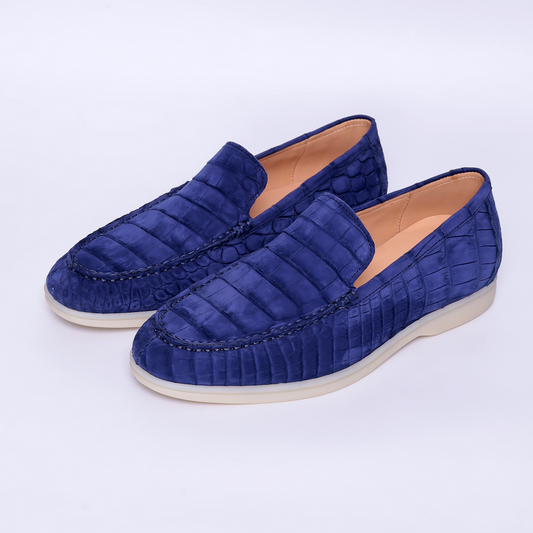
Navy handmade exotic leather goods show their scale texture through a dark blue finish, so the hide’s pattern and surface structure should be assessed before color alone.
What “navy exotic leather” covers
This article focuses on navy accessories and footwear made from alligator or crocodile leather, especially shoes and belts. “Belly” describes the smoother, more regularly scaled area commonly chosen for refined panels, while “hornback” describes the raised, ridged back area. These are hide regions, not separate species.
Alligator and crocodile should not be treated as interchangeable labels. American alligator commonly has a comparatively regular belly scale pattern and generally lacks the small sensory pores found on crocodile scales. Crocodile often shows visible sensory pores, known as integumentary sensory organs or ISOs. These pores are a stronger visual clue than pattern regularity alone, although a finished coating, lighting, and viewing distance can affect what you see.
Caiman is another distinct crocodilian leather. Its flank scales can feel harder and look more irregular, and dye uptake may appear uneven. If a listing uses “crocodile” as a broad marketing term, ask for the exact species and the documentation available for the finished product.
How to style navy handmade exotic leather goods
Navy works well with business clothing because it is darker than many blue garments while offering more visible color than black. Navy crocodile or alligator shoes can sit naturally with charcoal, medium gray, navy, and brown tailoring. With black trousers, choose a navy shade with enough contrast to keep the footwear from reading as black under indoor lighting.
For a belt, match the belt’s darkness and surface finish to the shoes rather than trying to match every scale row. A navy belt with a restrained buckle can work with gray trousers, dark denim, or a navy suit. If the belt has a pronounced hornback ridge or a high-gloss finish, keep other accessories quieter so the textures do not compete.
Navy custom alligator shoes can be specified with a smooth calfskin lining or another lining option suitable for the intended use, but the construction details should be confirmed with the maker. A navy pair with a simpler upper and discreet hardware is easier to wear across offices and formal settings than a heavily contrasted design.
For more help with office footwear, see How to Choose Bespoke Crocodile Leather Shoes for Business Wear.
What to check before buying
Species and hide section
Ask whether the item is alligator, crocodile, or caiman, and whether the visible panels use belly, flank, or hornback leather. Belly leather is commonly selected when a regular scale layout is wanted. Hornback has raised structures and creates a different visual and tactile result; it should not be judged by the same expectations as a flat belly panel.
Grade terminology
Grade labels vary by supplier and tannery. One seller may use a label to describe a largely blemish-free central belly area, while another may assess the usable area, defect location, scale regularity, and expected cutting yield differently.
Ask what the grade means for the intended cut. A defect near an edge may reduce cutting yield without affecting every small accessory equally. For a wide shoe vamp, large belt panel, or coordinated pair, the location of marks matters more than a grade word viewed in isolation. Visual grade also does not prove durability.
Color and finish
Request clear photographs in neutral light and ask whether the navy finish is matte, semi-gloss, or highly polished. Scale edges, natural variation, and dye absorption may read differently across those finishes. A dark blue surface can also look nearly black in low light, so compare it with the clothing and footwear colors you plan to use.
Trade documentation
CITES rules apply to international trade in listed wildlife specimens. Crocodilian skins entering international trade are subject to identification and tagging provisions, so ask the seller what provenance and trade documentation accompanies the material. CITES documentation supports regulated trade compliance; it should not be presented as standalone proof that a particular finished item is authentic.
Price factors for navy crocodile and alligator goods
A responsible quote depends on more than the word “exotic.” Concrete factors include:
- Species: Alligator, crocodile, and caiman are different materials with different scale structures and sourcing considerations.
- Hide section: Belly panels, flank sections, and hornback areas require different design decisions and produce different visual results.
- Usable area and cutting yield: A larger clean central area can matter for shoe vamps or long belt straps, while a smaller accessory may use the hide more efficiently.
- Grade definition: Ask whether the quoted grade refers to blemishes, scale regularity, defect placement, or yield.
- Construction and hardware: Last shape, sole construction, lining, buckle, edge finishing, and other specifications affect labor and material use.
- Customization: Pattern changes, initials, unusual widths, and coordinated accessories may require additional development or cutting work.
At CrocodileViet, discussing the intended product before confirming a material helps connect the hide section to the actual pattern. That matters because a grade suitable for a compact card holder may not provide the uninterrupted area desired for a broad belt or shoe vamp.
Fit and sizing for custom shoes and belts
For custom or bespoke crocodile leather shoes, provide your usual EU, US, or UK size, but do not treat that number as sufficient on its own. Length, forefoot width, heel width, instep height, toe shape, and left-right differences can change the fit. A wide fit may need a different last rather than simply a larger size, while a high instep can require extra volume over the vamp.
Remote measurements are more useful when they include foot length, ball circumference, instep circumference, heel circumference, and the widest forefoot measurement for each foot. Take them while standing, wearing the sock thickness intended for the shoes. Photographs of the feet beside a ruler may provide additional context, but they do not replace clear measurements.
For a custom crocodile belt, measure the distance from the buckle’s leather fold to the hole used most often, rather than measuring an old belt from end to end. State the desired strap width, buckle style, and whether the belt will be worn through narrow or wide trouser loops. A custom belt should also account for the wearer’s preferred waist position and clothing layers.
Care for navy exotic leather
Start with a dry, soft cloth to remove surface dust after use. Keep the item away from prolonged water exposure, strong heat, and direct sunlight, since moisture and heat can affect leather finishes and color. Store shoes with suitable support and keep belts flat or loosely rolled without sharp bends.
Do not apply generic oils, waxes, or household cleaners without checking the maker’s instructions. Exotic skins differ in scale texture and finish, and a product suitable for smooth calfskin may darken, soften, or alter a navy exotic surface. If the leather becomes wet, blot it gently and let it dry naturally away from a heater.
There is no useful fixed care schedule for every wearer. Check the surface after use, especially around the vamp, buckle fold, and high-contact areas, and follow the product-specific instructions supplied by the workshop.
Frequently Asked Questions
How can I distinguish navy alligator from navy crocodile?
Look first for the small sensory pores on the scales: crocodile commonly shows visible pores, while American alligator generally lacks them. Scale pattern alone is less reliable because regularity varies and finishes can obscure surface details.
Is belly leather better than hornback for navy shoes or belts?
Neither is automatically better. Belly leather has a smoother, more regularly scaled layout suited to many refined panels, while hornback has raised ridges and a stronger texture. The suitable choice depends on the design, contact points, and appearance you want.
What should I ask about a crocodile or alligator grade?
Ask how the supplier defines the grade, where visible defects are located, how regular the scales are, and how much usable area is available for your intended cut. Grade labels vary by supplier and tannery, and visual grade does not establish durability.
Can I order custom alligator shoes or a bespoke crocodile leather belt remotely?
Remote orders can be discussed using EU, US, or UK sizing plus detailed length and circumference measurements. For shoes, include width and instep information; for belts, provide the usual hole position, strap width, buckle preference, and waist measurement method.
Request a navy handmade exotic leather piece
To discuss navy alligator or crocodile shoes, belts, or another handmade exotic leather item, contact CrocodileViet with your preferred species, hide section, size, and finish. WhatsApp is also available for sharing measurements and reference photos.