
How to Tell Real Crocodile Leather from Croc-Embossed Leather: What to Check Before You Buy

Share
How to Tell Real Crocodile Leather from Croc-Embossed Leather Before You Buy
Real crocodile leather usually shows naturally irregular scale shapes and spacing, while croc-embossed leather often repeats a pressed pattern across a manufactured hide.
That difference is useful, but it is not enough on its own. High-grade embossing can imitate changes in scale size and spacing, and genuine crocodile hides also vary from one animal and section to another. A reliable genuine crocodile leather check combines the surface pattern with the leather’s reverse, construction, product documentation, and the seller’s answers.
1. Study the scale pattern, but do not treat it as proof
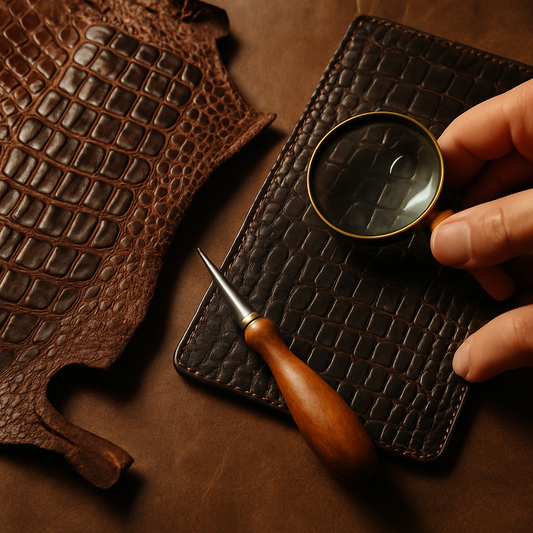
Look across a broad area rather than inspecting one or two scales. Genuine crocodile belly leather tends to show small variations in scale shape, spacing, alignment, and size. The pattern should feel balanced without looking mechanically repeated.
Embossed leather may show:
- Repeated groups of scales at regular intervals
- Identical scale shapes appearing in several locations
- Grooves with the same depth across the entire panel
- A pattern that continues over edges or seams without adapting to the product
These clues deserve attention, but an embossed surface can imitate natural variation. Likewise, a genuine hide may be cut into a small panel where variation is difficult to see. Pattern inspection is therefore a screening method, not a final verdict.
2. Check whether the claimed hide section makes sense
Crocodile belly leather is often selected for its relatively regular scale arrangement and usable central area. The transition from belly to flank can help you assess the section: crocodile belly scales generally move more gradually into smaller flank scales, while alligator scales tend to shift more abruptly. Species and hide variation affect this comparison, so it supports an assessment rather than settling it.
Do not confuse crocodile with alligator or caiman. These are different materials. Caiman belly skins may contain hard bony buttons, which can change both the surface feel and the commercial value. A seller who uses “crocodile” as a general label for every crocodilian should be asked for the exact species.
3. Look for an umbilical scar where the belly section suggests one
Alligator often has an elongated, webbed umbilical scar on the belly, while crocodile lacks that feature. This can help separate an alligator belly from a crocodile belly when the hide section is visible.
It is not a standalone authenticity test. Embossing can reproduce an umbilical scar, and a finished product may have cut away the relevant area. Treat the scar as supporting evidence alongside the species description and documentation.
4. Inspect the reverse and the cut edges
Turn the item over if the construction allows it. Genuine crocodile leather is a skin material with a characteristic fibrous reverse, although the surface may be lined, split, sanded, or finished during manufacturing. Croc-embossed leather is usually another animal leather or synthetic material carrying a pressed pattern on its grain side.
Useful areas to inspect include:
- The inside of an unlined card slot
- The underside of a belt near the buckle
- A concealed seam allowance
- The edge of a wallet panel or strap
Do not cut or burn the item to test it. Heat and chemical tests can damage genuine leather, produce misleading results, and create a safety risk. A visible edge can provide information without harming the product.
5. Use touch and smell as supporting clues only
Genuine crocodile leather can feel firm, structured, and slightly varied across the scales. The valleys between scales may have different flexibility from the raised areas. Embossed leather can also be flexible and convincing, particularly after finishing.
Smell is even less conclusive. Dyes, coatings, adhesives, lining materials, and storage conditions influence the scent of a finished product. A leather-like smell does not establish crocodile origin, and an unfamiliar smell does not disprove it.
6. Ask for species and CITES documentation
All crocodilian species are listed in CITES Appendix I or II, and international trade in specimens is regulated. Ask the seller for the stated species and the applicable CITES documentation for the item or shipment. Permit requirements can differ according to species, origin, destination, and product type.
CITES paperwork supports legal trade and species identification; it does not, by itself, prove that every visible surface is genuine crocodile leather. The documents should match the seller’s description rather than use “crocodile” as an interchangeable term for all reptile leather.
For a wider comparison of animal leather identification, see How to Choose How To Spot Real Alligator Leather for Business Wear.
Real vs embossed crocodile leather: a practical comparison
| What to check | Genuine crocodile leather | Croc-embossed leather |
|---|---|---|
| Scale arrangement | Natural variation in shape, spacing, and size | May repeat pressed shapes or spacing across the panel |
| Hide section | May show a plausible belly-to-flank transition | Pattern is applied to a separate base leather or material |
| Reverse | Shows crocodilian skin structure, subject to lining and finishing | Shows the structure of the base material |
| Documentation | Seller should identify species and provide applicable trade records | Documentation should describe the base material accurately |
How grading and price affect your check
Do not assume a higher grade label proves a real crocodile surface. Grading commonly reflects defects and usable prime area, including scars, cuts, holes, scale slip, and buttons. Grade numbers and criteria vary by supplier, tannery, and market, so ask what the seller’s grade actually measures.
Price also depends on more than species. Concrete factors include the amount of usable belly area, hide length or width, scale regularity, visible defects, tanning and finishing, construction, lining, hardware, labor, and documentation or shipping requirements. Some crocodile markets price skins by belly width, while American alligator skins are commonly sold by length. A low price can justify more questions, but a high price alone does not authenticate the leather.
Fit and sizing when buying a finished item
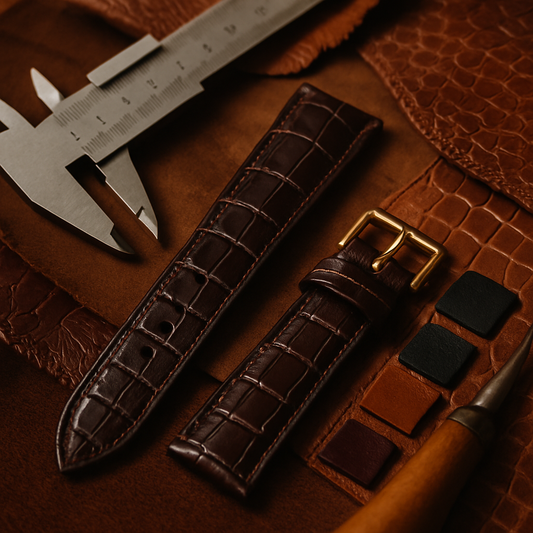
Authenticity and fit are separate checks. For a belt, measure the distance from the buckle’s pin to the hole you use, then compare that measurement with the seller’s stated range rather than relying only on total length. For shoes, confirm the EU, US, or UK sizing system, foot length, width, and instep volume. Crocodile uppers may soften with use, but they do not eliminate the need for a suitable wide fit.
If you are ordering remotely, send the requested measurements in the seller’s format and ask for product length, width, opening dimensions, and any adjustment range. A product made from genuine crocodile leather can still fit poorly if the dimensions are unclear.
Care after you confirm the material
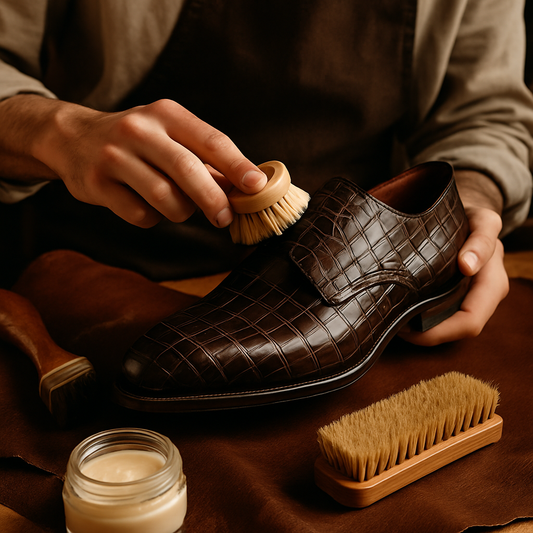
Use a dry, soft cloth to remove dust after wearing the item. Keep crocodile leather away from prolonged moisture, strong heat, solvents, and direct sunlight. If it becomes wet, blot it gently and let it dry at room temperature rather than applying a heater.
There is no useful fixed care schedule for every product. Frequency depends on handling, climate, finish, and whether the item is a belt, wallet, bag, or shoe. Ask the workshop which conditioner suits the specific finish before applying any product, and test it on a hidden area first.
Frequently Asked Questions
Can a repeated scale pattern prove that leather is embossed?
No. Repetition can suggest embossing, but high-grade embossing may imitate natural variation and a small genuine panel may appear regular. Check the reverse, species information, construction, and documentation as well.
Does a visible umbilical scar prove that the leather is alligator?
No. Alligator often has an elongated, webbed umbilical scar, while crocodile lacks it, but embossing can reproduce the feature. Use it as supporting evidence rather than proof.
What documentation should I request for genuine crocodile leather?
Request the stated species and applicable CITES documentation for the item or shipment. CITES rules vary by species, origin, destination, and product type, and paperwork should agree with the seller’s description.
Why can two crocodile leather products have very different prices?
Price can reflect usable belly area, hide length or width, scale regularity, scars, cuts, holes, scale slip, tanning, finishing, construction, hardware, labor, and trade or shipping requirements. Supplier grading labels are not universal.
View CrocodileViet’s in-house crocodile leather collection at crocodile leather. For product questions or remote measurements, contact CrocodileViet through WhatsApp.