
Colorful Crocodile Bags at Auction: What Buyers Should Check Before Bidding

Share
What to Check Before Bidding on Colorful Crocodile Bags at Auction
A dyed finish does not establish a bag’s species, grade, or authenticity, so auction bidders should begin with the hide, documentation, measurements, and seller’s grading standard.
Start with the auction description, not the color
“Crocodile” may describe a broad product category rather than a precise species identification. True crocodiles and alligators belong to different groups, and a listing that uses only “crocodile” leaves an important question unanswered: which species supplied the hide?
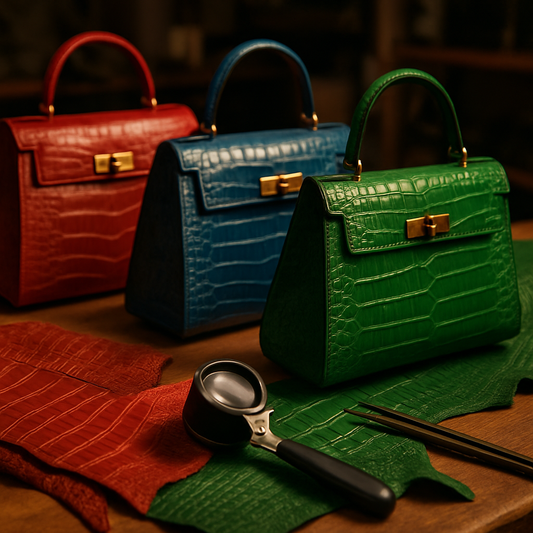
Ask for the species name, the hide area used, and supporting provenance. A colorful crocodile leather handbag may have a vivid red, blue, green, or multi-tone finish, but dye does not identify the animal or establish the legality of the item. A clear description should also distinguish central belly leather from flank or hornback material.
- Belly: the central underside, usually selected for its relatively smooth, regular scale layout.
- Flank: the side area, where scale shapes and size can vary more noticeably.
- Hornback: back leather that may retain raised bony scutes.
If an auction house supplies only a color name and a general “exotic leather” label, treat the description as incomplete rather than assuming the bag is made from central crocodile belly.
Inspect the scale pattern and surface clues
Crocodile belly scales often show small sensory pores, while alligator belly scales generally do not. These pores can be a useful visual clue when examining clear photographs, but they do not prove authenticity or species on their own. A convincing crocodile bag authenticity assessment needs several pieces of evidence rather than one surface trait.
Alligator belly leather commonly presents a regular or balanced scale pattern. Crocodile scale layouts can vary more by species and hide area, and the pores may be visible as small points in individual scales. Lighting, dye, finish, and photograph resolution can obscure these details, so request close images taken without strong glare.
An alligator hide often has an umbilical scar, while crocodile generally lacks the same feature. This difference may help an experienced examiner assess a hide, but it should remain one clue among others. It is not a substitute for species documentation or a physical inspection.
Look beyond the center of the bag. Ask for photographs of corners, the base, handle attachments, flap edges, gussets, and any exposed interior leather. These areas may reveal repairs, holes, cuts, color variation, or a finish applied to conceal defects.
Ask how the bag was graded
Hide grades are not a universal consumer-facing scale. Suppliers and tanneries may use different labels, and grading commonly relates to the usable, blemish-free cutting area rather than a guarantee of durability. A bag described as a higher grade under one seller’s system may not match the same label elsewhere.
| Question for the auction seller | Why it affects the bid |
|---|---|
| Which species is identified in the records? | “Crocodile” alone may not specify the animal or establish provenance. |
| Which hide section was used? | Belly, flank, and hornback have different scale structures and visual character. |
| What does the grade mean in this seller’s system? | The label may refer to cutting area, scars, holes, or other defects rather than long-term performance. |
| Are repairs, replacements, or concealed flaws recorded? | Restoration can affect resale expectations, appearance, and the amount you are willing to bid. |
At CrocodileViet, we examine the usable hide area before cutting a product because scale placement and defect location affect how much leather can be used visibly and structurally. That manufacturing view is useful at auction: a bag with attractive scales on the front may still contain repaired or lower-use sections on its sides and base.
Check documents before treating the item as legal to move
CITES controls can apply to international trade in crocodilian products. Personal-effects exemptions and antique rules are conditional, so a handbag should not be assumed to qualify simply because it is owned by an individual or described as vintage.
Request records identifying the species and legal source, then check the destination country’s requirements. Depending on the specimen, transaction, and route, permits or certificates may be needed. The seller should explain which documents accompany the bag and whether they apply to the specific item rather than to a general batch of goods.
Be especially cautious with an “antique crocodile bag” listing. Under EU guidance, a worked antique involves substantial alteration before 3 March 1947. A seller’s age estimate alone does not establish that status, and commercial sale or cross-border movement may still require documentation.
Price the bag using concrete factors
An auction estimate should reflect more than the color or the word “crocodile.” Compare:
- identified species and documented legal source;
- belly, flank, or hornback construction;
- usable scale area on visible panels;
- scars, holes, repairs, edge wear, and lining condition;
- hardware, closures, handle attachments, and replacement parts;
- dimensions, strap or handle drop, and interior capacity;
- documentation, import requirements, buyer’s premium, taxes, shipping, and possible restoration.
Visual grade is not the same as durability. Construction, leather thickness, seam placement, hardware, and use history all influence how a bag performs. A bright color can attract attention in an auction photograph while concealing surface cracking or uneven refinishing, so inspect images at the edges and ask whether the finish is original or later applied.
Confirm measurements and carrying fit
Ask the auction house for the bag’s length, height, width or depth, handle drop, and detachable strap length. Measurements taken flat can differ from the usable interior once the bag is filled. Request photographs beside a ruler if the listing provides only a general size such as “medium.”
For remote bidding, compare those figures with a bag you already carry. Check whether your phone, wallet, glasses, and documents fit without pressing against the gussets or closure. For a shoulder or crossbody design, calculate the strap drop over the clothing you expect to wear.
EU, US, and UK sizing, wide-fit terminology, and instep measurements belong primarily to footwear; they are not reliable handbag size standards. For a crocodile leather handbag, the relevant fit questions are body dimensions, opening width, handle clearance, strap adjustment, and weight when loaded.
Care for a dyed crocodile bag after purchase
Use a dry, soft cloth as the default for dust or fingerprints. Keep the bag away from prolonged moisture, direct heat, and strong sunlight, since water and heat can affect both the leather and its dyed finish. Avoid applying an unfamiliar conditioner, polish, or solvent: a product suitable for smooth cow leather may alter crocodilian scale texture or color.
Store the bag supported in its natural shape, with interior packing that does not force the gussets outward. Keep hardware from pressing against the leather, and allow the item to dry naturally if it encounters light moisture. Instead of following a fixed cleaning schedule, inspect the finish and scale edges according to use and have a qualified leather specialist assess significant staining, cracking, or color transfer.
Styling a colorful crocodile bag
A saturated bag can work as the strongest color in an otherwise restrained outfit: pair cobalt or emerald with navy, charcoal, cream, or warm brown; use red against denim, black, or neutral tailoring; and let a multicolor finish repeat one small shade from a scarf, shoe, or belt.
For formal settings, a compact structured shape can sit neatly beside a tailored suit or dress. For everyday use, softer clothing and simple metal accessories can keep the bag from competing with other patterned pieces. The scale pattern already supplies texture, so combining it with several high-contrast prints may make the outfit visually busy.
Frequently Asked Questions
Does a bright color prove that a bag is genuine crocodile?
No single color or dye proves species, quality, or authenticity. Review the scale pattern, possible sensory pores, construction, species records, and legal-source documentation together.
What documents should I request before bidding on a crocodile bag auction?
Ask for documentation identifying the species and legal source, plus any permits or certificates required for the destination country and transaction. CITES requirements can vary by species, route, and exemption.
How can I tell whether the bag uses crocodile belly leather?
Look for a relatively smooth, regular scale layout across the central panels and ask the seller to identify the hide section. Flank and hornback leather have different scale structures, while photographs alone may not settle the question.
Does a higher hide grade mean the bag will last longer?
Not necessarily. Grading labels vary by supplier and may describe usable, blemish-free cutting area. Durability also depends on construction, finish, hardware, storage, and use.
For documented crocodile leather products and construction details, browse the CrocodileViet crocodile leather collection. For questions before ordering or comparing an auction item, contact us through WhatsApp.