
How Crocodile Leather Sneakers Are Made: From Hide Selection to Hand Finishing

Share
How Crocodile Leather Sneakers Are Made: From Hide Selection to Hand Finishing
Crocodile leather sneakers are made by selecting a usable belly or back section, tanning it into leather, cutting panels around the scale pattern, and then stitching and hand-finishing the shoe.
The phrase “crocodile leather sneakers” can describe sneakers made from several crocodilian leathers, including true crocodile and American alligator. These materials are related but not visually identical. A careful manufacturing process therefore begins with identifying the hide type, assessing its usable area, and deciding how its scale pattern will appear across the finished shoe.
1. Hide selection: belly cut, back, or another section
A belly cut comes from the smooth ventral part of the hide. It is commonly selected for sneakers when the design calls for a regular, balanced scale pattern. The back, often called hornback, has a more textured surface and may be chosen when the maker wants stronger relief across the upper.
Belly and back are not interchangeable materials. Bony belly skin, which is common in many caimans, is different from the classic smooth belly cut. For this reason, the material description should identify the crocodilian type and hide section rather than relying only on a broad phrase such as exotic leather.
True crocodile belly scales generally show sensory pores, while alligator and caiman belly scales lack them. Species and tanning can affect the final appearance, and scale shape alone does not provide a reliable identification method. Alligator belly leather often has a regular, balanced arrangement, while crocodile can vary more by species and may show visible sensory pores, also known as integumentary sensory organs or ISOs.
Another visual feature can help with inspection: alligator often has an umbilical scar, while crocodile generally lacks one. None of these details should be treated as the sole proof of authenticity. Species records, lawful sourcing documents, and supplier information remain important.
2. How the hide is graded for sneaker production
Hide grading is not a universal industry-wide scale. One supplier may use grades based on blemishes and the amount of usable cutting area, with higher grades containing more defect-free belly leather. Another supplier may use different labels or criteria.
For sneakers, the relevant question is not simply whether a hide carries a particular grade number. The question is whether the hide can provide clean, well-positioned pieces for the visible panels. A small mark near an edge may have little effect if it falls outside the pattern, while the same mark in the toe area may affect the finished appearance.
| Decision factor | Why it matters for crocodile leather sneakers |
|---|---|
| Hide section | Belly gives a more regular scale layout; back leather gives more surface texture. |
| Usable cutting area | The hide must provide enough uninterrupted leather for the toe, quarter, tongue, and other visible panels. |
| Surface marks | Defects matter according to their position, size, and whether a pattern piece will display them. |
| Species and market convention | Crocodile skins are commonly priced by belly width, while American alligator skins may be sold by length. |
| Finish required | A smooth finish and a nubuck finish create different visual and handling characteristics. |
At CrocodileViet, our in-house manufacturing model connects hide inspection with pattern planning before cutting. That matters because the best use of a hide depends on where the scale rows and any natural marks will sit on the completed sneaker, not just on the hide label.
3. Tanning turns the hide into workable leather
Fresh animal skin is perishable. Tanning converts it into durable leather by treating its collagen fibers with tanning agents. This stage stabilizes the material so it can be handled, shaped, and used for footwear.
Tanning is separate from coloring, finishing, cutting, stitching, and hand finishing. A hide may be tanned first and then receive a particular color or surface treatment later. That distinction is useful when comparing crocodile leather sneakers because two pairs can use a similar species and hide section but have different appearances due to their later finishing processes.
The tanning result also affects how the scale surface feels and responds during production. Leather selected for a smooth polished appearance is handled differently from leather intended to show a softer, brushed surface. The intended finish should therefore be decided before the panels are cut.
4. Preparing smooth, polished, and nubuck surfaces
Sneaker makers may select belly leather for its cleaner scale arrangement or back scales for a more pronounced texture. Pattern placement is especially important on a sneaker because several panels meet across the toe, sides, tongue, and heel. The scale direction should work with those panel boundaries rather than appearing interrupted without purpose.
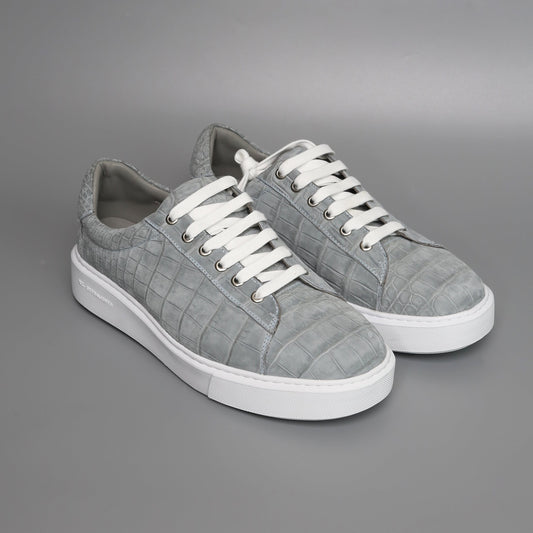
Nubuck alligator sneakers use a softer, brushed surface treatment rather than the reflective appearance associated with a high-gloss finish. The treatment changes how light reaches the scales and can make the leather appear more muted. It also means the surface requires different care from heavily polished leather.
A color is applied after tanning as part of the later finishing sequence. The final shade can depend on the base leather, dye or pigment system, surface treatment, and finishing method. Product descriptions should therefore name the actual material and finish instead of assuming that every dark or matte pair was made in the same way.
5. Cutting panels around the scale pattern
Once the leather is prepared, the maker places the sneaker patterns over the usable area. The goal is to obtain the required panels while managing scale alignment, natural marks, and the direction of the leather.
The toe is often visually prominent, so its scale placement can influence the character of the pair. Side panels, quarters, tongues, and heel sections may require different shapes and widths. A hide that looks attractive as a whole still needs enough suitable areas for the actual pattern pieces.
This is where an in-house workshop has a practical advantage: the material assessment and panel layout can be reviewed within the same production process. At CrocodileViet, keeping these decisions connected helps reduce the risk of choosing a hide based only on an attractive uncut section that does not serve the sneaker pattern well.
6. Stitching the upper and completing the sneaker
After cutting, the leather panels are assembled into the upper. Crocodile and alligator leather have visible scale structures, so stitching must support the panel design without obscuring the areas intended to be seen. The upper is then combined with the remaining sneaker components according to the design.
The construction stage is not only about joining pieces. It also determines how the leather bends at the toe, how the side panels sit around the foot, and how the scale pattern changes as the shoe takes its three-dimensional shape. A flat hide and a finished sneaker cannot be judged in exactly the same way.
Hand finishing follows the main construction work. Its specific tasks vary by workshop, but this stage is used to inspect the completed surface and prepare the sneaker for presentation. Tanning, coloring, stitching, and hand finishing are separate stages, so a description of one does not automatically confirm the others.
Price: what affects the cost of crocodile leather sneakers?
The price of crocodile leather sneakers depends on several concrete factors:
- Species and hide section: true crocodile, American alligator, caiman, belly, and back leather occupy different market categories.
- Usable area: a hide with more defect-free leather suitable for visible panels can cost more than one with limited cutting space.
- Scale placement: additional material or planning may be needed when a design requires careful alignment across panels.
- Finish: polished, matte, and nubuck surfaces involve different finishing requirements.
- Construction: the pattern, number of panels, sole design, stitching, and hand-finishing work affect labor and material use.
- Market measurement: crocodile skins are commonly priced by belly width, while American alligator skins may be sold by length.
A hide grade should not be read as a direct durability rating. Visual grade usually describes blemishes and usable appearance, and grading labels vary by supplier or tannery. Durability also depends on tanning, construction, wear, and care.
Fit and sizing for crocodile leather sneakers
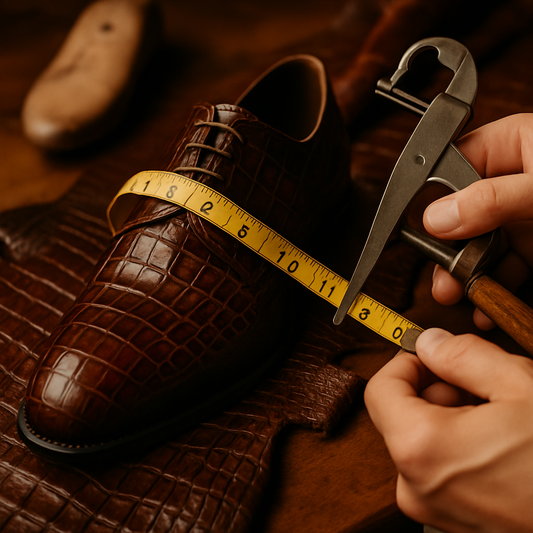
Choose the size using the brand’s own chart rather than converting between systems by memory. A useful chart should state the relationship between EU, US, and UK sizes and provide the foot length in centimeters or millimeters.
Length is only one measurement. Record the widest part of the foot, check whether you need a wide fit, and note the instep height. Crocodile leather sneakers may feel different from fabric sneakers because the upper has its own structure and may not accommodate extra volume in the same way.
For remote orders, measure both feet while standing, use the larger result, and send the length, width, and instep information to the workshop. A trace of the foot or a clear measurement photograph can help, but it should support—not replace—the supplier’s stated sizing method.
For advice on coordinating a pair with tailored clothing, see How to Choose Crocodile Leather Sneakers for Business Wear.
Care after hand finishing
Use a dry, soft cloth as the default cleaning method after wear. It removes surface dust without introducing moisture or a product that may alter the finish. Store the sneakers away from prolonged direct heat and allow them to air naturally if they become damp.
Do not apply a general leather cream or polish without checking that it suits the exact finish. Nubuck alligator sneakers, for example, should not be treated as though they have a glossy, heavily coated surface. Avoid soaking the leather, and contact the workshop or a specialist before attempting to remove a deep mark.
There is no useful fixed care schedule for every wearer. Cleaning needs depend on use, climate, dust, and the finish of the leather. Inspect the pair regularly and respond to visible dirt or moisture rather than applying products on an automatic timetable.
Styling crocodile leather sneakers
For business-casual clothing, a restrained sneaker shape with a low-contrast upper works well with wool trousers, chinos, or dark denim. A smooth belly pattern can sit quietly beside tailored clothing, while textured back leather creates a stronger surface feature and may suit simpler garments.
With casual clothing, alligator sneakers can be paired with straight-leg denim, cotton trousers, or relaxed tailoring. Keep the rest of the outfit relatively clear if the scale pattern is prominent. A nubuck finish usually works naturally with matte fabrics such as brushed cotton, suede-like textures, and knitwear.
Color coordination also depends on contrast. A dark pair can anchor lighter trousers, while a lighter or warmer shade may connect with tan belts, knitwear, or outerwear. The aim is to relate the sneaker to one or two colors in the outfit rather than matching every item exactly.
Legal sourcing and CITES documentation
CITES regulates international trade in crocodilian specimens. Recognizable crocodilian leather pieces in products, including shoes, can require permits or re-export documents depending on the species, origin, and transaction. CITES guidance also describes tagging and documentation systems for international trade in skins.
CITES compliance is not the same as proof of authenticity by itself. A responsible brand should retain evidence of legal sourcing and check the current requirements for the particular species and shipment. Buyers ordering across borders should also confirm which documents apply to their destination.
Frequently Asked Questions
Are crocodile and alligator belly sneakers made from the same leather?
No. Crocodile and alligator are different crocodilian materials. True crocodile belly commonly shows sensory pores, while alligator belly lacks them and often presents a regular, balanced scale pattern. Species records should support visual inspection.
Why do makers use belly leather for crocodile leather sneakers?
Belly leather is often selected for its smoother surface and more regular scale arrangement. It can provide a cleaner layout across visible sneaker panels, although back leather may be selected when a more textured appearance is wanted.
Does a higher hide grade mean the sneakers will last longer?
Not necessarily. Supplier grading commonly relates to blemishes and usable cutting area, and grading labels vary. Longevity also depends on tanning, construction, use, and care, so visual grade should not be treated as a durability guarantee.
What should I send for a remote sneaker sizing check?
Send your foot length, widest-foot measurement, instep information, and the EU, US, or UK size you usually wear. Measure both feet while standing and use the larger result when comparing it with the workshop’s size chart.
See the crocodile leather sneakers collection to review the available design and material details. For sizing or sourcing questions, contact CrocodileViet through WhatsApp.