
7 Things to Check Before You Buy Nubuck Alligator Leather Online

Share
7 Checks Before Buying Nubuck Alligator Leather Online
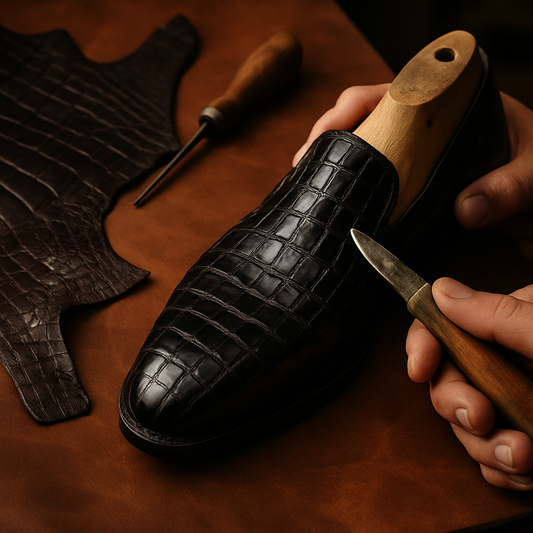
Before buying nubuck alligator leather online, verify that the material is genuine alligator with a buffed grain-side finish rather than alligator-embossed leather or suede.
Online listings can make several different materials sound alike. “Nubuck” describes the surface finish, while “alligator” identifies the species of hide. A reliable listing should make both points clear and give enough information for you to assess the actual leather, sizing, care requirements, and transaction paperwork.
1. Confirm that it is genuine alligator nubuck
Nubuck is made by lightly buffing the grain side of leather to create a fine nap. Suede is generally made from the flesh side or from a split, so the two terms describe different materials even though both have a soft, matte surface.
Check whether the seller identifies the material as genuine alligator leather. “Alligator print,” “alligator pattern,” and “alligator-embossed leather” can describe another leather stamped with a scale design. Those terms do not establish that the hide itself came from an alligator.
A useful product description should separate:
- Species: genuine alligator, rather than an imitation scale pattern.
- Finish: nubuck, meaning a lightly buffed grain-side surface.
- Construction: whole hide, cut panel, shoe upper, or finished product.
- Visible condition: scale layout, scars, pores, color variation, and other marks.
At CrocodileViet, we manufacture our alligator goods in-house. That gives our team a direct reason to describe the species and finish separately: buyers need to know what material they are evaluating before they compare appearance, sizing, or price.
2. Inspect the scale pattern and sensory pits
Alligator belly leather usually has a comparatively regular, balanced scale pattern. Crocodile belly leather varies more by species and often shows visible sensory pores, also called integumentary sense organs or ISOs, on the belly scales.
These features can remain visible after tanning, but one visual trait should not be treated as conclusive proof of authenticity. Ask for sharp, well-lit photographs of the actual hide or finished item, including a close view of the belly scales. Product photos taken from too far away can conceal the scale structure and surface treatment.
An alligator hide may also show an umbilical scar, while crocodile commonly lacks this feature. The presence or absence of one mark should be considered alongside the species description, seller documentation, and photographs rather than used as a stand-alone test.
Look for photos that show the central belly area, the sides, the scale transitions, and the finished nap. A heavily edited image can make the leather appear flatter or more consistent than it is in person.
3. Ask how the hide is graded
Hide grades are not a universal standard. One supplier may use grade labels based on the location and number of defects across four hide quadrants, while another seller may use different definitions or apply more subjective judgments.
Before ordering, ask:
- What does each grade label mean in that seller’s system?
- Does the grade refer to the full hide, the usable belly area, or the finished cut?
- Are scars, healed marks, scale irregularities, holes, or color shifts included in the assessment?
- Can the seller provide photographs of the actual hide or exact product?
Do not confuse visual grade with durability. A hide with fewer visible marks may be preferred for appearance, but grade terminology alone does not establish how a finished item will perform. Construction, thickness, edge work, lining, closures, and how the item is used also affect practical wear.
4. Check the measurement basis and fit
Alligator hides are commonly sized by belly width, measured horizontally across the widest part of the belly and expressed in centimeters. Confirm this measurement basis before comparing listings, because a whole hide and a cut panel are not equivalent purchases.
For a leather panel, ask whether the stated width is the total hide width or the usable area after trimming. For finished nubuck alligator shoes, ask for the insole length, outsole length, forefoot width, and opening or instep measurements where relevant.
If you are buying nubuck alligator shoes, compare the seller’s chart with the sizing system you normally use:
- EU sizing is not interchangeable with US or UK sizing, so confirm the conversion used by that seller.
- Measure both feet and use the larger measurement when the difference is noticeable.
- For wide feet, request the ball-of-foot width rather than relying only on the nominal size.
- For a high instep, ask about the vamp opening, tongue, elastic, or adjustable fastening.
- If you are ordering remotely, send foot length, ball width, instep circumference, and a tracing if the workshop accepts remote measurements.
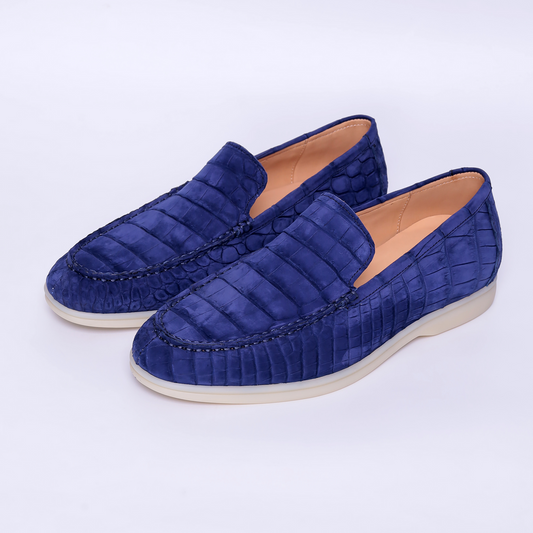
Nubuck alligator loafers and nubuck alligator mules can fit differently from lace-up shoes. Loafers depend on the heel grip and vamp shape, while mules need enough forefoot coverage to stay secure without pressing across the toes. A size number alone cannot describe those fit points.
5. Compare the price using specific factors
The price of nubuck alligator leather reflects more than a grade label. Compare the material, quantity, usable area, finish, and product construction before deciding whether two listings are genuinely comparable.
Relevant factors include:
- Whether the listing is for a whole hide, a cut section, a pair of uppers, or a completed item.
- The measured belly width and the amount of usable leather after trimming.
- Species identification and the seller’s definition of grade.
- Scale regularity, visible marks, color consistency, and the amount of nap work.
- For footwear, the sole, lining, insole, heel, hardware, finishing, and construction method.
- Shipping, duties, taxes, return conditions, and any measurement service.
A low price may reflect a smaller cut, more visible natural marks, a different construction, or an imitation material. A higher price does not automatically prove better durability or better fit. Request a written specification and photographs of the actual item before comparing offers.
6. Find out what protective treatment the nubuck has
Nubuck has a raised nap, so its surface can respond differently to moisture, rubbing, oils, and cleaning products than smooth finished leather. Some alligator nubuck is sold with a matte, buffed surface and little or no topcoat. Other products may receive a protective treatment.
Ask the seller:
- Whether a water-repellent or other protective treatment has been applied.
- Whether the treatment changes the color, sheen, or feel of the nap.
- Which products are suitable for that specific finish.
- Whether the item can be returned if the color or texture differs from the photographs.
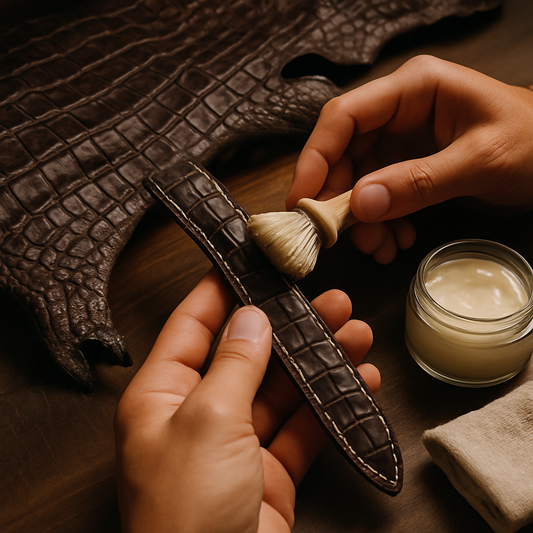
For routine care, begin with a clean, dry cloth to remove loose dust. Keep the leather away from prolonged moisture and let it dry naturally if it becomes damp. Avoid applying waxes, oily conditioners, or generic smooth-leather creams without checking compatibility, because they can flatten or darken the nap.
There is no useful fixed care schedule for every nubuck item. Cleaning needs depend on contact with dust, rain, friction, and body oils, as well as the protective treatment already present.
7. Verify transaction-specific documentation and use
CITES applies to international trade in crocodilian skins and products. American alligators are listed in CITES Appendix II, which permits regulated, traceable commercial trade. U.S. export controls also rely on legal-acquisition findings and tagged skins.
A seller’s general statement that an item is “CITES compliant” is not enough to answer every shipping question. Requirements can depend on the species, country of origin, destination, shipping route, and whether the transaction involves raw skin or a finished product.
Ask the seller what documentation applies to your specific order and route. You may need to check the rules of both the exporting and importing countries. CITES paperwork supports regulated trade documentation; it does not, by itself, prove that a product is genuine alligator.
For a finished item, also confirm the return policy, delivery terms, declared material description, and whether the photographs show the actual product. These details matter if the color, scale layout, nap, or fit differs from your expectations.
Styling nubuck alligator footwear
Nubuck alligator shoes work well with fabrics that do not compete with the matte surface. A pair of loafers can sit comfortably with tailored trousers, brushed cotton, or dark denim, while mules can suit relaxed trousers and cropped hems that leave the heel visible.
Keep the rest of the outfit comparatively restrained when the scale pattern is prominent. For a quieter combination, match the shoe color to a belt or bag without requiring an exact shade. Texture also matters: wool trousers, linen blends, and matte cotton usually create a more coherent outfit than several glossy accessories worn together.
For business wear, choose the shoe shape according to the setting. A closed loafer with a moderate vamp generally reads more formal than an open-back mule, while either can work in a less formal environment when the trousers and other accessories support it. For more suggestions, see How to Choose Nubuck Alligator Shoes for Business Wear.
Frequently Asked Questions
How can I tell whether nubuck alligator leather is genuine?
Check that the listing identifies genuine alligator separately from the nubuck finish, then request photographs of the actual hide or item. Scale structure, sensory pits, an umbilical scar, supplier documentation, and transaction paperwork can help with evaluation, but one sensory or visual feature should not be treated as conclusive proof.
Is nubuck the same as suede?
No. Nubuck is produced by lightly buffing the grain side of leather to create a fine nap. Suede is generally produced from the flesh side or a split, so the two finishes should not be used interchangeably.
How is alligator leather sized online?
Raw alligator hides are commonly described by belly width measured horizontally across the widest part of the belly, often in centimeters. Ask whether the measurement refers to a whole hide or a cut and whether it represents total or usable width. Finished footwear requires separate length, width, instep, and size-system information.
What should I ask about CITES before ordering internationally?
Ask which documents apply to the exact species, origin, finished or raw status, destination, and shipping route. Check the import and export rules for that transaction instead of relying on a general CITES statement.
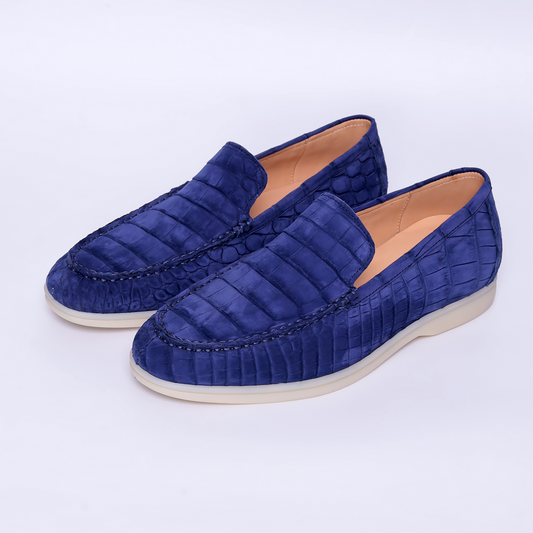
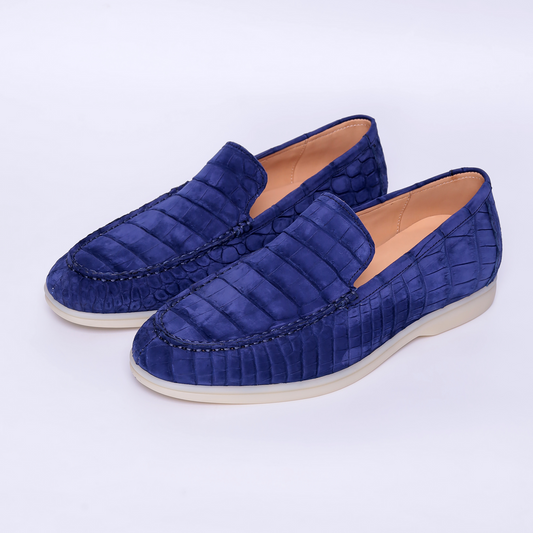
View the nubuck alligator leather slip-on loafers to review a finished footwear option from CrocodileViet. For sizing or material questions, contact us through WhatsApp before ordering.