
What Makes Genuine Crocodile Jacket Worth Buying? Quality, Craft and Longevity

Share
What Makes a Genuine Crocodile Jacket Worth Buying? Quality, Craft and Longevity
A genuine crocodile jacket earns its price through three separately verifiable areas: sound crocodile leather, competent garment construction, and care that protects the hide over time.
What “genuine crocodile” should mean
“Genuine crocodile” should identify the leather as crocodile hide, but the phrase alone does not establish the species, origin, grade, tanning method, or overall jacket quality. Those details require product-specific information from the seller.
Crocodile belly leather is commonly chosen for jacket panels because it is flatter and has a more regular, balanced scale pattern than the raised back. Hornback is a different cut, defined by the bony scales along the back, while flank leather comes from the side area and can show a less regular pattern.
Visible sensory pores are one feature often associated with crocodile belly scales. American alligator belly scales generally lack the repeated pores commonly seen in crocodile leather, and American alligator often has an umbilical scar that crocodile lacks. These observations can help with an initial visual assessment, but one sensory trait does not prove authenticity. Scale shape varies by species, so identification should be supported by the seller’s documentation and product details.
Quality factors that affect a crocodile leather jacket
| Factor | What to examine | Why it matters |
|---|---|---|
| Hide area | Belly, flank, or hornback panels | The cut affects the scale pattern, surface shape, and visual character of the jacket. |
| Visible defects | Scars, scratches, holes, and damaged scales | These can affect the appearance and usable panel area. |
| Grading convention | The supplier’s definition of each grade and the area assessed | Grade labels vary by tannery, species, and system, so a number without its convention is incomplete. |
| Panel layout | Scale alignment, symmetry, and placement across the front and back | Good layout helps the jacket look intentional rather than assembled from unrelated sections. |
| Garment construction | Seams, lining, closures, pockets, cuffs, and hem finishing | These parts affect comfort, fit, and how well the jacket handles repeated use. |
Hide grade is not the same as jacket quality
Crocodilian hide grades generally relate to visible defects, including scars, scratches, holes, or scale damage. However, grading systems differ by species, supplier, and tannery. Some systems assess the belly in quadrants, while American alligator grading may assess a midsection that includes the belly and flank. For that reason, asking what area was graded is as important as asking for the grade itself.
A high hide grade does not automatically establish the quality of the finished jacket. The result also depends on panel selection, cutting, seam work, lining, fit, hardware, and finishing. A jacket made from a well-graded hide can still feel uncomfortable if its proportions are wrong or its interior construction is poorly suited to the wearer.
Why craft affects the wearing experience
Crocodile leather has a scale structure that requires a different approach from smooth cowhide or lambskin. Panels need to be positioned with the scale direction and visual flow in mind. The front, back, sleeves, and collar may not display the same pattern, so layout influences whether the finished garment looks balanced.
Cutting also affects comfort. A jacket that places a large, rigid scale area across a bending point may feel restrictive even if the leather itself is attractive. Sleeve width, shoulder shape, armhole position, and the amount of ease through the chest all influence how the jacket moves.
At CrocodileViet, we manufacture our crocodile and alligator leather goods in-house. This setup allows the workshop to coordinate hide selection, cutting, assembly, and finishing within one production environment, which is useful because decisions made at the hide stage affect the final jacket’s panel layout and fit. It also gives buyers a clearer point of contact for questions about the leather and construction of a specific piece.
Ask for practical information rather than relying on labels alone: Which hide section is used? How was the leather graded? What measurements does the finished jacket have? What lining and closure details are included? These questions reveal more than a broad claim such as “genuine” or “high grade.”
Longevity: what the leather can and cannot promise
Crocodile leather can serve for many years when it is stored, worn, and maintained appropriately, but no responsible seller should guarantee a fixed lifespan. Longevity depends on exposure to moisture, heat, friction, body oils, storage conditions, frequency of wear, and the quality of the garment’s construction.
The surface should develop its character through use without being treated as damage-proof. Repeated rubbing against rough bags, vehicle seats, or metal accessories can mark the scales. Excessive heat can dry the leather or affect its finish, while moisture may create staining or changes in texture if it is not handled promptly.
Price: what you are actually paying for
The price of a genuine crocodile jacket reflects more than the raw hide. Concrete cost factors include the usable area of the hide, the number of panels required for the size, the hide section used, visible defect levels, tanning and finishing, pattern complexity, lining, hardware, labor, and the time involved in cutting and assembling a difficult material.
Larger jackets can require more usable belly area and may need additional panels to maintain a coherent layout. A design with a broad crocodile front, matching pocket flaps, or a structured collar can consume more selected material than a simpler design. Custom measurements may also require a different cutting plan.
Do not compare two prices using the word “grade” alone. One supplier may grade belly quadrants, while another may use a midsection system or a different scale. Compare the leather section, measurements, construction details, documentation, and service terms together.
Fit and sizing for a crocodile jacket
Start with the finished jacket’s chest, shoulder, sleeve, back, and body measurements rather than relying only on S, M, L, or XL. A useful comparison includes the wearer’s body chest measurement plus the jacket’s ease. The correct allowance depends on whether the jacket is intended for a shirt, knitwear, or a heavier layer.
- Length: Check the back length and sleeve length against a jacket that already fits. Crocodile leather can look visually heavy when the body is too long or the sleeves are too short.
- Width: Measure chest, waist, hem, upper arm, and cuff. A broad shoulder does not necessarily require extra waist room.
- Footwear and sizing systems: EU, US, and UK shoe sizes should not be used as substitutes for jacket measurements. If the product is part of a coordinated outfit, record clothing measurements separately from shoe sizing.
- Wide fit: Look for shoulder width, chest width, hem width, and sleeve circumference rather than choosing a larger standard size automatically.
- Instep: Instep is relevant to footwear, not jacket sizing. If a seller uses a general measurement form for several leather products, make sure the jacket fields are completed separately.
- Remote measurements: Measure over the clothing you expect to wear, keep the tape level, and provide front, back, chest, waist, shoulder, and sleeve measurements. A well-lit photo of a correctly fitting jacket can also help clarify proportion.
For remote orders, ask whether the stated dimensions are body measurements or the actual garment measurements. That distinction can prevent a jacket from arriving too tight across the chest or too loose through the waist.
Care for a genuine crocodile jacket
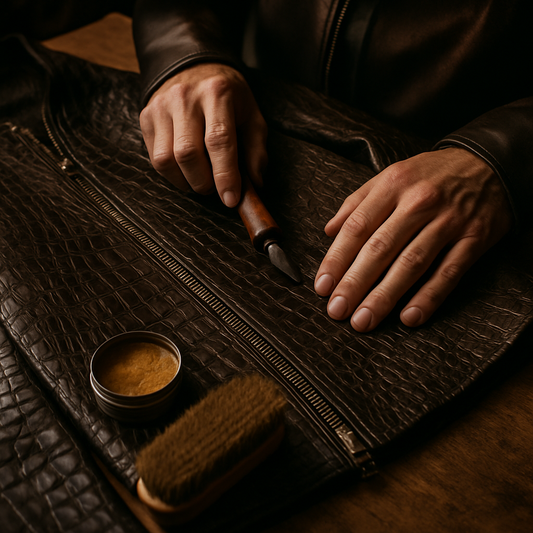
For routine care, wipe the jacket with a clean, dry, soft cloth to remove surface dust. There is no useful fixed maintenance schedule for every wearer because climate, frequency of use, and the jacket’s finish differ.
- Hang the jacket on a broad, supportive hanger so the shoulders do not collapse.
- Keep it away from direct heat, radiators, and prolonged strong sunlight.
- Allow damp leather to dry gradually at room temperature rather than using a hair dryer.
- Avoid household oils, alcohol-based cleaners, and untested conditioners, which may alter the finish or darken the scales.
- Store it in a breathable garment cover rather than sealed plastic, especially in humid conditions.
- For a significant mark or wetting incident, ask the workshop or a leather specialist about a suitable treatment before applying a product.
Styling a crocodile leather jacket
A crocodile jacket works best when the rest of the outfit gives the leather room to remain the main texture. For business wear, pair a dark jacket with a plain shirt, tailored trousers, and understated leather shoes. For casual use, denim or matte cotton can reduce visual formality, while a fine-gauge knit adds warmth without competing with the scale pattern.
Color coordination should account for the jacket’s finish. Glossy or strongly patterned crocodile can pair well with low-texture clothing, while a matte finish can work with a wider range of fabrics. Keep belts, bags, and shoes in related tones when you want a connected outfit; use one contrasting accessory when you want the jacket to have more visual emphasis.
If you are comparing an alligator leather jacket for men with crocodile, remember that the scale pattern, pores, and scar features can differ by species and hide. Choose based on the specific leather and the intended use, not on a general assumption that one label guarantees a particular result. For business styling, see How to Choose Alligator Leather Jacket Men for Business Wear.
Documentation and responsible purchasing
CITES regulation applies to international trade in crocodilians and their products, but the required controls depend on the species, its CITES listing, and the transaction. Buyers should request the legally required documentation and product identification relevant to the purchase rather than assume that every crocodile jacket carries identical paperwork.
Documentation supports legal trade requirements, but it does not replace examination of the jacket itself. Confirm the species description, hide section, measurements, construction details, and care information alongside any applicable paperwork.
Frequently Asked Questions
Does a high crocodile hide grade guarantee a high-quality jacket?
No. A hide grade generally describes visible defects under a particular grading system. The finished jacket also depends on panel layout, cutting, seams, lining, fit, hardware, and finishing. Grading labels vary by supplier, species, and tannery.
How can I tell whether a jacket uses crocodile rather than alligator leather?
Crocodile belly scales commonly retain visible sensory pores, while American alligator belly scales generally lack the repeated pores. American alligator often has an umbilical scar that crocodile lacks. These features support an initial assessment but do not prove species or authenticity by themselves; product documentation is also important.
What measurements should I request before buying a crocodile jacket online?
Request the actual garment measurements for chest, waist, hem, shoulder, sleeve length, upper arm, cuff, and back length. Confirm whether the measurements are taken flat or around the garment, and compare them with a jacket that fits you well.
How should I care for a genuine crocodile jacket after wearing it?
Wipe away surface dust with a clean, dry, soft cloth and hang the jacket on a broad hanger. Keep it away from direct heat and strong sunlight, let damp leather dry gradually, and ask a leather specialist before using cleaners or conditioners.
View the CrocodileViet crocodile and alligator jacket collection to compare available designs and construction details. For measurements or leather questions, contact CrocodileViet through WhatsApp.