
Crocodile Leather Customs Documentation vs Lizard Leather: Which Is Better?

Share
Crocodile Leather Customs Documentation vs. Lizard Leather: Which Is Better?
Crocodile leather customs documentation is generally determined by species, source, product form, shipment, and destination, while lizard leather paperwork must be checked against the particular lizard species and applicable national rules.
The better material for an international purchase depends on the product, the destination country, the available trade documents, the leather characteristics you want, and the seller’s ability to describe the material accurately. Crocodile and lizard leather are not interchangeable customs categories, and one set of rules cannot be applied to every exotic leather.
Why crocodile and lizard leather follow different documentation paths
Crocodile and lizard belong to different groups of reptiles, and their trade controls are species-specific. The word “crocodilian” covers crocodiles, alligators, and caimans; it is not simply another name for crocodile. This distinction matters because an invoice, permit, re-export certificate, or other record may need to identify the actual species rather than using a broad material description.
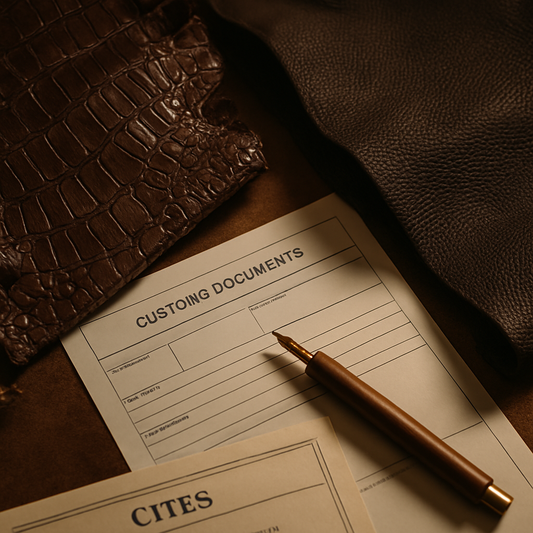
For crocodilian skins in international trade, CITES guidance generally involves individual, non-reusable tags. These tags can include a country-of-origin code, a unique serial number, and a species code, with the tag number recorded on relevant trade documents. That system concerns crocodilian skins and should not automatically be transferred to lizard leather.
Lizard documentation depends on the exact species, its CITES listing, the country of export and import, the product form, and any national requirements. A finished lizard wallet may therefore require a different document review from a crocodile skin, and a lizard species from one country may not follow the same route as another.
What crocodile leather customs documentation may involve
There is no single document pack that applies to every crocodile leather shipment. The applicable requirements can change according to these factors:
- Species identification: crocodile, alligator, and caiman are separate groups, so the commercial description should match the actual material and supporting records.
- Appendix status: commercial international trade in Appendix-I crocodilians is generally prohibited except through specified routes, while Appendix-II trade requires applicable CITES authorization and conservation conditions.
- Source and origin: the country where the animal or skin originated can affect the documents and codes required.
- Product form: raw skins, tanned leather, finished panels, belts, bags, and other goods may not be treated identically.
- Destination rules: the importing country can request additional information or impose requirements beyond the exporting country’s process.
- Shipment records: tag numbers and other identifiers may need to correspond with the permit, certificate, invoice, or customs declaration.
CITES documentation supports lawful trade conditions; it does not, by itself, prove that a product is genuine or establish its construction quality. Species identification, commercial invoices, product descriptions, and the documents required by the authorities still need to align.
How lizard leather documentation differs
Lizard leather does not have one universal customs procedure covering every species. Before shipping, the seller and buyer should identify the lizard species, confirm its CITES listing where relevant, and check the rules of both the exporting and importing countries.
The product description also matters. A finished watch strap, a leather panel, and a complete skin can fall under different administrative treatment. Some destinations may ask for species information, origin details, permits, or certificates; others may apply national restrictions to particular species or product forms.
For this reason, a seller who describes an item only as “exotic leather” has not provided enough information for a reliable import assessment. The buyer should request the material’s species description and ask which documents are available for the intended destination before placing an international order.
Comparison: crocodile leather vs. lizard leather for international orders
| Decision factor | Crocodile leather | Lizard leather |
|---|---|---|
| Species identification | Should distinguish crocodile from alligator and caiman, with the description matching the trade records. | Should identify the particular lizard species because requirements can differ within the lizard category. |
| Tagging and records | Crocodilian skins in international trade generally use individual, non-reusable tags with identifying information. | The cited crocodilian tagging system should not be assumed to apply in the same way to lizard leather. |
| CITES assessment | Depends on species, Appendix status, source, product form, and shipment route. | Depends on the particular species’ listing, source, product form, and national rules. |
| Visual identification | Scale appearance can help describe the hide but is not a definitive species test. | Pattern and scale features may vary by species and should not replace documentary identification. |
| Customs risk | Incomplete species or tag information can delay review or create problems at import. | Using a generic “lizard” description without species information can create similar uncertainty. |
Material differences beyond customs paperwork
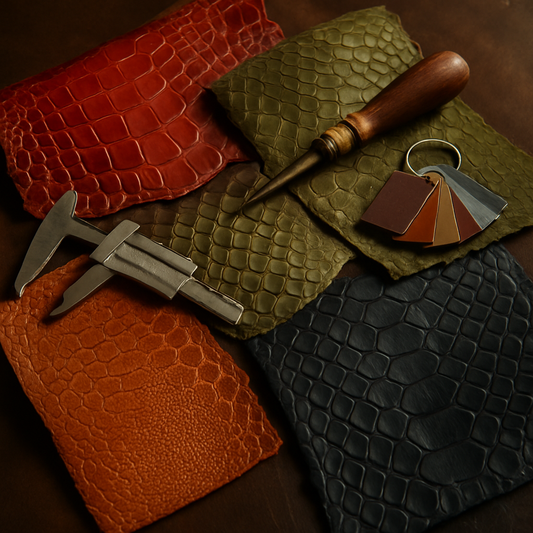
Documentation is only one part of the buying decision. Crocodile and lizard leather also differ in scale layout, panel size, surface character, and how the hide is selected for a particular product.
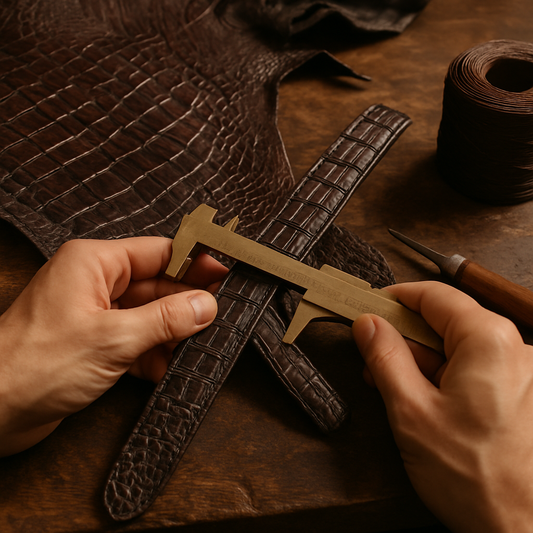
Alligator belly leather is known for a comparatively regular, balanced scale pattern. Crocodile leather varies more by species and individual hide, and it often shows visible sensory pores, commonly called integumentary sensory organs or ISOs. Crocodile may also present more variation across the belly and surrounding areas than an alligator belly. An umbilical scar is often visible on alligator leather and is generally absent from crocodile leather, but these observations do not replace species documentation.
Scale appearance alone is not a definitive species test. Finishing, photography, cutting, and the position of a panel can also change how the surface appears. At our workshop, we match the material description to the actual product because accurate labeling helps customers compare the leather with their shipping documents and reduces confusion between crocodile, alligator, and other reptile materials.
Visual grade is not the same as durability. A regular-looking belly pattern does not automatically mean that a product will withstand heavier use, and a more varied pattern does not automatically indicate a weak leather. Durability depends on the hide, tanning, thickness, construction, edge treatment, hardware, and how the finished item is used. Grading labels also vary by supplier or tannery, so a label such as “grade A” has no universal meaning without the system behind it.
Price factors for crocodile and lizard leather
Customs documentation is not the only reason prices differ between these materials. A quote can reflect:
- the species and lawful source of the leather;
- the usable area and size of the hide;
- belly, flank, tail, or other hide placement;
- scale regularity, visible pores, scars, and surface marks;
- color, finish, thickness, and whether the leather is matte or glossy;
- the amount of leather needed for the product and the waste from cutting;
- lining, hardware, stitching, edge work, and other construction requirements;
- document review, export handling, and destination-specific shipping requirements.
There is no reliable basis for calling crocodile or lizard universally “better” from price alone. A higher quote may reflect a larger usable panel or a more complex product rather than a standardized global hide grade.
Questions to ask before international shipping
Ask the seller to confirm the exact material and product form in writing. For crocodile, request the species description and ask whether the relevant tag or document information is available for the destination. For lizard, ask which species is used and which CITES or national requirements have been checked.
Also confirm whether the buyer or seller is responsible for import clearance, duties, permits, and additional charges. Shipping rules can change according to the destination, and a seller’s export documents do not necessarily settle the importer’s obligations.
For a practical overview of the broader process, see Cites Crocodile Leather Shipping: Complete Guide for 2026–2027 and CITES Rules for Crocodile and Alligator Leather: Documents to Check Before Shipping.
Care after the leather arrives
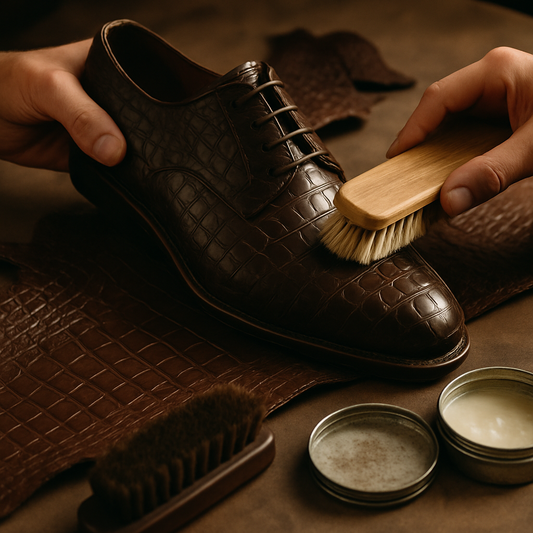
Use a dry, soft cloth to remove surface dust. Keep the item away from prolonged moisture, direct heat, and strong chemical cleaners, and allow damp leather to dry naturally rather than applying heat. There is no fixed cleaning schedule that suits every crocodile or lizard product; use depends on handling, climate, finish, and visible soiling.
Store the item in a breathable place rather than sealing it while damp. If the surface needs conditioning or stain treatment, check the finish and ask the maker before applying a product, since an unsuitable formula can alter color or sheen.
Frequently Asked Questions
Does crocodile leather require the same documents as lizard leather?
No. Crocodilian skins in international trade generally follow tagging and documentation guidance specific to crocodilians, while lizard requirements must be checked against the particular lizard species, product form, CITES listing, and national rules.
Does a CITES document prove that crocodile leather is authentic?
No. CITES documentation relates to regulated trade conditions and does not by itself prove species authenticity, leather quality, or the construction of a finished product. The material description and supporting records should agree.
Can scale patterns identify crocodile leather at customs?
Scale patterns can provide useful visual information, but they are not a definitive species test. Crocodile varies by species and may show sensory pores, while alligator often has a more regular belly pattern and may show an umbilical scar.
What should I ask before ordering crocodile leather internationally?
Ask for the exact species description, product form, origin information, available tag or certificate details, and confirmation of which party handles export and import requirements for your destination.
Shipping information
For CrocodileViet’s current shipping information, review the CrocodileViet shipping policy. For destination-specific questions, contact CrocodileViet through WhatsApp before ordering so the material description and shipping responsibilities can be checked in advance.