
What Makes Luxury Alligator Dress Shoes Worth Buying? Quality, Craft and Longevity — Part 3

Share
Why Luxury Alligator Dress Shoes Can Be Worth Buying: Quality, Craft, and Longevity — Part 3
Luxury alligator dress shoes can justify a higher price when the hide section, leather grading, construction, fit, and aftercare support years of regular use rather than relying on the word “luxury” alone.
What you are actually paying for
The value of alligator leather shoes comes from several decisions made before the finished pair reaches your wardrobe. The most visible is the hide itself, but the leather’s cut, scale layout, surface finish, shoe pattern, construction, and fit all affect the result.
For dress shoes, belly-cut alligator is often selected for its comparatively regular and balanced scale pattern. That appearance should not be confused with a guarantee of durability, and it should not be used alone to identify the species. Scale appearance changes according to the hide section, species, and finish.
Crocodile leather can show more variation from one species and cut to another. Repeated sensory pores, commonly called integumentary sensory organs or ISOs, may remain visible after tanning and are a stronger visual clue for crocodile than scale symmetry alone. Alligator belly scales generally lack these visible pores. An umbilical scar, when present on a belly cut, can also support an alligator identification because crocodile bellies generally lack the same feature.
These observations help with inspection, but a single sensory trait should not be treated as proof of authenticity. International trade documentation also depends on the species, source, and applicable CITES listing. CITES controls relevant trade; it does not by itself prove that a particular item is genuine.
How hide grading affects a pair
Terms such as Grade 1 and Grade 2 are not universal industry standards. Suppliers and tanneries may use different systems, and the assessment often focuses on defects across the belly and flank rather than evaluating every part of the hide in the same way.
For example, one supplier may describe Grade 1 as a belly with no visible defects, while a lower grade reflects the number and position of marks. That description is meaningful only when the supplier’s own criteria are stated alongside it. A label without its grading system gives too little information for a reliable comparison.
For a dress shoe, inspect more than the grade name:
- Scale placement: large belly scales should sit in a visually balanced position across the vamp, especially on a plain-toe or wholecut design.
- Defect location: a small mark hidden near a seam has a different effect from one placed at the center of the toe.
- Cut and finish: belly, flank, and hornback sections do not have the same texture or scale arrangement.
- Pair matching: the two shoes should be planned as a pair, since one side can otherwise look noticeably different from the other.
- Surface treatment: polishing and finishing can change how sharply the scales, pores, and color variation appear.
At CrocodileViet, discussing the actual cut and visible placement is more useful than giving a grade label without context. The reason is practical: the part of the hide placed over the toe and vamp is what you will see every time the shoes are worn, while an unused area of the hide does not affect the finished appearance in the same way.
Craft decisions that affect useful life
Alligator leather is not a substitute for sound shoe construction. A well-selected hide can still produce an uncomfortable or short-lived pair if the last, pattern, sole, or finishing work is poorly suited to the wearer.
The upper should be shaped so the scale layout follows the shoe rather than fighting it. This matters particularly on pointed or elongated lasts, where an unsuitable cut can stretch the pattern toward the toe and create an unbalanced appearance. The leather also needs enough room at flex points; excessive tension can affect both comfort and the surface over time.
Fit is part of longevity. Shoes that are too short compress the toes, while shoes that are too wide may crease heavily because the foot moves inside the upper. A correctly fitted pair distributes pressure across the foot and reduces unnecessary strain on the leather.
Our workshop perspective is straightforward: the material, pattern, and last must be considered together. This is why a request for a certain hide section or color should be assessed against the intended shoe design, not treated as an isolated material order. The same alligator cut can look balanced on one pattern and crowded on another.
Price: what creates the difference
The price of luxury alligator dress shoes reflects more than the animal species. Concrete cost factors include:
- the usable area of the hide and the amount discarded around defects;
- whether the design requires a large, uninterrupted belly section;
- the size of the shoes and the leather required for the vamp, quarters, tongue, and lining;
- the complexity of the pattern and the amount of hand-finishing required;
- sole, heel, lining, and fastening materials;
- labor for cutting, stitching, shaping, finishing, and inspection;
- shipping, duties, and documentation for applicable international orders.
American alligator skins are commonly sold by length in feet, regardless of belly width. That is a sourcing convention, not a rating of finished-shoe quality. A longer hide is not automatically better for every pair, and a width measurement still matters when the design needs a broad, uninterrupted vamp.
Ask what the quoted price includes: the species and cut, the shoe construction, the sole material, the available size range, shipping terms, and any applicable trade documentation. “Grade 1” should also be explained according to the supplier’s own criteria rather than accepted as a universal definition.
Fit and sizing for alligator dress shoes
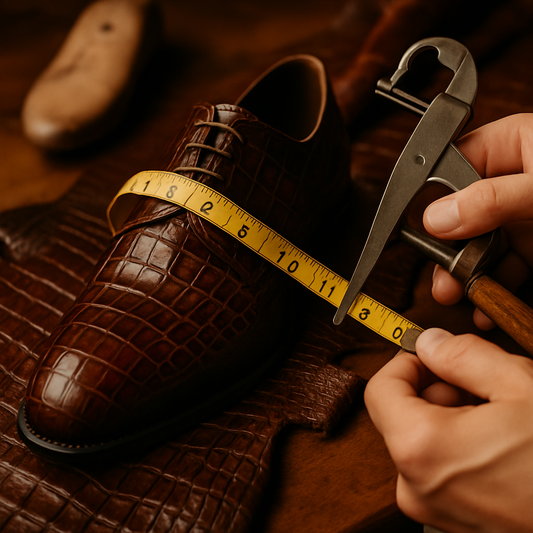
Start with foot length and width, then compare those measurements with the maker’s last and size chart. EU, US, and UK sizes are not interchangeable labels; the same nominal size can differ between brands and between lasts.
Measure both feet while standing, preferably at the end of the day when feet may be slightly larger. Record the longer foot’s length, the widest point across the forefoot, and the instep circumference if requested. A wide fit may require a different last rather than simply moving up one size, because extra length can leave the heel loose.
Instep height is especially relevant for lace-up alligator shoes. A high instep can create pressure across the tongue and eyelets, while a low instep may allow excess movement even when the length is correct. For remote orders, send the requested measurements, a tracing if accepted by the maker, and details of your usual size in EU, US, and UK systems. Also mention whether you normally wear thin dress socks, thicker socks, or orthotics.
Care that supports longer wear
After wearing the shoes, remove surface dust with a dry, soft cloth. Allow moisture from rain or perspiration to evaporate naturally, and keep the pair away from direct heat, radiators, and hair dryers. Heat can dry the leather unevenly and affect its finish.
Use shoe trees that hold the shape without forcing the vamp or stretching the quarters. Rotate pairs instead of wearing the same shoes continuously, giving the leather time to dry between uses. Avoid applying ordinary leather products without checking that they are suitable for exotic skins; an unsuitable solvent, wax, or conditioner can darken the scales or leave an uneven film.
There is no useful fixed care schedule for every owner. Climate, wear frequency, perspiration, finishing type, and exposure to water all change the need for cleaning or conditioning. If the surface becomes dull, sticky, cracked, or uneven, have the shoes assessed before applying more product.
Styling luxury alligator dress shoes
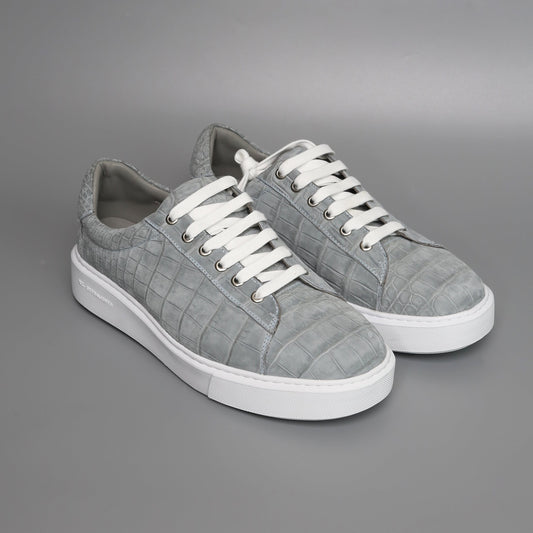
Black alligator shoes work naturally with charcoal, navy, and black tailoring, while brown shades can connect with navy, tan, olive, and medium-grey trousers. Match the belt or other leather accessory by color family and finish rather than trying to reproduce every scale pattern.
A cap-toe or restrained wholecut design suits formal business clothing. Loafers and less structured lace-ups can work with tailored trousers, dark denim, or an unstructured jacket when the rest of the outfit is kept simple. A strongly patterned suit already supplies visual activity, so a cleaner shoe shape may produce a more coherent result.
For more color-specific ideas, read Navy Alligator Skin Shoes: Styling, Care and Buying Tips.
Frequently Asked Questions
Are regular belly scales proof that a shoe is made from alligator?
No. Alligator belly scales are often comparatively regular or balanced, but scale symmetry also varies by cut, species, and finish. Visible repeated sensory pores are a stronger clue for crocodile, while an umbilical scar can support an alligator identification when present. No single visual trait proves authenticity.
What does Grade 1 mean on alligator leather shoes?
Grade 1 has no universal definition. One supplier may use it for a belly with no defects, while another supplier may apply a different system. Ask for the supplier’s criteria and confirm whether the grade evaluates the belly, flank, or the complete hide.
Why can two pairs of genuine alligator shoes have different prices?
Price can change with the usable hide area, scale placement, shoe size, uninterrupted leather needed for the vamp, pattern complexity, labor, sole and lining materials, finishing, and shipping or documentation costs. Species alone does not explain the full price.
What measurements should I send for a remote order?
Send the length and widest point of both feet, instep circumference when requested, your usual EU, US, and UK sizes, and information about socks or orthotics. Mention whether you need a wide fit, because increasing length is not a reliable substitute for extra width.
Choose a pair based on evidence
Luxury alligator dress shoes are worth considering when the leather’s cut, grading explanation, construction, fit, price factors, and care requirements are clear. Review the available alligator shoe collection and contact CrocodileViet on WhatsApp to discuss measurements, materials, and design requirements.