
How Genuine Alligator Shoes For Men Are Made: From Hide Selection to Hand Finishing — Part 2

Share
How Genuine Alligator Shoes for Men Are Made: From Hide Selection to Hand Finishing — Part 2
Genuine alligator shoes for men begin with selecting suitable belly leather, where the scales are smooth, pliable and arranged in a comparatively regular, balanced pattern.
1. Identifying the Correct Alligator Hide
Alligator and crocodile are distinct material names, not interchangeable labels. For men’s shoes, the hide must first be identified as alligator and then assessed for usable surface area, scale structure and visible defects.
American alligator belly scales generally lack the conspicuous sensory pores, also called integumentary sensory organs or ISOs, commonly visible on crocodile belly scales. Scale shape alone is not enough for identification. The absence of pores across the belly, together with the transition from smaller flank scales to the belly section, provides more useful visual information.
The belly is important because its scales provide the smooth, pliable surface commonly associated with alligator leather shoes. However, each pair does not necessarily use an identical hide layout. The design, shoe size, pattern pieces and desired scale placement affect which sections are selected for the vamp, quarters, tongue or other components.
At CrocodileViet, we manufacture our leather goods in-house so the hide can be assessed before cutting rather than treated as a generic sheet of material. This matters because scale alignment, defect placement and usable dimensions influence both the appearance and the amount of leather required for a pair.
2. How Hide Grade Relates to Shoe Construction
“Grade 1” is commonly used to describe the highest hide grade, but it is not a universal grading system. Suppliers and tanneries can differ in the area they inspect, the defects they count and the threshold for each label.
One published alligator grading system evaluates the belly-and-flank midsection while excluding the head and tail. Its assessment considers the location and extent of defects. Scars, scratches, uneven shading and scale deformities can affect the grade, while holes or grain problems may result in a particularly severe downgrade under that supplier’s rules.
For this reason, a grade label should be read together with the supplier’s convention. A high grade does not automatically mean that every part of the hide is suitable for every shoe panel, and a lower label does not by itself describe the durability of the finished footwear.
Visual grade and durability are separate questions. Grade mainly describes surface presentation and defect distribution within a stated grading system. Construction, leather thickness, lining, stitching, sole structure and use also affect how a pair performs over time.
3. Planning Scale Placement Before Cutting
Cutting alligator leather requires more planning than cutting a plain cowhide panel because the scale pattern is part of the finished design. The maker needs to examine the hide’s width, length, belly-to-flank transition, shading and any marks that may become prominent after the leather is shaped.
The central belly area often provides the balanced scale arrangement used on visible shoe sections. Flank areas may have different scale sizes and curvature, which can be useful or unsuitable depending on the pattern piece. A larger men’s shoe may require more length or width than a smaller size, so the available hide cannot be judged from a single attractive section alone.
At our workshop, we review the intended pattern against the actual hide before cutting. The reason is practical: moving a pattern piece by a small amount can place a scar under a less visible section, preserve a more balanced scale run on the vamp, or avoid wasting a usable area. The exact layout still depends on the shoe design rather than a single universal cutting formula.
4. Shaping and Assembling the Shoe
After the leather pieces are planned and cut, they are prepared for assembly with the other components of the shoe. The alligator panels must be handled with attention to their grain and scale direction because aggressive manipulation can affect how the surface sits around curves.
Different shoe designs use different combinations of panels. A loafer, cap-toe oxford, monk strap and casual model do not place the same demands on the hide. Some designs show a broad uninterrupted vamp, while others divide the visible surface with seams or overlays. That is why it would be inaccurate to claim that every pair uses the same belly-to-flank layout.
In-house production gives us a direct reason to inspect the leather during assembly: the surface can be checked as it moves from a flat hide section into a three-dimensional shoe. Scale direction, seam placement and panel tension are easier to review before later finishing has been completed.
5. What “Hand Finishing” Means
Hand finishing is the final visual and tactile review of the completed shoe, including the leather surface, edges, seams and overall pair matching. It is not a substitute for correct hide selection or construction. Finishing can refine the presentation, but it cannot remove a structural problem or change the original grade of the hide.
For alligator shoes, finishing requires restraint. Excessive abrasion, heat or product application can alter the surface and reduce the clarity of the scales. The aim is to bring the panels together visually, check that the leather sits cleanly and remove minor workshop residue without disguising the material’s real characteristics.
We finish and inspect pairs in-house because the final evaluation needs to consider both shoes together. A single shoe may look acceptable on its own while the pair shows noticeably different shading, scale direction or panel balance. Reviewing both shoes side by side helps us identify issues before dispatch and explains why hand finishing is tied to pair matching, not just shine.
6. CITES Documentation and Material Traceability
Documentation is separate from visual inspection. For U.S. American alligator exports, the U.S. Fish and Wildlife Service states that the skin must have a CITES tag; without one, it cannot be exported from the United States.
CITES trade documentation should not be confused with a blanket ban. In general, international trade requires an export permit or re-export certificate, while an import permit is not required under CITES unless the destination country’s national law requires one. Requirements can depend on the species, country and route, so buyers should request the applicable documentation rather than treating a tag as visual proof of authenticity.
A sensory feature, scale pattern or color is not proof by itself. Documentation, supplier information and a clear material description provide stronger support than relying on one appearance-based clue.
7. Price Factors for Men’s Alligator Shoes
The price of alligator leather shoes reflects several concrete factors:
- Usable hide area: A larger pair may require more usable belly leather, especially when the design calls for broad visible panels.
- Defect distribution: Scars, scratches, shading, scale deformities, holes and grain problems affect how much of the hide can be used on prominent sections.
- Pattern complexity: Divided panels, decorative seams and designs requiring close scale alignment increase planning and assembly work.
- Construction: The sole, lining, insole, stitching and finishing method contribute to the total cost independently of the hide.
- Documentation and sourcing: Lawful sourcing and applicable trade paperwork are part of responsible production and international shipment.
A grade label alone cannot explain the price. Buyers should ask what area was graded, which supplier’s system was used and what construction details are included.
8. Sizing and Fit Before Ordering
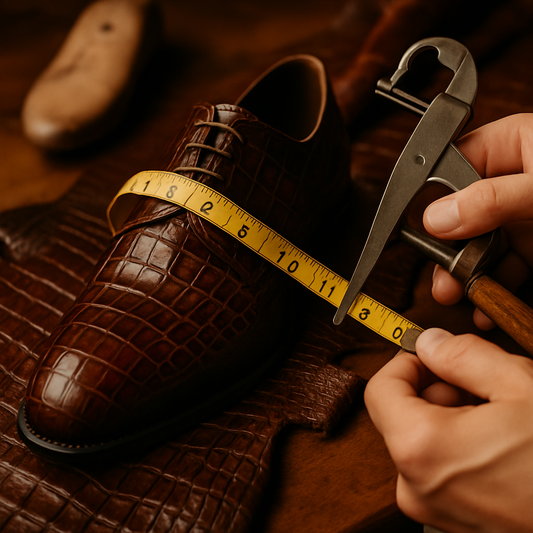
Alligator leather shoes should be sized by length and width, not by the visual size of the scale pattern. A customer ordering remotely should provide foot length and the widest foot measurement, preferably for both feet. It is also useful to mention whether the foot has a high instep, broad forefoot or other fit concern.
EU, US and UK sizes are not identical numbering systems, so the seller should confirm which scale is being used. A wide fit may require a different last rather than simply a longer size. Adding length to compensate for width can leave excess space at the heel and change the way the shoe bends.
Remote measurements are most useful when taken while standing, with the foot bearing weight, and with the socks normally worn with the shoes. Compare those measurements with the maker’s own chart instead of converting between EU, US and UK sizes without checking the brand’s last.
9. Care After Hand Finishing
Use a dry, soft cloth as the default method for removing dust after wear. If the leather becomes damp, allow it to dry gradually away from direct heat. Strong heat can affect the leather’s surface and shape.
Do not apply an unfamiliar cream, oil or polish across the scales without testing it on a concealed area and confirming that it is suitable for alligator leather. Heavy product buildup can collect around scale edges and change the finish. A shoe tree can help support the shoe’s shape, provided it is correctly sized and not forcing the vamp upward.
There is no useful fixed care schedule for every wearer. Climate, frequency of use, perspiration, storage and exposure to rain all change the appropriate interval. Clean the shoes when dust or residue is visible, and have specialist refinishing considered when the surface has deeper marks or an altered finish.
10. Styling Genuine Alligator Shoes for Men
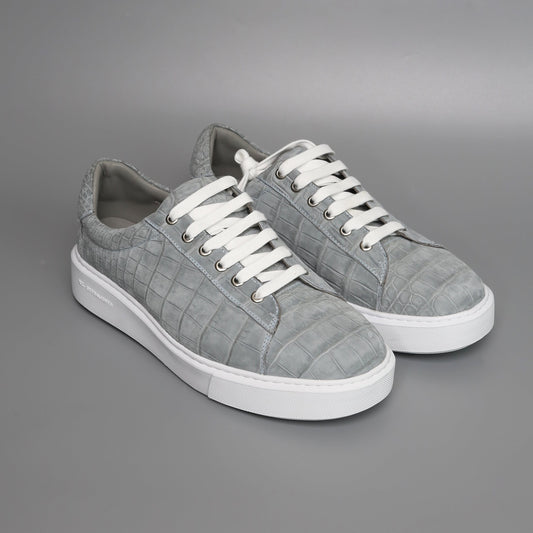
For formal dressing, black or dark brown alligator shoes can work with charcoal, navy or deep brown tailoring when the rest of the outfit is restrained. A belt or watch strap in a related tone can connect the leather without requiring an exact pattern match.
For business-casual clothing, a less formal shoe shape can be paired with wool trousers, tailored chinos or dark denim. Let the shoe’s scale pattern remain the main texture and avoid combining it with several heavily patterned accessories.
Color changes the styling approach. A navy pair can work with gray trousers, mid-blue tailoring and understated brown accessories; more specific ideas appear in Navy Alligator Skin Shoes: Styling, Care and Buying Tips.
Frequently Asked Questions
How can I tell alligator leather from crocodile leather?
Alligator belly scales generally lack the conspicuous sensory pores commonly visible on crocodile belly scales. Scale shape alone is not conclusive, so material documentation and supplier information should also be reviewed.
Does Grade 1 guarantee the most durable alligator shoes?
No. Grade 1 is commonly a top hide grade, but grading systems vary by supplier and mainly address visible defects within a defined area. Durability also depends on construction, leather thickness, lining, sole and use.
Will every pair of men’s alligator shoes use the belly section in the same way?
No. The belly is a key area because its scales are smooth and pliable, but pattern layout depends on the shoe design, size, available hide and the placement of defects or scale transitions.
What measurements should I send for a remote shoe order?
Send standing foot length and the widest foot measurement for both feet, and mention a wide forefoot, high instep or other fit concern. Confirm the maker’s EU, US or UK size chart and whether a wider last is available.
Browse the CrocodileViet alligator and crocodile shoe collection to review available designs. For sizing or material questions, contact CrocodileViet through WhatsApp.