
What Makes Crocodile Leather Quality Grades Worth Buying? Quality, Craft and Longevity

Share
Are Crocodile Leather Quality Grades Worth Buying? Quality, Craft, and Longevity
Crocodile leather is commonly graded by the condition of its belly panel because this is the most usable area for finished leather goods.
That grading system can help you judge how much usable surface, pattern consistency, and visible flaw control you are paying for. It does not, by itself, prove that a finished item is durable or authentic. A worthwhile purchase depends on the grade together with the species, usable area, construction, handwork, and care the item receives.
What crocodile leather quality grades actually describe
Most crocodile grading systems focus on the belly panel rather than treating the entire skin as one identical surface. The belly is commonly selected for goods because its scales are flatter and its pattern is more regular than the harder, more irregular areas toward the sides and tail.
Typical defects considered during grading include:
- Scars and scratches
- Cuts and holes
- Scale slip
- Defects affecting the position of a finished pattern
- Damage concentrated in one or more sections of the belly panel
The location and number of defects can matter more than the defect category alone. A small mark near an edge may be easier to remove during cutting than a similar mark in the center of a wallet front, belt panel, or bag flap.
How the common grade numbers work
A widely used convention describes Grade 1 as a belly panel without visible defects, with lower grades indicating increasing damage. Some suppliers use fractions such as 1/2, 2/3, 3/4, and 4/5 to indicate damage appearing across one to four belly quadrants.
These labels are not universal. Grading terminology can vary between suppliers and tanneries, so a stated grade should be accompanied by an explanation of the actual belly condition. Ask whether the grade refers to the raw skin, the tanned leather, the whole panel, or the section selected for the product.
| Buying factor | What to check | Why it affects the finished item |
|---|---|---|
| Belly grade | Defects, their number, and their position within the usable panel | A central defect may affect a visible front more than an edge defect |
| Species | Whether the seller clearly identifies the crocodilian species | Scale shape, texture, and pattern vary between species |
| Usable area | The portion large and clean enough for the intended component | A high grade on a small section may not suit a wide belt or large flap |
| Scale matching | Whether adjoining pieces have a controlled direction and visual flow | Good layout prevents abrupt changes across a front panel or strap |
| Construction | Stitching, edge finishing, lining, hardware, and reinforcement | These determine how the leather performs in regular use |
| Handwork | Cut accuracy, stitch consistency, and clean joining of panels | Careful assembly protects the grade advantage from being lost during production |
Why a higher grade can be worth buying
A higher belly grade can be worthwhile when the product shows a large, uninterrupted section of crocodile leather. This is particularly relevant for a bag flap, broad belt face, watch strap, or another component where the center of the panel remains visible.
Fewer defects give the maker more freedom when placing the pattern. The cutting plan can keep the most regular scales in the most visible area rather than routing around marks. It also gives more control over matching the scale direction between separate pieces.
That does not mean every buyer needs the highest available grade. A small wallet component may be cut from a section where a lower grade has no visible issue after layout. A deliberate design may also place a natural mark near an edge or under a fold. The relevant question is whether the actual section used on the product suits its purpose.
Grade is not the same as durability
Visual grade mainly describes the appearance and usable condition of the belly panel. It is not a direct durability rating.
A high-grade panel can still be poorly cut, weakly joined, or attached to unsuitable lining and hardware. A lower-graded panel can perform well if the selected area is sound and the construction matches the way the item will be used. Longevity depends on several connected decisions:
- The condition of the original skin and its preservation before tanning
- The thickness and flexibility of the finished leather
- The size of each cut piece
- Stress placed on seams, folds, and attachment points
- Stitching and edge construction
- Exposure to moisture, friction, heat, and pressure
Good crocodile skins are often described as short-term preserved, fully fleshed, and neither hard nor dry before further processing. Poor preservation can affect both grade and usability. For that reason, asking only for a grade number gives an incomplete picture.
How we use grade information in workshop cutting
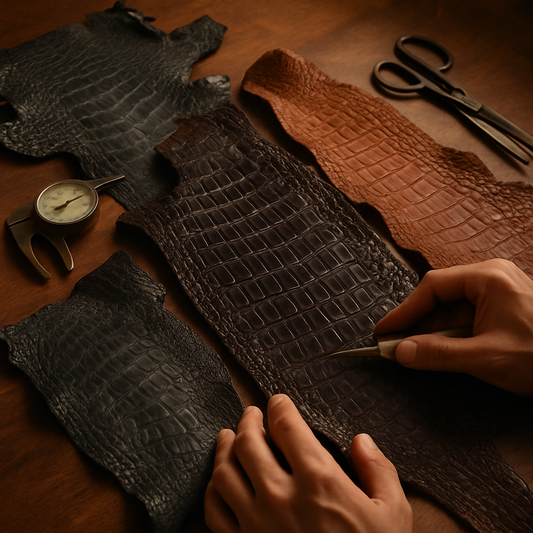
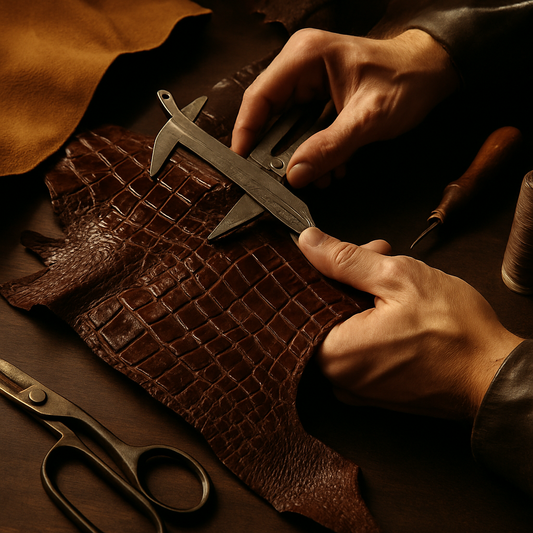
In our workshop, the grade matters because it helps us plan where a panel can serve the product, not because the number replaces inspection. We examine the usable belly area, then match its scale size, direction, and defect position to the component being made.
For a broad visible panel, we want the center to read regularly from one side to the other, so scale alignment and a clean cutting area receive priority. For a narrow strap, the usable length and consistent scale progression may matter more than having a large uninterrupted rectangle. This is why the same grade can produce different results in different product sizes.
Scale pattern also needs species-accurate assessment. Crocodile patterns vary more by species and often show visible sensory pores, commonly called ISOs. A pattern that looks regular in one crocodile species should not be judged by an alligator standard. Pattern appearance can support an assessment, but one visual trait alone does not prove authenticity.
What affects the price of a graded crocodile product
There is no reliable price attached to a grade label by itself. Suppliers and workshops may price a finished item differently even when they use similar grade terminology.
Concrete price factors include:
- Species and legal sourcing requirements
- Belly grade and the amount of usable area
- Scale size and the difficulty of matching adjoining sections
- Leather thickness and finishing method
- Amount of crocodile leather used in the item
- Lining, hardware, reinforcement, and edge treatment
- Cutting complexity and handwork
- Whether a design requires a large uninterrupted panel
A higher grade can raise material cost, but a lower grade does not automatically indicate poor workmanship. Request photographs of the actual visible panels and ask which parts of the product use crocodile leather rather than relying on a grade name alone.
Fit and dimensions still matter
Grade cannot correct an unsuitable size. Before ordering a wearable crocodile item, record the finished length and width required, then compare those measurements with the seller’s specifications.
- For belts, measure the point where the buckle will sit rather than relying only on trouser size.
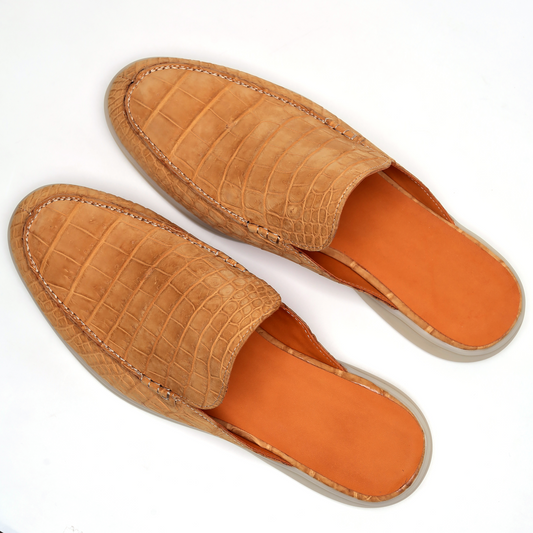
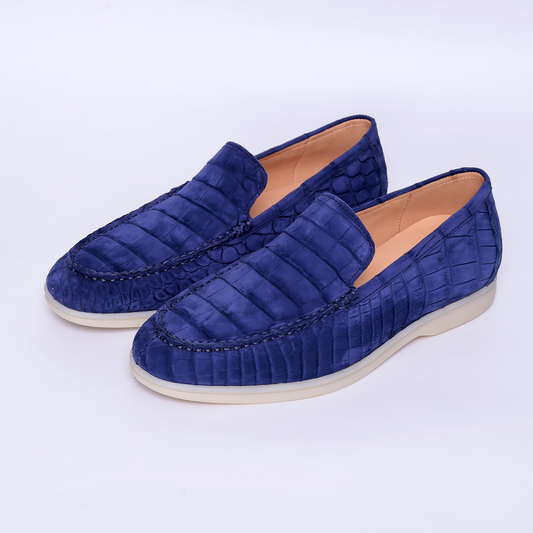
- For footwear, check length, width, instep height, and whether the shape suits a wide fit.
- Compare sizing information across EU, US, and UK systems when footwear is involved.
- For remote orders, send measured foot or body dimensions if the workshop accepts them; this can be as useful as trying the item in person.
- For a bag or accessory, check the internal dimensions and the space taken by lining, folds, and hardware.
These measurements also help the workshop determine whether the available belly area is large enough for the intended component without forcing an unsuitable join.
Care that supports long service
Keep crocodile leather away from prolonged moisture, strong heat, and unnecessary friction. For ordinary dust, use a soft, dry cloth first. If a mark requires more than dry cleaning, use only a lightly damp cloth as a last resort, then allow the item to dry naturally away from direct heat.
Do not apply household cleaners, alcohol-based products, or an untested conditioner. There is no fixed conditioning schedule that suits every finish; the surface, climate, use, and manufacturer’s instructions should determine whether any conditioning is appropriate.
Authenticity and legal documentation
If you are learning how to tell real crocodile leather from an imitation, inspect more than the surface pattern. Ask for the species name, material description, photographs of the actual item, and information about the seller’s documentation. A regular scale pattern or visible pore pattern can be useful evidence for discussion, but neither sensory appearance nor one isolated feature proves authenticity.
Crocodilian leather trade is regulated under CITES. Depending on the species, origin, and transaction, international movement may require permits, re-export certificates, tags, or other documentation. CITES paperwork addresses regulated trade compliance; it does not by itself prove that a particular piece is genuine. A responsible purchase connects the physical product with species-accurate paperwork where the transaction requires it.
So, are crocodile leather quality grades worth buying?
They are worth using as one buying measure when the grade is explained clearly and matches the product’s visible area. A higher grade is most useful when you want a broad, clean panel with controlled scale placement. For a smaller item, the actual cut section, construction, and handwork may matter more than the highest number available.
The strongest decision combines belly condition, usable area, species, scale matching, construction, legal documentation, and care requirements. That approach gives the grade a practical meaning instead of treating it as a standalone promise about durability or authenticity.
To discuss crocodile leather quality grades and the construction of a specific item, visit CrocodileViet’s workshop information. You can also contact CrocodileViet through WhatsApp with the product dimensions and the use case you have in mind.