
Navy Water On Exotic Leather: Styling, Care and Buying Tips

Share
Navy Alligator and Crocodile Leather: Water Care, Styling, and Buying Advice
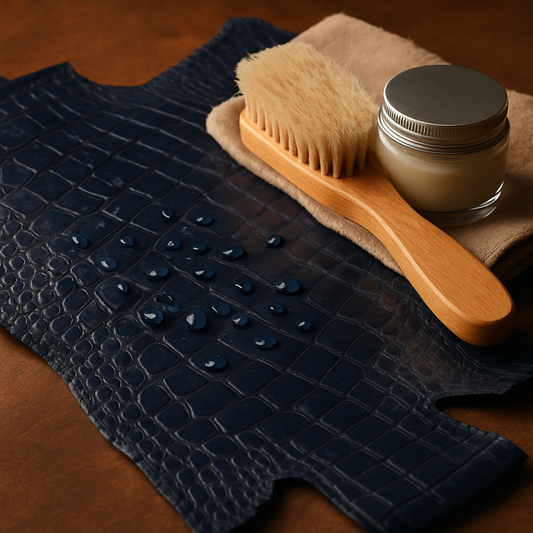
A few water droplets on navy alligator or crocodile leather should be blotted with a clean, dry, absorbent cloth and then left to dry at room temperature, away from direct heat.
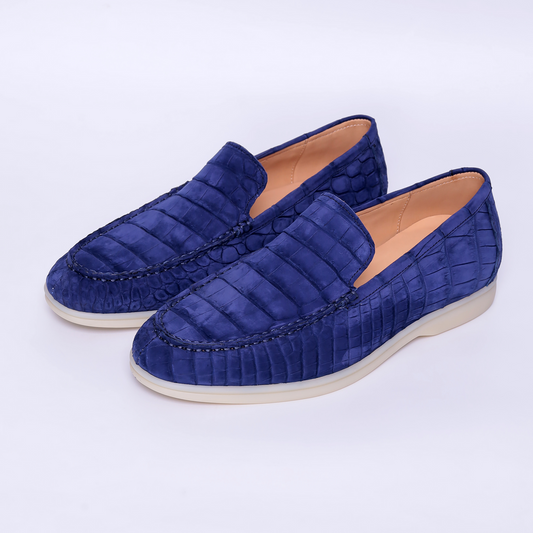
Navy is a useful color for alligator and crocodile leather because it reads differently under changing light: nearly black in a dim interior, clearly blue in daylight, and more textured where the scales catch the light. That depth also means water marks, uneven dye absorption, and surface residue can show differently than they do on black leather. Caring for navy pieces calls for restraint: remove water quickly, avoid aggressive cleaning, and inspect the finish before adding any conditioner.
What Water Can Do to Navy Crocodilian Leather
Brief contact with clean water is not automatically damaging, but standing water can leave a tide line as the leather dries. On navy leather, that line may appear lighter, darker, or slightly duller than the surrounding surface. The result depends on the finish, the amount of water, dissolved minerals in the water, and whether the leather was already dry or coated with product residue.
The scale structure also affects how water is seen. Alligator belly leather generally has a more regular, balanced arrangement of square to rectangular scales. A faint mark may therefore appear across a visually organized field of scales. Crocodile leather varies more by species and can show a less regular scale layout, which may make a mark less linear but does not make it less important to address.
Water on exotic leather deserves prompt, calm handling rather than rubbing. Friction can alter the surface sheen, especially on a dark dyed finish, while heat can dry the leather too quickly and contribute to stiffness or uneven appearance.
If Your Navy Item Gets Wet
- Blot the affected area with a clean, dry, lint-free cloth. Press lightly rather than wiping back and forth.
- Remove the item from direct sun, radiators, hair dryers, and enclosed hot cars.
- For shoes, use clean shoe trees or lightly packed unprinted paper to support their shape while they dry. Do not force the upper open or overfill it.
- Let the piece dry gradually in a ventilated room.
- Wait until the leather is fully dry before judging whether a ring or color change remains. Fresh moisture can temporarily darken navy leather.
If the leather has been soaked, shows cracking after drying, or has a visibly changed finish, professional leather assessment is the lower-risk option. Repeated saturation can affect both the leather and the construction beneath it, including linings, edge paint, adhesives, or internal reinforcement.
How to Clean Navy Crocodile Leather Shoes and Accessories
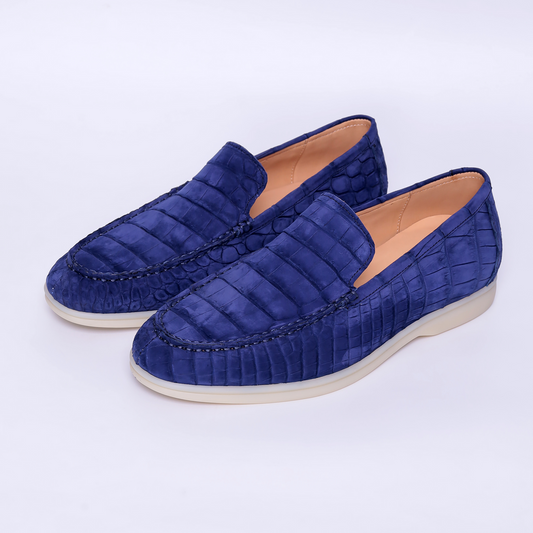
For routine dust, a dry cloth is the default. This is especially useful for navy crocodile leather shoes, where dust can settle along scale edges and soften the contrast of the pattern. Use light pressure and move with the direction of the scales rather than catching a cloth edge beneath them.
A damp cloth is a last resort, reserved for localized residue that cannot be lifted dry. The cloth should be only barely damp, not wet enough to transfer moisture into seams or between scales. Work on a small area, use clean water, and immediately blot with a dry cloth. Household cleaners, alcohol wipes, saddle soap, baby wipes, and strong polishes can change the finish or leave a darker patch on navy dye.
Salt residue needs particular care. It can attract moisture and leave a pale, crusted edge on footwear. First let the residue dry, then lift loose material gently with a soft dry cloth. If a damp pass is necessary, keep it confined to the affected area and allow the shoe to dry naturally. A large wet wipe across an entire vamp can create a broader water mark than the original residue.
How to Care for Alligator Leather Without Over-Treating It
Conditioning is not a routine to perform by the calendar. Condition alligator leather only when its condition calls for it: the surface may feel unusually dry, lose flexibility, or look flat after ordinary dust removal. The right amount also depends on the item’s finish, thickness, climate exposure, and prior care products.
Before applying any conditioner, ask the maker or seller whether the product is suitable for that particular finish. Some conditioners can darken navy dye, leave residue in the scale pattern, or change the gloss level. If a compatible product is confirmed, use a very small amount and keep it away from stitching, painted edges, hardware, and lining unless those materials are separately approved for treatment.
For a navy piece, assess the color under daylight and indoor light after any treatment. A product that looks unobtrusive under warm lighting may reveal a darker patch or altered sheen outdoors. Stop rather than layering more product in an attempt to even the appearance.
Styling Navy Alligator and Crocodile Leather
Navy works best when its blue undertone has room to register. In low light, a navy crocodilian accessory can look nearly black; in daylight, the scale relief and blue color become more apparent. Whether that shift is useful depends on the setting and the surrounding materials.
Business and Formal Settings
- Pair navy alligator or crocodile shoes with mid-grey, charcoal, tobacco, or medium-blue tailoring. These colors allow the leather to read as navy rather than disappear against a black trouser hem.
- Use a navy belt with shoes that are close in color and surface character. Exact shade matching is not required, but visibly different blues can look accidental if one item is glossy and the other is matte.
- For a navy briefcase or document holder, choose restrained clothing textures such as worsted wool, cotton poplin, or smooth knitwear. The scale pattern supplies enough surface interest on its own.
Smart Casual Wear
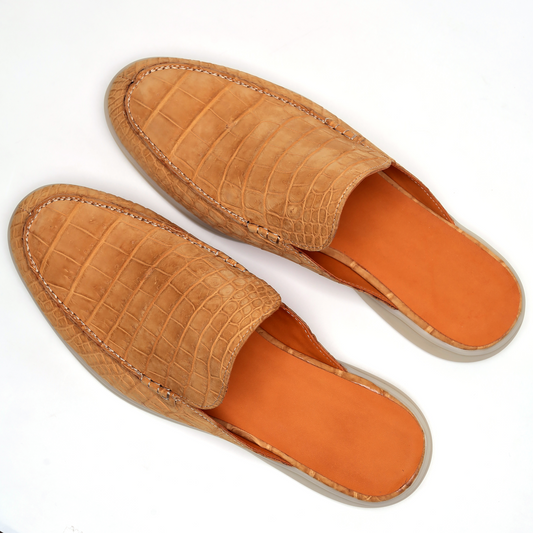
- Combine navy crocodile loafers or boots with ecru denim, stone chinos, olive trousers, or dark indigo jeans. These backgrounds show the navy color without competing with it.
- A navy alligator watch strap can work with a steel watch case, pale-blue shirt, dark knit, or brown suede footwear. It links naturally to cool-toned metal while remaining distinct from brown leather.
- For evening clothing, navy leather can sit well with black, but use a visible difference in texture or tone so the accessory does not look unintentionally mismatched.
What to Check Before Wearing It in Wet Conditions
Rain is not only a concern for the leather surface. Look at stitched seams, edge finishing, sole attachment on footwear, and the closure area of bags or wallets. A navy finish may conceal a wet spot at first, so inspect again after the item has dried. If rain is expected, a less sensitive everyday leather item may be the more practical choice.
Buying Navy Alligator or Crocodile Leather: What Actually Affects Price
Price is not determined by the word “exotic” or by a dark navy color alone. A buyer should ask what species is used, where on the hide the panels came from, how much clean usable area was available, and how the maker matched the scales across the finished item.
| Decision factor | Why it affects a navy alligator or crocodile item | What to examine |
|---|---|---|
| Species | Alligator belly commonly presents a more regular, balanced scale field, while crocodile may show more variation in scale pattern. | Ask for the species rather than relying only on a general “exotic leather” description. |
| Hide grade | Grade generally concerns defects in the prime belly or midsection cutting area, not simply the whole hide. | Ask how the seller or tannery defines its grade. Labels vary by supplier and are not universal. |
| Usable area | A larger clean belly area gives the maker more freedom to place broad, visually coherent navy panels. | Look for uninterrupted placement on bag fronts, shoe vamps, belt straps, or wallet exteriors. |
| Scale matching | Matching left and right shoe vamps or adjacent bag panels requires more selective cutting. | Compare the scale size, direction, and visual weight across paired or adjoining sections. |
| Construction and handwork | Pattern placement, edge finishing, lining installation, stitching, and hardware fitting all affect the labor required. | Inspect seams, corners, edge paint, alignment, and how the leather behaves around curves. |
Hide size is often measured across the widest point of the belly in centimeters. This matters because a larger item may require a broader section of usable hide, particularly if the design calls for large, centered belly scales. Sellers may also describe belly, back-cut, hornback, or crown-width sections; these terms refer to different areas or ways of splitting the skin and should not be treated as interchangeable.
Grade language needs context. In some alligator-hide systems, quadrant-based descriptions such as Grade 1, 1/2, 2/3, 3/4, and 4/5 indicate increasing defects in the belly area. Some crocodile grading systems use Grade I through IV, from a nearly clean prime cutting area to heavily defective or salvage material. Neither system is a single worldwide rule, so the seller’s definition matters more than the label alone. Visual grade also concerns appearance; it does not independently establish durability.
Authenticity, Documentation, and Navy Finish Inspection
Genuine alligator and crocodile leather should be represented accurately, not merely described as “croc print.” Embossed crocodile is usually cowhide or another conventional leather stamped with a reptile pattern, rather than genuine crocodilian skin.
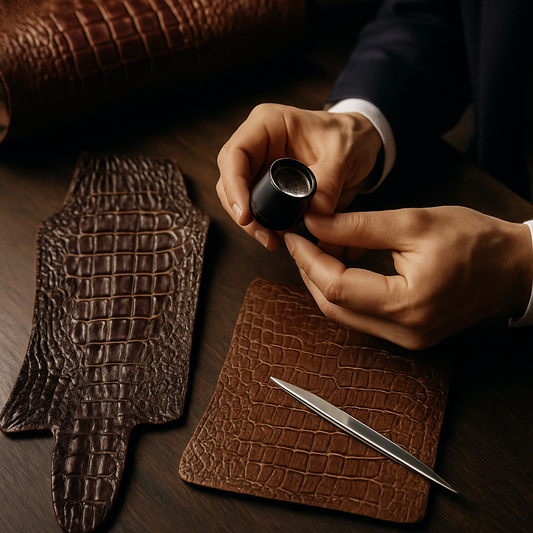
Physical characteristics can support an informed assessment but should be considered together with product information and lawful sourcing records. Crocodile leather often shows visible sensory pores, sometimes called ISOs, in the center of scales. Alligator leather generally lacks those pores and often has an umbilical scar, which crocodile lacks. No single visual trait should be treated as conclusive proof of authenticity.
Most commercially traded crocodilian leathers are subject to CITES controls, commonly under Appendix II. Buyers should expect appropriate source and export documentation where legitimate trade requires it. Such paperwork concerns trade compliance; it does not by itself prove that a particular finished item is authentic.
For navy leather specifically, inspect the color in natural daylight. Check whether the dye looks consistent across the panels while allowing for normal variation created by scale shape and light reflection. Ask whether the finish is matte, semi-gloss, or gloss, because this affects how readily water spots, scratches, and fingerprints may show.
Fit and Sizing for Navy Crocodilian Shoes
For shoes, in-person try-on and remote measurements are equally important ways to assess fit. An in-person fitting reveals heel hold, toe room, and pressure points. Remote buying requires accurate foot length and width measurements, plus comparison with the maker’s stated EU, US, or UK sizing system.
Do not use a conversion chart as the only decision point. Ask for the internal length where available, identify whether the last is narrow, regular, or wide, and state whether you have a high instep. Crocodilian uppers should not be bought with the expectation of substantial stretching: scale structure and finishing can limit how comfortably the material yields. For loafers, boots, and lace-up shoes, the instep and vamp shape can matter as much as nominal size.
Closing Care Checklist
- Use a dry cloth for routine dust on navy alligator and crocodile leather.
- Blot rain or spills promptly; do not rub or apply direct heat.
- Use a barely damp cloth only for localized residue that cannot be removed dry.
- Condition only when the leather’s condition warrants it and the product is confirmed as suitable for the finish.
- Store the item dry, supported where needed, and away from prolonged direct sunlight.
- Inspect navy color in daylight before and after cleaning or treatment.
For more material and care notes from CrocodileViet, visit our leather journal. You can also contact us through WhatsApp to discuss a specific item, its finish, or its care needs.